

上期我们留的表达是:
be associated with 与……相关
参考答案:
Regular reading is associated with a wider vocabulary.
经常阅读与更丰富的词汇量相关。
常见错误:❌ Regular reading is associated to a wider vocabulary.✅ Regular reading is associated with a wider vocabulary.此搭配用with,不用to;“相关”也不自动等于“有因果关系”。
好,今天继续精读 ↓
What Do Babies Know?|婴儿知道什么?
Reading Passage 3|(考场真题)
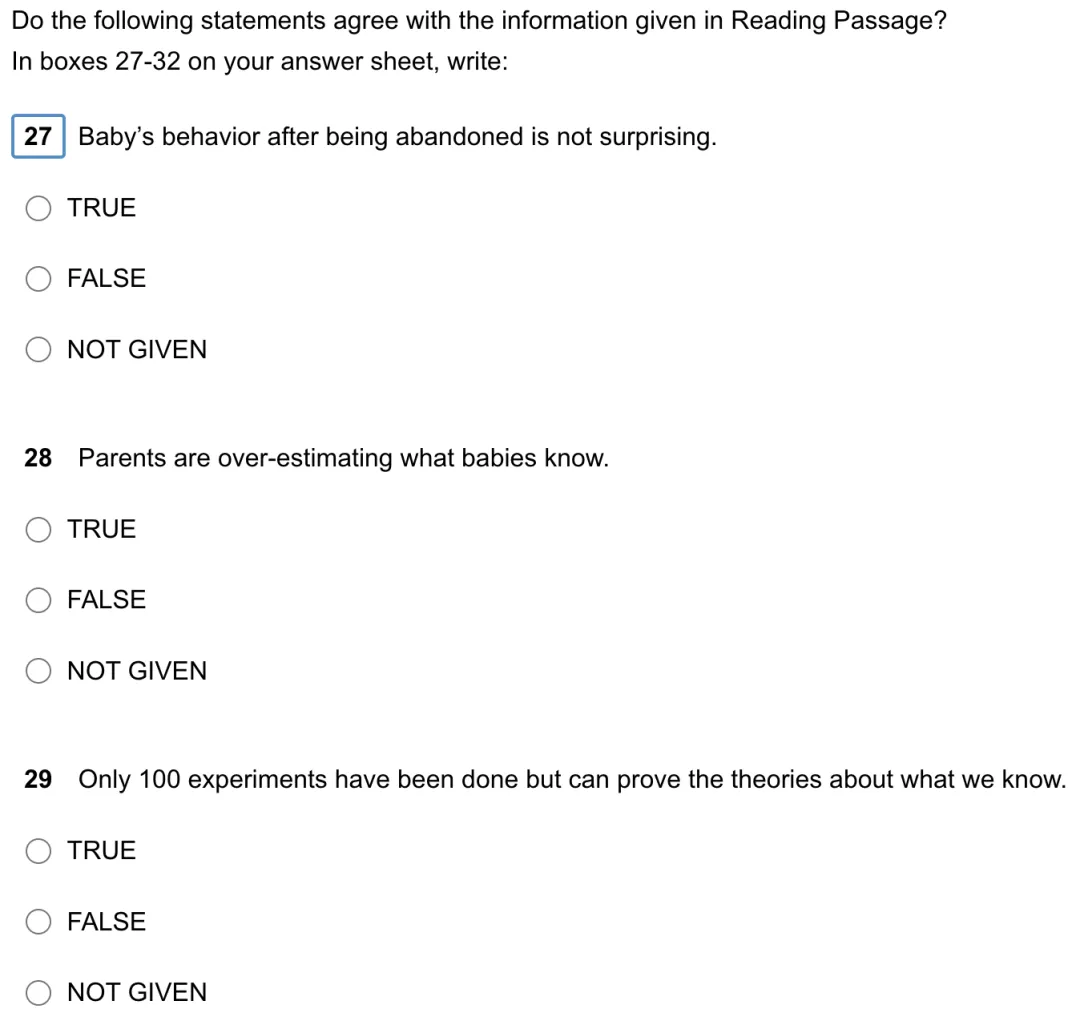
Questions 27–32:判断题
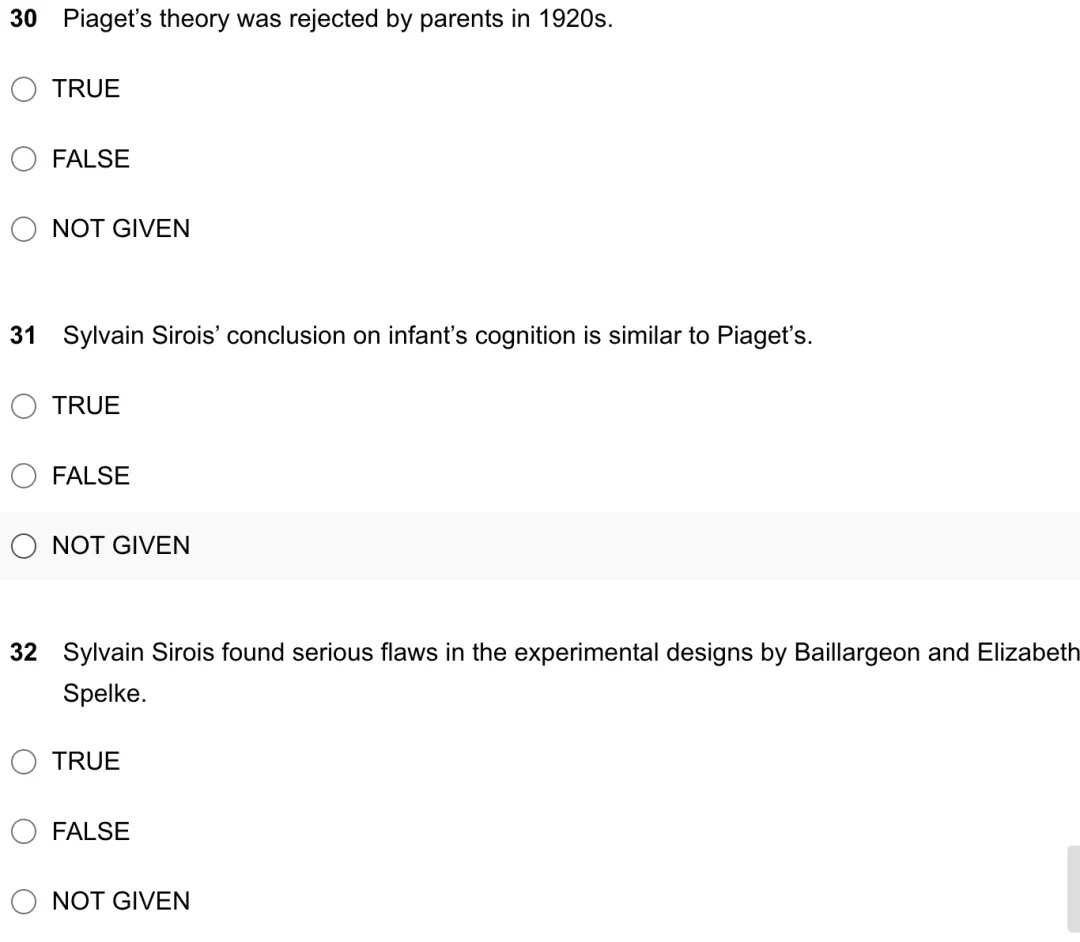
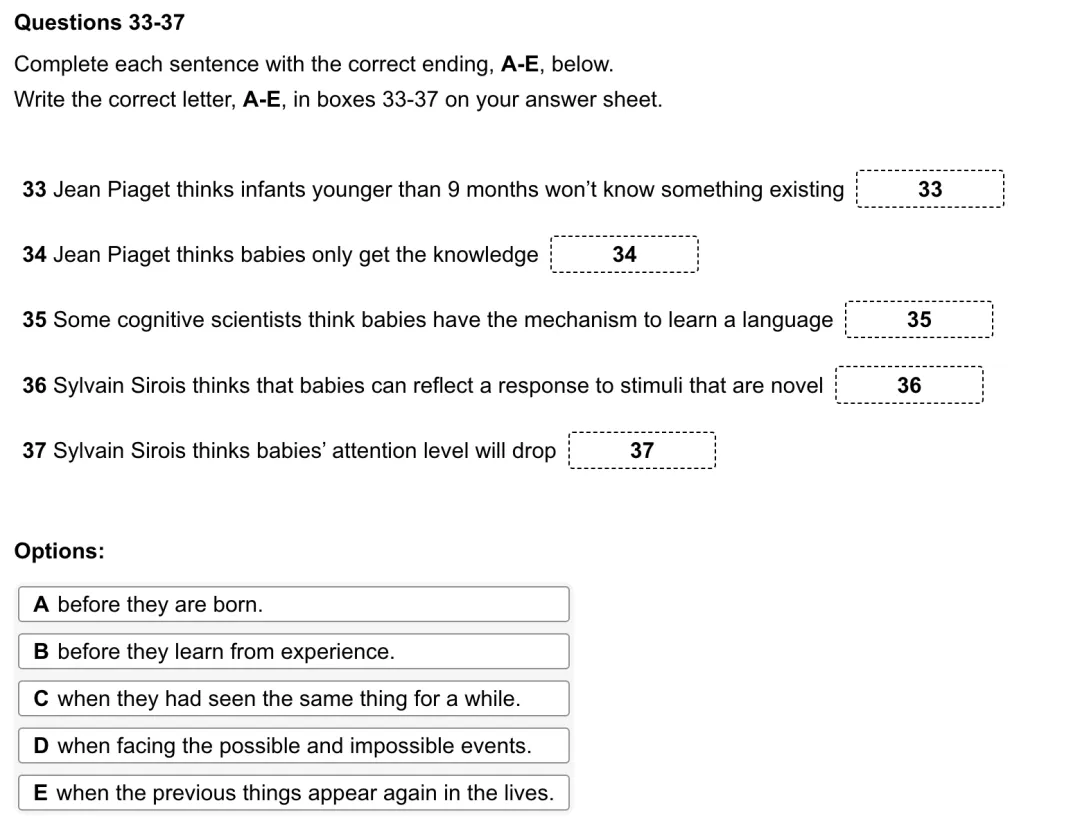
Questions 33–37:句尾匹配
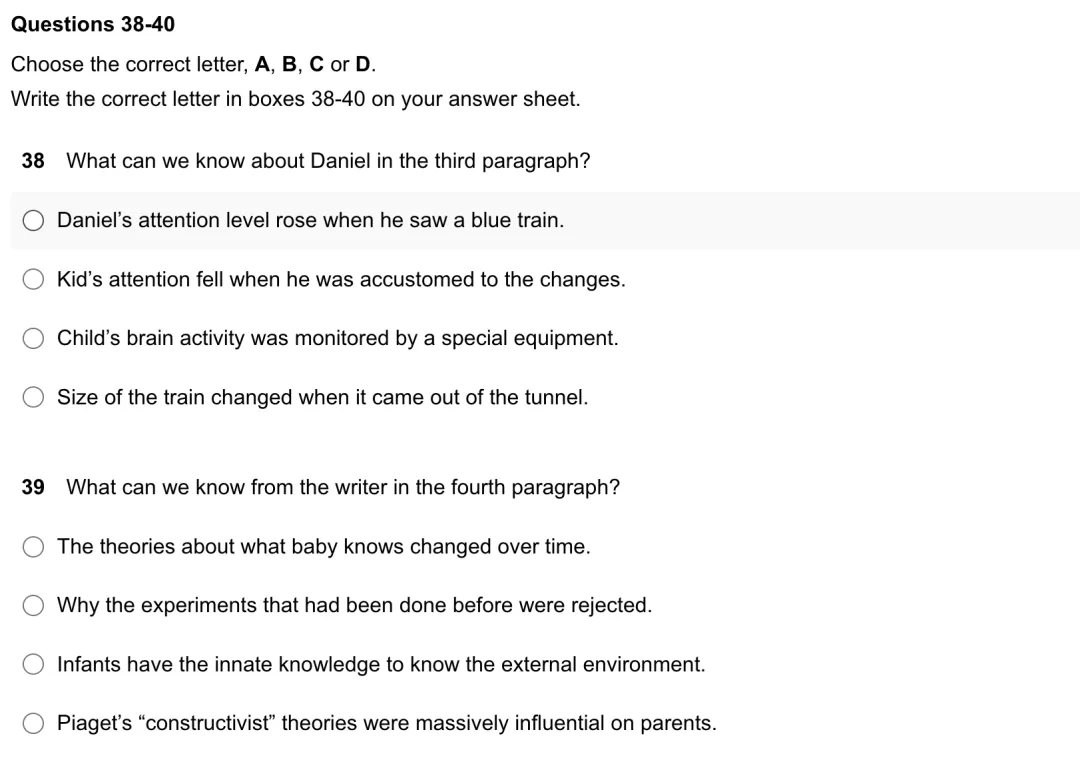
Questions 38–40:单选题
建议:先限时20m完成整篇,再回来一起逐段精读。
Daniel进入实验室 → 提出先天与经验之争 → 小火车测试注意力 → 回顾皮亚杰与先天论 → 经典实验用注视时间推断认知 → Sirois提出新奇性解释 → 用反射与信息不匹配解释学习。
同样的观察结果,可以有不同解释。先问“实验看到了什么”,再问“研究者据此推断了什么”。
As Daniel Haworth is settled into a high chair and wheeled behind a black screen, a sudden look of worry furrows his 9-month-old brow. His dark blue eyes dart left and right in search of the familiar reassurance of his mother's face. She calls his name and makes soothing noises, but Daniel senses something unusual is happening. He sucks his fingers for comfort, but, finding no solace, his mouth crumples, his body stiffens, and he lets rip an almighty shriek of distress. This is the usual expression when babies are left alone or abandoned. Mom picks him up, reassures him, and two minutes later, a chortling and alert Daniel returns to the darkened booth behind the screen and submits himself to baby lab, a unit set up in 2005 at the University of Manchester in northwest England to investigate how babies think.
段落大意:9个月大的Daniel在陌生环境中不安哭闹,得到母亲安抚后参与实验;这一场景引出研究婴儿思维的实验室。
furrow one’s brow 皱眉;使额头出现皱纹。
dart left and right 左右快速移动。
in search of 寻找……。
reassurance 安慰;使人安心的话或举动。
soothing noises 安抚性的声音。
solace 安慰;慰藉。
let rip a shriek 突然放声尖叫。
distress 痛苦;不安。
chortling and alert 咯咯笑着、精神活跃的。
set up 建立;设立。
场景描写之后,评价句才是判断题落点。
Daniel寻找母亲、吸手指、身体绷紧,随后大声哭叫。这些细节描述不安。
This is the usual expression when babies are left alone or abandoned.
usual明确说这种反应常见,对应Q27的not surprising。不要因为前面写something unusual is happening,就把“环境不寻常”误当成“婴儿反应不寻常”。
结尾a unit set up in 2005 … to investigate how babies think交代实验室建立时间与目的,为后文研究铺垫。
Q27|TRUE
定位证据: This is the usual expression when babies are left alone or abandoned.
usual对应not surprising。题目判断的是被独自留下后的行为是否常见,而不是实验环境是否陌生。
当Daniel Haworth被安置在高脚椅上、推到黑色屏风后面时,这个9个月大的孩子突然露出忧虑的神色,皱起了眉头。他深蓝色的眼睛左右快速转动,寻找母亲那张能让他安心的熟悉面孔。母亲叫着他的名字,发出安抚的声音,但Daniel感到有不寻常的事情正在发生。他吸吮手指寻求安慰,却没有得到慰藉,于是嘴一瘪、身体绷紧,发出一声极其响亮、充满不安的尖叫。这是婴儿被独自留下或被抛下时的通常反应。妈妈把他抱起来安慰,两分钟后,Daniel又咯咯笑着、精神十足地回到屏风后昏暗的小隔间,接受婴儿实验室的测试。这个研究单位于2005年在英格兰西北部的曼彻斯特大学成立,旨在研究婴儿如何思考。
Watching infants piece life together, seeing their senses, emotions and motor skills take shape, is a source of mystery and endless fascination—at least to parents and developmental psychologists. We can decode their signals of distress or read a million messages into their first smile. But how much do we really know about what's going on behind those wide, innocent eyes? How much of their understanding of and response to the world comes preloaded at birth? How much is built from scratch by experience? Such are the questions being explored at baby lab. Though the facility is just 18 months old and has tested only 100 infants, it's already challenging current thinking on what babies know and how they come to know it.
段落大意:实验室研究婴儿对世界的理解有多少与生俱来、有多少来自经验;仅测试100名婴儿便已开始挑战现有观点。
piece … together 把……逐步拼合起来。
motor skills 运动技能。
take shape 逐渐成形。
decode signals 解读信号。
read … into … 从……中解读出……;有时含过度解读之意。
preloaded at birth 出生时就已具备的。
from scratch 从零开始。
challenge current thinking 挑战现有观点。
两个问题确立全文争论:先天已有,还是后天建构?
comes preloaded at birth与is built from scratch by experience构成对照。
read a million messages into their first smile是夸张表达,说明人们会赋予婴儿的微笑许多含义;它没有直接比较“父母估计的知识量”与“婴儿实际知道的知识量”。
段尾Though … only 100 infants … already challenging …形成让步:实验室年轻、样本有限,却已开始挑战现有看法。
100 infants是100名婴儿,不是100次实验;challenging也不是证明旧理论正确。
Q28|NOT GIVEN
定位证据: We can decode their signals of distress or read a million messages into their first smile.
这句话说明人们会解读婴儿的信号,并未评价父母是否高估婴儿知道多少。全文没有把父母的估计与婴儿实际知识量作比较,所以不能由a million messages推成over-estimating,也没有反向证据支持FALSE。
Q29|FALSE
定位证据: Though the facility is just 18 months old and has tested only 100 infants, it's already challenging current thinking
原文是测试100名婴儿,不是只做100次实验;结果正在challenging现有看法,而非证明现有理论。题目同时偷换统计单位和研究结论方向。
观察婴儿如何把生活中的信息逐步拼合起来,看着他们的感官、情绪和运动技能逐渐成形,是一件充满神秘感、令人无尽着迷的事——至少对父母和发展心理学家而言如此。我们能解读他们不安的信号,也能从他们第一次微笑中读出无数含义。但对于那双睁得大大的、天真的眼睛背后究竟发生了什么,我们真正知道多少?他们对世界的理解和回应,有多少是出生时就具备的?又有多少是通过经验从零建立起来的?婴儿实验室正在探索的正是这些问题。虽然这个机构才成立18个月,只测试过100名婴儿,却已经开始挑战关于婴儿知道什么、又如何获得这些知识的现有观点。
Daniel is now engrossed in watching video clips of a red toy train on a circular track. The train disappears into a tunnel and emerges on the other side. A hidden device above the screen is tracking Daniel's eyes as they follow the train and measuring the diameter of his pupils 50 times a second. As the child gets bored—or "habituated", as psychologists call the process— his attention level steadily drops. But it picks up a little whenever some novelty is introduced. The train might be green, or it might be blue. And sometimes an impossible thing happens— the train goes into the tunnel one color and comes out another.
段落大意:设备记录Daniel的眼睛和瞳孔变化;他看惯火车后注意力下降,出现新变化时注意力会略有回升。
be engrossed in 全神贯注于……。
a circular track 环形轨道。
emerge 出现;从……中出来。
track someone’s eyes 追踪某人的眼睛运动。
pupil 瞳孔;此处不是学生。
habituated 已习惯的;习惯化的。
steadily drop 稳步下降。
pick up 回升;增强。
novelty 新奇性;新事物。
眼动数据不是脑活动数据,颜色变化也不是尺寸变化。
设备记录eyes与pupils,频率是每秒50次;本段没有说设备直接监测Daniel的大脑活动。
gets bored / habituated → attention level drops:看惯之后注意力下降。
novelty introduced → picks up a little:加入新变化后注意力略有回升。
火车可能换成绿色或蓝色,也可能进出隧道时颜色不同。这里强调变化的新奇性,不是证明蓝色本身具有特殊吸引力。
这个实验先说明注意力如何变化;关于变化意味着什么,后面才展开争论。
Q38|B
定位证据: As the child gets bored—or "habituated", as psychologists call the process— his attention level steadily drops.
B直接概括习惯化后注意力下降。A的蓝色只是新奇变化的一个例子,文中也允许这种变化带来注意力回升,因此A并非与原文完全相反;但B是更明确、无需指定颜色的直接陈述。C把眼动和瞳孔监测换成脑活动监测;D把颜色改变换成尺寸改变。
Daniel现在正全神贯注地观看视频片段:一辆红色玩具火车在环形轨道上行驶。火车驶入隧道、消失不见,又从另一侧出来。屏幕上方一个隐藏的装置,正在追踪Daniel跟随火车移动的眼睛,并以每秒50次的频率测量他的瞳孔直径。随着孩子感到无聊——心理学家把这个过程称为“习惯化”——他的注意力水平稳步下降。但每当引入一点新变化时,注意力就会略有回升。火车可能变成绿色,也可能变成蓝色。有时还会发生一件不可能的事:火车进隧道时是一种颜色,出来时却变成了另一种。
Variations of experiments like this one, examining infant attention, have been a standard tool of developmental psychology ever since the Swiss pioneer of the field, Jean Piaget, started experimenting on his children in the 1920s. Piaget's work led him to conclude that infants younger than 9 months have no innate knowledge of how the world works or any sense of "object permanence" (that people and things still exist even when they're not seen). Instead, babies must gradually construct this knowledge from experience. Piaget's "constructivist" theories were massively influential on postwar educators and psychologist, but over the past 20 years or so they have been largely set aside by a new generation of "nativist" psychologists and cognitive scientists whose more sophisticated experiments led them to theorise that infants arrive already equipped with some knowledge of the physical world and even rudimentary programming for math and language. Baby lab director Sylvain Sirois has been putting these smart-baby theories through a rigorous set of tests. His conclusions so far tend to be more Piagetian: "Babies," he says, "know nothing."
段落大意:皮亚杰强调从经验中逐步建构知识,后来的先天论强调婴儿已有某些知识;Sirois测试后更倾向皮亚杰的观点。
innate knowledge 先天知识。
object permanence 物体恒存性;物体即使不可见仍然存在。
construct … from experience 从经验中建立……。
constructivist 建构主义的。
massively influential 影响巨大的。
set aside 搁置;放在一边。
nativist 先天论的;先天论者。
arrive equipped with 出生时已具备……。
rudimentary 初步的;基本的。
rigorous tests 严格的测试。
先确认谁持什么观点,再判断观点怎样变化。
Piaget:9个月以下婴儿没有文中所说的先天世界知识或物体恒存性认识,需要gradually construct this knowledge from experience。
后来的nativists:婴儿出生时已经具备某些物理世界知识,以及初步的数学、语言机制。
Sirois:结论tend to be more Piagetian,更倾向皮亚杰。
从1920s、postwar到over the past 20 years or so,时间线显示理论发生变化,不是在解释父母如何接受或拒绝理论。
物体恒存性不是“能看到物体”,而是理解物体看不见时仍存在。作者转述的“know nothing”也不应读成婴儿连反射都没有,G段会进一步限定。
Q30|NOT GIVEN
定位证据: Piaget's "constructivist" theories were massively influential on postwar educators and psychologist
原文提到1920年代开始实验、战后影响教育者和心理学家,没有交代1920年代父母是否拒绝该理论。不能把educators换成parents,也不能把后来理论被搁置移到1920年代。
Q31|TRUE
定位证据: His conclusions so far tend to be more Piagetian
more Piagetian表明Sirois的结论更倾向皮亚杰,对应similar to Piaget’s。这里是观点相近,不要求两人所有论述逐字相同。
Q33|B
定位证据: Instead, babies must gradually construct this knowledge from experience.
B before they learn from experience强调:这些知识需要经验来建立,并非学习之前就先天具备。不要扩大成婴儿没有任何反射或能力。E把“尚不理解物体恒存性”改成物体再次出现时仍不知道,不合题意。
Q34|E
定位证据: any sense of "object permanence" (that people and things still exist even when they're not seen)
选E。在现有选项中,E与文中“婴儿尚未形成物体恒存性认识”的描述相对更接近。但选项表述不够严谨:原文并未明确说,只有事物再次出现,婴儿才会获得相关知识。应区分“看见物体”与“理解物体在看不见时仍然存在”。B的before they learn from experience则与“从经验中逐渐建立知识”方向相反。
Q35|A
定位证据: infants arrive already equipped with some knowledge of the physical world and even rudimentary programming for math and language
A在此用于表达相关机制是先天已有的,而不是完全由出生后的经验建立。对应arrive already equipped与rudimentary programming;不要把此选项进一步解读为本文已用产前实验测出了具体语言知识。
Q39|A
定位证据: but over the past 20 years or so they have been largely set aside by a new generation of "nativist" psychologists and cognitive scientists
A概括建构主义到先天论的理论变化。B说解释旧实验为何被拒绝,不是本段主要内容;C是部分研究者的主张,不能代替整段多种观点;D把受影响的教育者、心理学家换成父母。
像这样考察婴儿注意力的实验及其变体,自从这一领域的瑞士先驱Jean Piaget在20世纪20年代开始对自己的孩子进行实验以来,就一直是发展心理学的标准工具。皮亚杰的研究使他得出结论:9个月以下的婴儿,对世界如何运行没有先天知识,也没有任何“物体恒存性”意识,即不理解人和物即使看不见也仍然存在。相反,婴儿必须通过经验逐渐建立这些知识。皮亚杰的“建构主义”理论对战后的教育工作者和心理学家影响巨大,但在过去约20年里,这些理论在很大程度上被新一代“先天论”心理学家和认知科学家搁置了。他们更精密的实验使他们提出:婴儿出生时就已经具备一些关于物理世界的知识,甚至具备初步的数学和语言机制。婴儿实验室主任Sylvain Sirois一直在对这些“聪明婴儿”理论进行一系列严格测试。他目前的结论更倾向于皮亚杰:“婴儿,”他说,“什么都不知道。”
What Sirois and his postgraduate assistant Lain Jackson are challenging is the interpretation of a variety of classic experiments begun in the mid-1980s in which babies were shown physical events that appeared to violate such basic concepts as gravity, solidity and contiguity. In one such experiment, by University of Illinois psychologist Renee Baillargeon, a hinged wooden panel appeared to pass right through a box. Baillargeon and M.I.T's Elizabeth Spelke found that babies as young as 3 1/2 months would reliably look longer at the impossible event than at the normal one. Their conclusion: babies have enough built-in knowledge to recognise that something is wrong.
段落大意:经典实验发现婴儿更长时间注视不可能事件,研究者将其解释为婴儿具备识别异常的先天知识。
interpretation 解释;解读。
violate 违反;违背。
gravity 重力。
solidity 实体性;物体不能相互穿透的性质。
contiguity 接触性;相邻性。
hinged 用铰链连接的。
pass right through 直接穿过。
built-in knowledge 内在已有的知识。
把观察结果与理论解释分成两层。
实验场景:一块带铰链的木板看上去直接穿过箱子,违背正常物理预期。
观察结果:3个半月大的婴儿对不可能事件看得更久。
研究者的解释:婴儿已经有足够的内在知识,知道哪里不对。
段首强调Sirois挑战的是interpretation。F段将提供另一种解释:注视更久可能只是因为新奇,而不是因为理解物理上的不可能。
看到了同一种行为,不等于只能得出一种解释。
Sirois和他的研究生助手Lain Jackson正在挑战的,是对一系列经典实验的解释。这些实验始于20世纪80年代中期,研究人员向婴儿展示了一些看似违背重力、实体性和接触性等基本概念的物理事件。在其中一个由伊利诺伊大学心理学家Renee Baillargeon进行的实验中,一块用铰链连接的木板似乎直接穿过了一个箱子。Baillargeon与麻省理工学院的Elizabeth Spelke发现,小至3个半月的婴儿也会稳定地对不可能事件注视更久,而不是对正常事件如此。她们的结论是:婴儿具有足够的内在知识,能够意识到某件事不对劲。
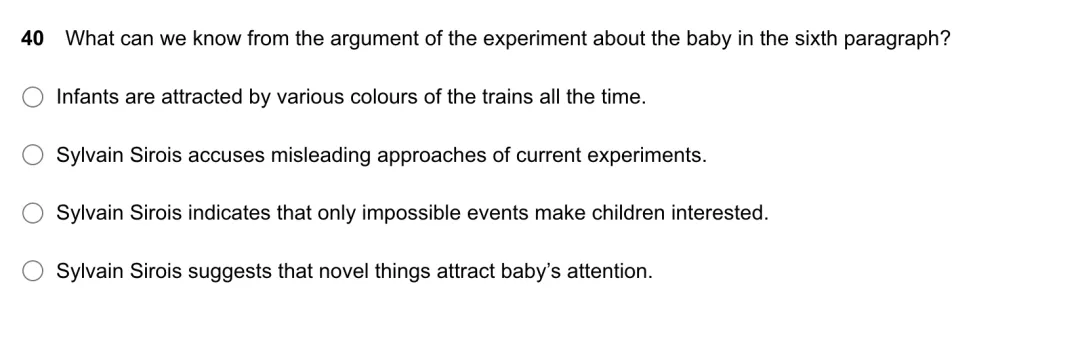
Sirois does not take issue with the way these experiments were conducted. "The methods are correct and replicable," he says, "it's the interpretation that's the problem." In a critical review to be published in the forthcoming issue of the European Journal of Developmental Psychology, he and Jackson pour cold water over recent experiments that claim to have observed innate or precocious social cognition skills in infants. His own experiments indicate that a baby's fascination with physically impossible events merely reflects a response to stimuli that are novel. Data from the eye tracker and the measurement of the pupils (which widen in response to arousal or interest) show that impossible events involving familiar objects are no more interesting than possible events involving novel objects. In other words, when Daniel had seen the red train come out of the tunnel green a few times, he gets as bored as when it stays the same color. The mistake of previous research, says Sirois, has been to leap to the conclusion that infants can understand the concept of impossibility from the mere fact that they are able to perceive some novelty in it. "The real explanation is boring," he says.
段落大意:Sirois认可实验方法,但认为注视时间反映新奇性;熟悉的不可能事件,并不比新奇的可能事件更有吸引力。
take issue with 对……提出异议。
replicable 可重复验证的。
forthcoming 即将到来的/出版的。
pour cold water over 对……泼冷水;打击其热情。
precocious 早熟的;过早发展的。
stimuli 刺激;stimulus的复数。
arousal 唤醒;激活状态。
in response to 作为对……的反应。
leap to the conclusion 贸然下结论。
the mere fact that 仅仅……这一事实。
认可方法,反对解释;新奇不等于不可能。
The methods are correct and replicable … it’s the interpretation that’s the problem.
not take issue with the way …明确否认他在攻击实验设计。问题在于如何解释结果。
impossible events involving familiar objects are no more interesting than possible events involving novel objects.
熟悉对象中的“不可能”事件,并不比新对象中的“可能”事件更有趣。决定注视反应的可能是新奇性。
Daniel看过几次变色火车后,同样会无聊。所以“看得更久”不能直接证明“理解不可能”;从可观察反应跳到抽象概念,需要额外证据。
Q32|FALSE
定位证据: Sirois does not take issue with the way these experiments were conducted.
does not take issue with加上correct and replicable直接反驳“发现实验设计严重缺陷”。他批评的是interpretation,而不是experimental designs。
Q36|D
定位证据: impossible events involving familiar objects are no more interesting than possible events involving novel objects.
D对应可能与不可能两类事件中都可能出现的新奇性反应。novel是新奇,不等于impossible;文中没有把兴趣限定为不可能事件。
Q37|C
定位证据: when Daniel had seen the red train come out of the tunnel green a few times, he gets as bored as when it stays the same color.
C when they had seen the same thing for a while对应看过几次后变得无聊。关键是熟悉、习惯化,不是事物是否违反物理规律。C段attention level steadily drops也提供直接支持。
Q40|D
定位证据: a baby's fascination with physically impossible events merely reflects a response to stimuli that are novel
D直接概括新奇刺激吸引注意。A的all the time忽视看惯后会无聊;B若指方法有误,与methods are correct相反;C的only impossible events与可能事件中的新奇对象也有吸引力相冲突。
Sirois并不反对这些实验的实施方式。“方法是正确而且可重复验证的,”他说,“问题在于解释。”在一篇即将发表于《欧洲发展心理学杂志》下一期的批判性综述中,他与Jackson对近期一些声称观察到婴儿先天或早熟社会认知技能的实验泼了冷水。他自己的实验表明,婴儿对物理上不可能事件的兴趣,仅仅反映了对新奇刺激的反应。眼动追踪器的数据和瞳孔测量结果——瞳孔会在唤醒或感兴趣时扩大——显示,涉及熟悉对象的不可能事件,并不比涉及新奇对象的可能事件更有趣。换句话说,当Daniel看过几次红色火车从隧道出来变成绿色后,他就会像看颜色始终不变的火车一样无聊。Sirois认为,以往研究的错误在于,仅凭婴儿能察觉某种新奇性这一事实,就贸然得出他们能够理解“不可能”这个概念的结论。“真正的解释很无趣。”他说。
So how do babies bridge the gap between knowing squat and drawing triangles—a task Daniel's sister Lois, 2 1/2, is happily tackling as she waits for her brother? "Babies have to learn everything, but as Piaget was saying, they start with a few primitive reflexes that get things going," said Sirois. For example, hardwired in the brain is an instinct that draws a baby's eyes to a human face. From brain imaging studies we also know that the brain has some sort of visual buffer that continues to represent objects after they have been removed—a lingering perception rather than conceptual understanding. So when babies encounter novel or unexpected events, Sirois explains, "there's a mismatch between the buffer and the information they're getting at that moment. And what you do when you've got a mismatch is you try to clear the buffer. And that takes attention." So learning, says Sirois, is essentially the laborious business of resolving mismatches. "The thing is, you can do a lot of it with this wet sticky thing called a brain. It's a fantastic, statistical-learning machine". Daniel, exams ended, picks up a plastic tiger and, chewing thoughtfully upon its head, smiles as if to agree.
段落大意:Sirois认为婴儿从原始反射和视觉缓冲机制起步,遇到预期与当前信息不匹配时投入注意力,逐步学习。
bridge the gap between 弥合……之间的差距。
know squat 什么都不知道;口语说法。
primitive reflexes 原始反射。
get things going 让事情开始运转。
hardwired 先天设定的;固有的。
visual buffer 视觉缓冲区。
lingering perception 持续残留的感知。
conceptual understanding 概念层面的理解。
mismatch 不匹配;不一致。
laborious 费力的;艰苦的。
“没有先天知识”不等于“没有先天机制”。
Sirois承认婴儿具有primitive reflexes,例如眼睛会被人脸吸引。
物体移走后,大脑仍保留某种视觉表征;他把这称为lingering perception,而不是conceptual understanding。
旧视觉表征与当前信息不匹配 → 尝试清除缓冲 → 投入注意力 → 逐步解决不匹配。
这补足了他的解释:学习可以从简单机制与信息处理开始,不必先假定婴儿理解复杂物理概念。结尾回到Daniel玩塑料老虎的场景,与文章开头呼应。
那么,婴儿是如何跨越从一无所知到能够画三角形的差距的呢?Daniel两岁半的姐姐Lois在等弟弟时,正高高兴兴地尝试画三角形。“婴儿必须学习一切,但正如皮亚杰所说,他们一开始拥有少数原始反射,让一切运转起来。”Sirois说。例如,大脑中有一种先天本能,会让婴儿的目光被人脸吸引。通过脑成像研究,我们还知道,大脑拥有某种视觉缓冲区,在物体被移走后仍继续保留其表征——这是一种残留的感知,而不是概念层面的理解。因此,当婴儿遇到新奇或意外事件时,Sirois解释说:“缓冲区与他们当时接收到的信息之间出现了不匹配。出现不匹配时,你会试着清除缓冲区,而这需要注意力。”所以,Sirois说,学习本质上就是费力地解决不匹配的过程。“关键在于,用这个叫作大脑的湿乎乎、黏糊糊的东西,你能完成大量这样的工作。它是一台了不起的统计学习机器。”测试结束后,Daniel拿起一只塑料老虎,若有所思地咬着它的头,露出仿佛赞同的微笑。
Q27 TRUEQ28 NOT GIVENQ29 FALSEQ30 NOT GIVENQ31 TRUEQ32 FALSEQ33 BQ34 EQ35 AQ36 DQ37 CQ38 BQ39 AQ40 D
判断题:单位、主体、态度都要对齐。100 infants不是100 experiments;educators不是parents;质疑interpretation不是质疑methods。Q28、Q30缺少对应信息,不能用常识补齐。
句尾匹配:读完整句,再检查知识从哪里来。Piaget强调经验建构,先天论强调出生时已具备部分机制。
单选:抓完整结论,不被具体颜色和设备词带偏。习惯后注意下降、理论随时间变化、新奇性吸引注意,分别是Q38–40的关键。
Q27|not surprising↔ the usual expression
Q29|prove the theories↔ challenging current thinking(反义替换)
Q31|similar to Piaget’s↔ tend to be more Piagetian
Q32|serious flaws in experimental designs↔ methods are correct and replicable(反义替换)
Q33|before they learn from experience↔ must gradually construct this knowledge from experience
Q35|the mechanism to learn a language↔ rudimentary programming for … language
Q36|possible and impossible events↔ possible events involving novel objects / impossible events involving familiar objects
Q37|seen the same thing for a while↔ had seen … a few times / gets as bored
Q38|was accustomed / attention fell↔ habituated / attention level steadily drops
Q39|theories … changed over time↔ constructivist theories … set aside by … nativist psychologists
Q40|novel things attract attention↔ a response to stimuli that are novel
1. in search of 寻找……
2. take shape 逐渐成形
3. from scratch 从零开始
4. be engrossed in 全神贯注于……
5. set aside 搁置;放在一边
6. be equipped with 具备;配备……
7. take issue with 对……提出异议
8. in response to 作为对……的反应
9. leap to the conclusion 贸然下结论
10. bridge the gap between 弥合……之间的差距
今天用下面这个表达造一句:
bridge the gap between 弥合……之间的差距
把你的句子留在评论区,明天我们会放参考答案和常见错误。
如果你刷了不少题,分数却一直上不去,可能真正需要解决的不是“刷题量”,而是找到自己的卡分点。关注公众号发送 “阅读” 两个字,看看你到底卡在哪里。

这里是「将来时」
每天用真实雅思材料一起练:
阅读精读 | 听力精听 | 写作拆解 | 口语表达
不只是知道答案。
更重要的是:
读懂原文,也看懂雅思是怎么从原文变成题目的。
将来时,从现在开始。


