

前两期我们用真题词频啃下了"动作与变化""环境与自然保护"。这一期进入最热门、也最容易"凭感觉背错词"的话题——科技与数字时代。
先做个小测试,一提科技,你脑子里是不是立刻蹦出这几个词:AI、digital(数字的)、robot(机器人)、algorithm(算法) ?
但把近五年 181 篇真题翻完,结果有点反常识:
artificial intelligence(AI) 出现 57 次,听着很多,却只集中在 9 篇里——其中一大半来自 2024 新课标II卷《AI by Design》和 2020 北京卷两篇 AI 专题文;
digital 20 次、只跨 9 篇;robot 4 次/2 篇,algorithm 3 次/2 篇。
它们是"话题热词",却不是跨卷反复考的真高频。真正篇篇刷屏的,是另外几个你天天见、却未必背全"全家"的词。
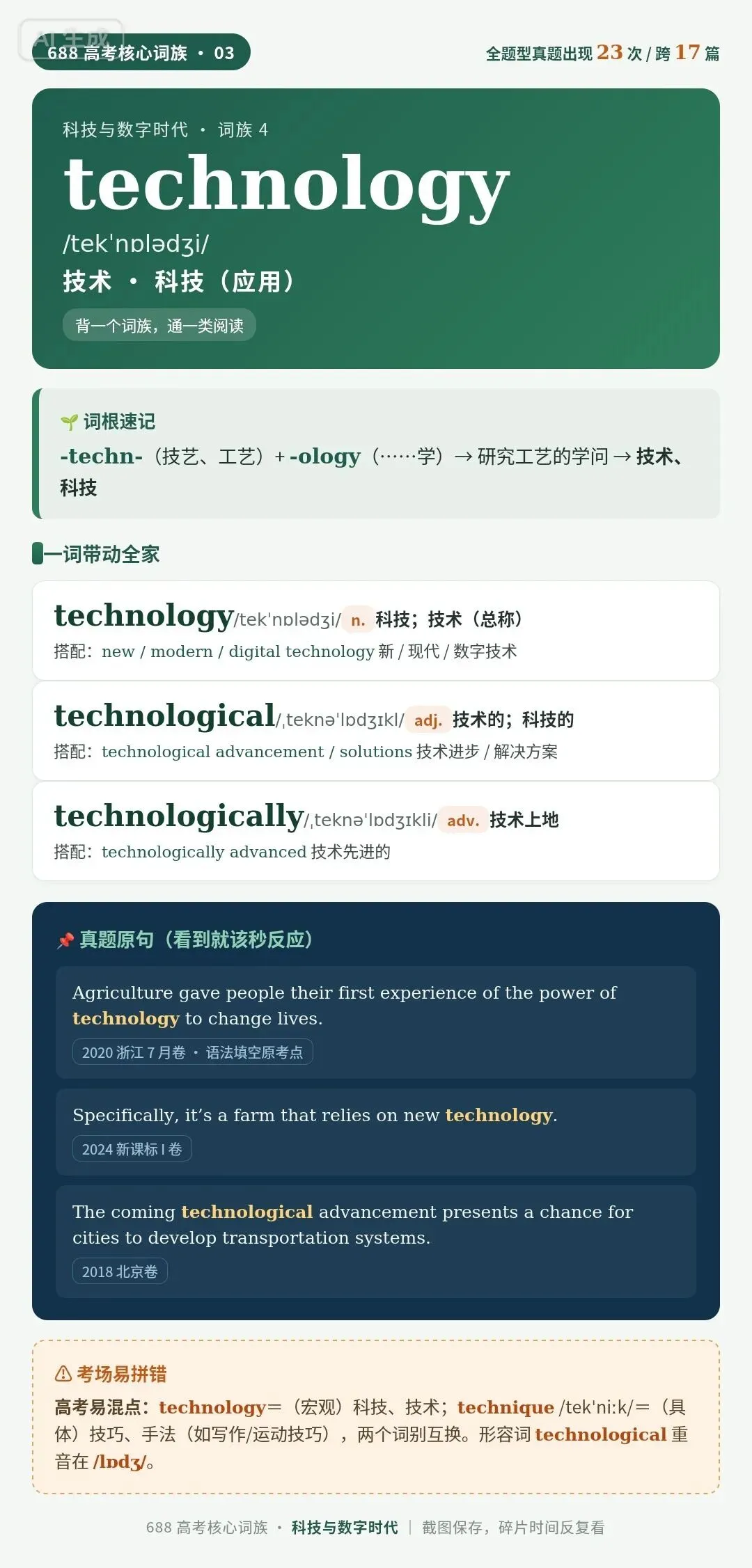
今天是第03期:科技与数字时代。仍然只按真题真实词频选词,5 个核心词族在近五年真题里跨 13~26 篇反复出现。一个词带出一整个家族:词根 + 派生词 + 高频搭配 + 真题原句。文末有全套练习、答案,还有那套任何作文题都能套的五步万能模板(本期换成科技版)。
建议先收藏,再往下做。👇
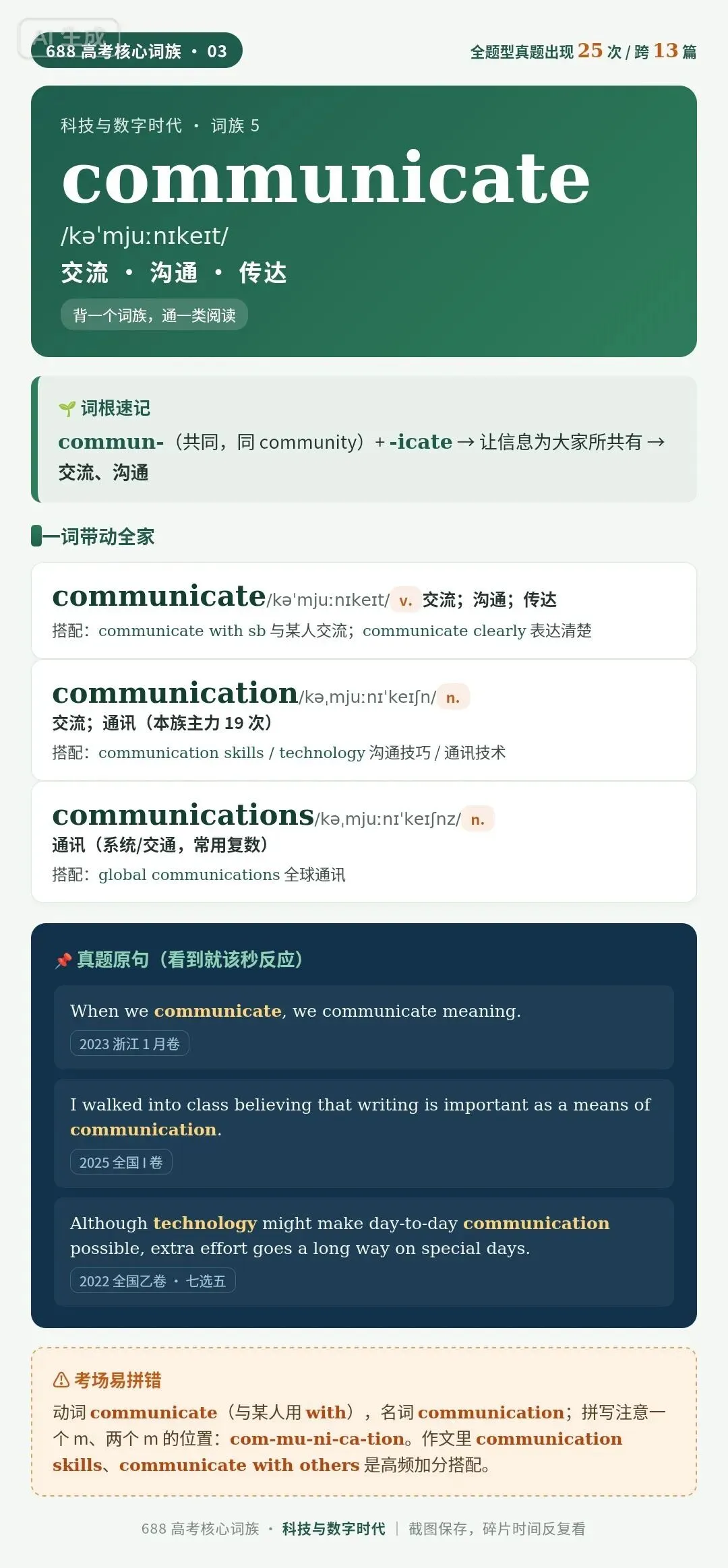
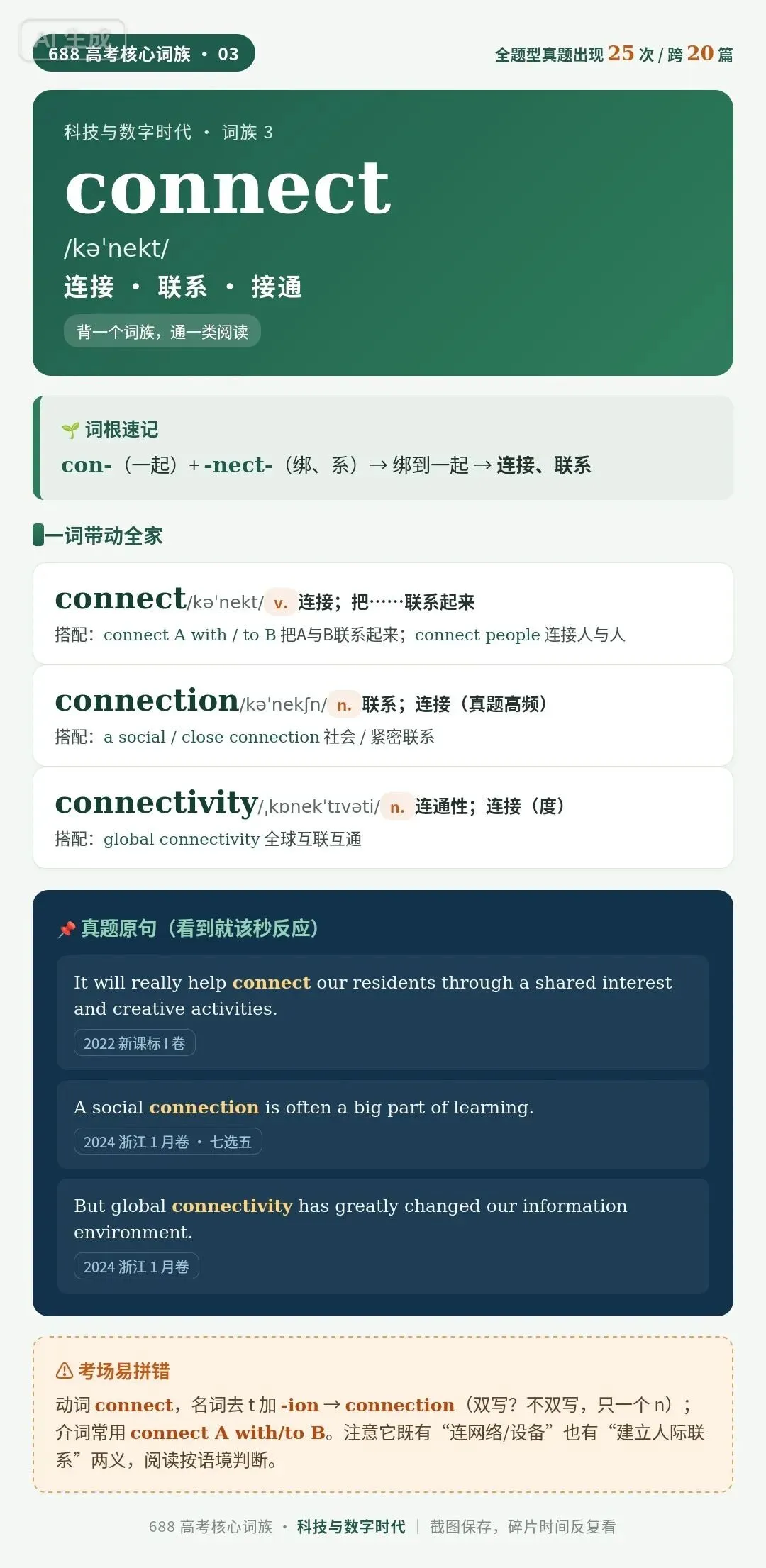
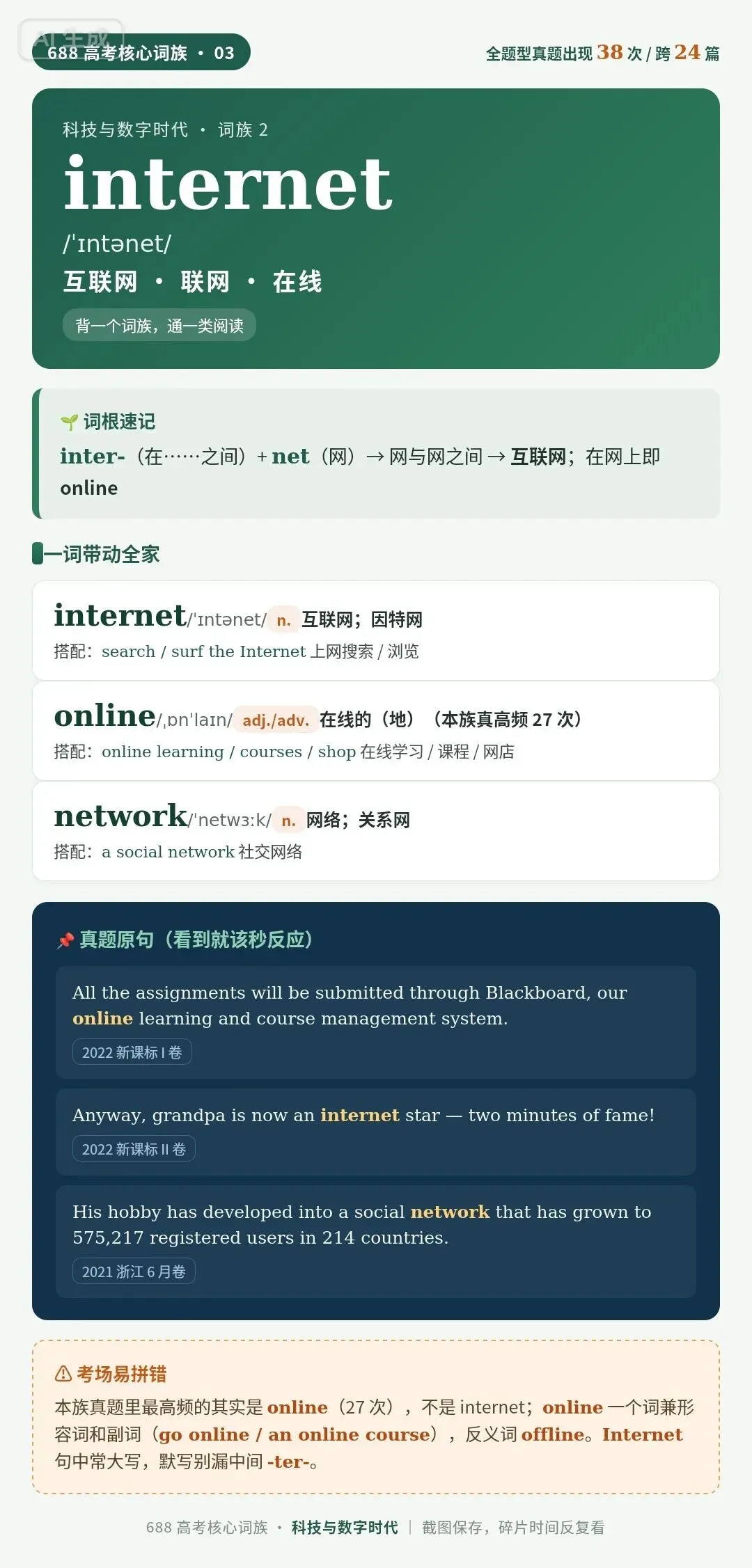
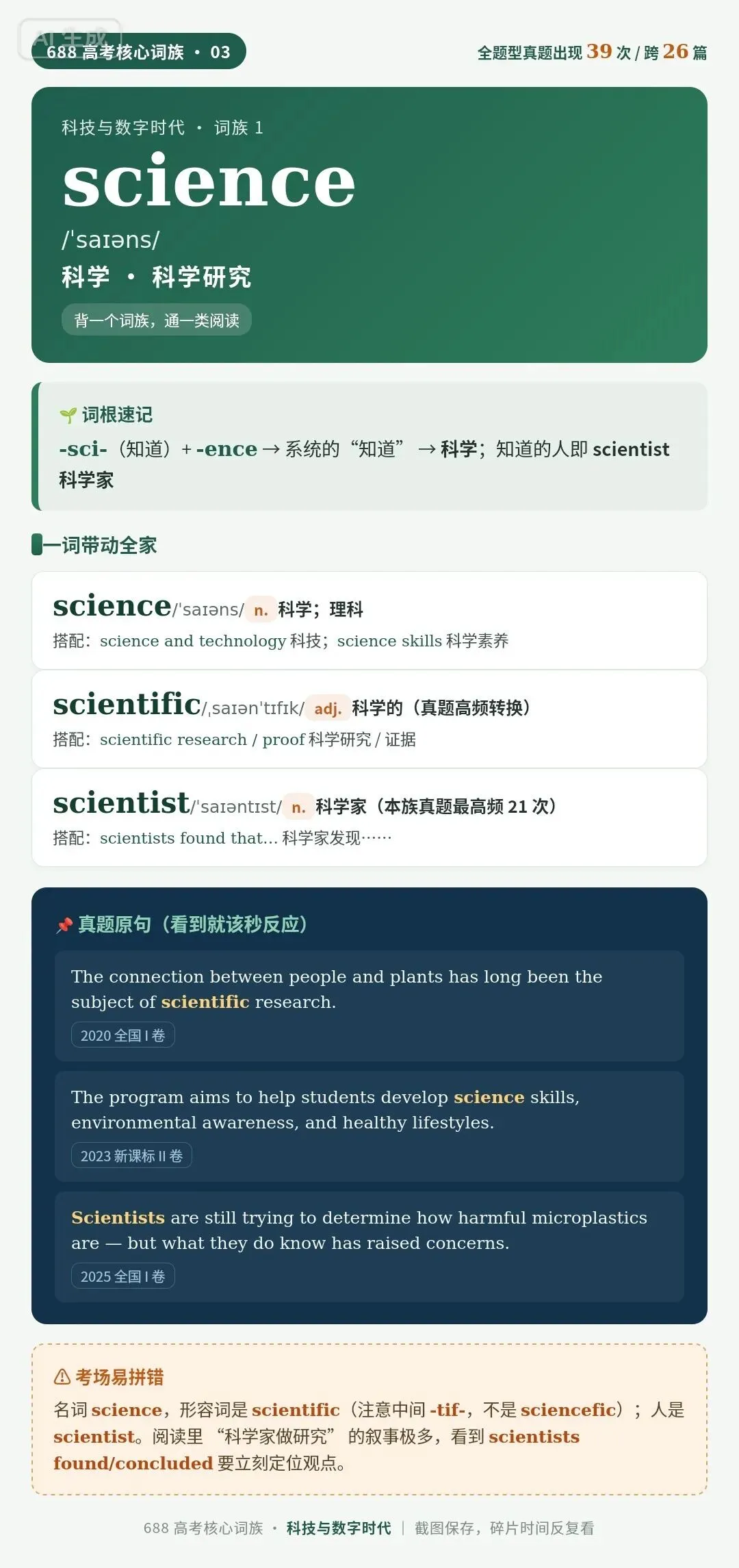
阅读下面短文,在空白处填入 1个适当的单词 或括号内单词的正确形式。(语篇情境参考 2020 浙江7月卷"technology changes lives"语法考点改编)
The library of our school has changed completely over the past three years.
Gone are the heavy wooden shelves and dim lamps. It is now a bright 61.________ (technology) space, designed 62.________ (connect) students with the wider world outside the classroom.
When the project began in 2022, only two old computers were available, and the thick walls behind 63.________ readers once felt separated seemed hopeless. Today, however, every desk has a screen, and students can borrow 64.________(digit) books, take online courses and search for the latest 65.________ (science)discoveries in seconds.
Some teachers worried that technology would reduce face-to-face 66.________ (communicate) , but the new space has brought people closer. Since then, many classes 67.________ (connect) with partner schools abroad, and students talk online every week.
Technology is no 68.________ (replace) for a warm conversation, but it can surely carry that warmth further. As the saying goes, it is people, not machines, 69.________ give technology its real meaning — a lesson well worth 70.________ (remember) .
四、完形填空(记叙文·15空)
阅读下面短文,从每题所给的 A、B、C、D 四个选项中选出最佳选项。(改编自 2022 新课标II卷"爷爷成 internet star"温情叙事)
When my grandfather retired and came to live with us, he seemed quiet and lonely. Most days he sat in the corner, staring at his phone without really using it. I could see the 1in his eyes, and I began to worry about him.
Then an idea came to me: why not teach him to make short 2? Granddad had once grown the sweetest vegetables in our village, so I set up a simple stand and showed him how to record his little garden and 3the clips online. At first he learned slowly, but he practised 4 every evening. His first video received only twenty views, 5he was not discouraged.
Weeks later, everything changed. A clip of him talking gently to a frosted tomato plant was 6 thousands of times. Suddenly, granddad was an internet 7. Warm messages poured in, and a local club even invited him to give a 8.
Granddad still does not quite understand how the 9 works, but his eyes are bright again. He says the best part is not being famous; it is feeling useful and 10 to the world once more.
At first I had simply wanted to cheer him up. 11, the experience taught me something bigger. I had always thought technology was cold, but I was 12. The screen alone means nothing; it is the care behind it that 13.
Granddad and I now film a new clip every weekend. We talk not about becoming stars, 14 about sharing a little warmth. I have come to believe technology can connect lonely hearts, and as long as people care, 15 has to feel alone.
1. A. pride B. loneliness C. anger D. hope
2. A. videos B. notes C. calls D. speeches
3. A. delete B. download C. share D. update
4. A. patiently B. secretly C. nervously D. carelessly
5. A. so B. or C. for D. yet
6. A. reported B. shared C. refused D. produced
7. A. pioneer B. engineer C. star D. writer
8. A. talk B. test C. prize D. promise
9. A. network B. machine C. program D. battery
10. A. connected B. compared C. exposed D. tied
11. A. Therefore B. However C. Besides D. Anyway
12. A. right B. ready C. wrong D. safe
13. A. disappears B. matters C. returns D. stops
14. A. and B. so C. but D. or
15. A. somebody B. anybody C. everybody D. nobody
五、阅读理解(说明文·C/D篇难度)
阅读下列短文,从每题所给的四个选项中选出最佳选项。(改编自 2024 新课标II卷《AI by Design》)
Will Artificial Intelligence Take Over?
Artificial intelligence, or AI, is no longer science fiction. From the apps on our phones to the online courses we follow at home, clever algorithms already organise much of daily life, often without our noticing. Yet a new book by technology expert Catriona Campbell warns that most people still understand far too little about a force that may reshape the next twenty years.
Campbell explains that today's systems are "narrow AI": they do one single job extremely well, such as translating languages, recognising faces or suggesting videos. The real turning point, she argues, will be artificial general intelligence, when machines learn to reason across many fields, almost like human scientists. Such technology could greatly improve medicine and education, but it could also reshape employment and the way we connect and communicate with one another.
That is why Campbell wants the public, technology companies and world leaders to start talking now, several decades before these changes fully arrive. "It is essential that we keep control of artificial intelligence," she writes, "or we risk being sidelined." Her real question is not how clever AI can become, but who gets to decide how it is used.
Rather than fearing the future, Campbell calls for sensible rules and better education. Schools, she believes, should teach students not only how to use digital tools, but how to question and judge them. Above all, she remains hopeful: human judgment, empathy and the warm connections we build with one another are things no algorithm can truly copy.
1. What is the purpose of the first paragraph?
A. To present the book and its warning about AI.
B. To explain how to download popular AI apps.
C. To prove that AI has already replaced scientists.
D. To compare different kinds of online courses.
2. According to Campbell, "narrow AI" refers to systems that ______.
A. can reason across many fields like humans
B. are already cleverer than world leaders
C. do one single particular job very well
D. refuse to translate or recognise faces
3. What does Campbell consider the most important question about AI?
A. How quickly machines can become more famous.
B. Who should have the power to decide its use.
C. Which company can sell the most robots.
D. Why students dislike online learning.
4. Which of the following best shows Campbell's attitude to the future of AI?
A. Doubtful and completely uninterested.
B. Fearful that machines will copy all humans.
C. Hopeful but calling for rules and education.
D. Certain that AI should be banned at once.
六、书面表达(应用文·约95词)
假定你是李华。你校本周五将举办"科技节"(Science and Technology Festival)。请给你的英国朋友 Chris 写一封电子邮件,邀请他参加,内容包括:
1. 科技节的时间、地点与目的;
2. 主要活动安排;
3. 你对科技的看法并发出邀请。
参考词汇:science, technology, online, AI (artificial intelligence), connect, communicate
万能挖空骨架(背下来,考场直接填):
Dear ____,
How is everything going? I'm writing to ①__________. ②__________ is held to ③__________.
The activities are as follows. First, we ④__________; besides, we can also ⑤__________.
Not only can we ⑥__________, but we can ⑦__________ wisely as well. I would be delighted if you could join us.
Looking forward to your reply.
Yours,
Li Hua
🔑 科技话题词怎么放?
④⑤用本话题的"动作/活动词"(study online / use AI / communicate / connect),②⑥⑦换成它们的名词或形容词派生(science → scientific;technology → technological;communication)。一篇自然用上 6~8 个科技话题词,阅卷老师一眼看到词汇功底。
🏆 高分三要素:
① 五步结构词一个不少(glad / first / besides / not only…but also / looking forward to);
② 至少1处词族派生 + 1个高级结构(倒装、被动、定语从句);
③ 三个要点全覆盖,人称和时态保持一致。
✅ 答案与解析(先自己做,再往下翻)
.
.
.
.
.
【语法填空】
technological 修饰名词 space 用形容词,technology → technological(科技的)。
to connect be designed to do sth(被设计用来做某事),用不定式。
which "介词 behind + 关系代词"引导定语从句,指代 the thick walls。
digital 修饰名词 books 用形容词,digit → digital(数字的)。
scientific 修饰名词 discoveries 用形容词,science → scientific(科学的)。
communication 作 reduce 的宾语用名词,communicate → communication(交流)。
have been connected classes 与 connect 是被动关系;since then 搭配现在完成时被动。
replacement be no replacement for …(无法取代……)固定表达,动词 replace → 名词 replacement。
that It is … that … 强调句型,强调主语 people。
remembering 固定搭配 be worth doing(值得做),用动名词。
【完形填空】
1-5 B A C A D
6-10 B C A A A
11-15 B C B C D
关键题点拨:
第1题 loneliness,与开头 quiet and lonely 呼应,名词"孤独";
第5题 yet,"只有20次播放,但他并不气馁",前后转折;
第7题 star,internet star 网络红人,原叙事核心,也呼应后文 not being famous;
第10题 connected,feel connected to the world 感到与世界相连,正是本期 connect 词族;
第15题 nobody,"只要有人在乎,就没有人必须感到孤单",收尾点题。
【阅读理解】
A 写作目的题。第一段由 AI 已渗入生活引出 Campbell 的新书及其警示。
C 细节题。第二段明确 narrow AI 指"把单一一件事做得极好"的系统。
B 细节题。第三段末句"真正的问题不是 AI 能多聪明,而是谁来决定如何使用它"。
C 态度题。末段她不恐惧未来,而是呼吁合理规则与更好教育,且保持乐观。
【书面表达·参考范文(101词)】
Dear Chris,
How is everything going? I'm writing to invite you to our school Science and Technology Festival, to be held this Friday in the school hall.
The festival was created to spark our interest in technology. First, students will display science projects, from small robots to apps built for online study. Besides, a teacher will show how AI helps us communicate and connect with the world faster.
Not only can we have fun, but we can also learn how to use technology wisely. I would be delighted if you could join us.
Looking forward to your reply.
Yours,
Li Hua
看,五步模板一个不少,science / technology / online / AI / communicate / connect 自然全用上了,还藏了 Not only 倒装、被动语态和不定式作定语——这就是第五档作文的样子。
写在最后
这一期我们用真题词频,啃下了"科技与数字时代"5个核心词族,也顺手识破了一个误区:最热的 AI、digital、robot 其实跨篇不多,真正反复考的是 science / online / connect / technology / communicate。
还是那句话:不要孤立背单词,要背"一个词的全家" + "它在真题里怎么考"。 背一个词族,通一类题型。
觉得有用,就点个"在看",转发给一起冲刺的同学,收藏本文,周末把练习限时做一遍。尤其是 technology vs technique、connect vs communicate 这两组,最值得单独存给同学。
下一期我们进入 「情感与情绪」 ,同样只挑真题真高频词,配全套练习和万能模板。
关注我,15个话题,陪你把高考阅读核心词汇一个一个吃透。 🌱


