

Writing
Writing Section
In the writing section, you will answer 12 questions to demonstrate how well you can write in English. There are three types of tasks.
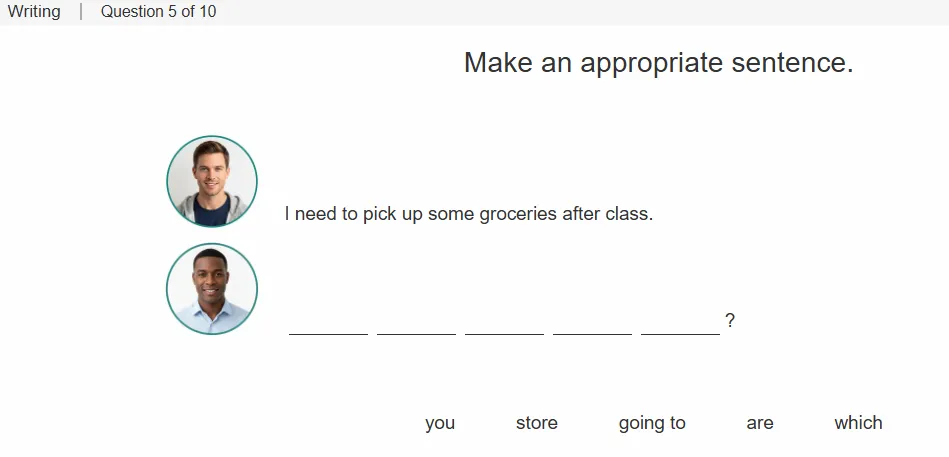
Build a Sentence
Move the words in the boxes to create grammatical sentences.
A clock will show you how much time you have to complete this task.




Write an Email
You will read some information and use the information to write an email.
You will have 7 minutes to write the email.
You major in marketing. You recently attended a workshop on digital marketing that was recommended by your professor. You found the workshop extremely informative and believe it greatly benefits your studies. You want to thank the organizer, Ms. Clark, and suggest that similar workshops be held more frequently.
Write an email to Ms. Clark. In your email, do the following:
Thank her for organizing the workshop and mention what you found most valuable about it.
Explain how the workshop benefits your studies.
Suggest that similar workshops be organized more frequently.
Write as much as you can and in complete sentences.
Your Response:
To: Ms. Clark
Subject: Appreciation for digital marketing workshop
Write for an Academic Discussion
Your professor is teaching a class on history. Write a post responding to the professor's question.
In your response, you should do the following.
Express and support your opinion.
Make a contribution to the discussion in your own words.
An effective response will contain at least 100 words.
Professor Achebe
Lately, we have been exploring the value of studying history and its relevance to modern life. Some historians argue that understanding historical events—such as revolutions, social movements, and political conflicts—helps us make sense of current issues like inequality, climate policy, and international relations. Others, however, believe that focusing too much on the past can distract us from solving urgent problems in the present, such as technological changes or public health crises. Which view do you agree with? Why?
Paul
I agree that studying history is essential to understanding current issues. It reveals patterns in human behavior and thus can help us avoid repeating mistakes. This context is crucial for making informed, thoughtful choices in politics, society, and even personal life.
Kelly
I believe that focusing on the present is more important. It is true that studying history can help build critical-thinking skills, but addressing today’s unique challenges requires immediate action and innovative thinking tailored to current circumstances rather than past lessons.
http://www.tuonindefu.com/?p=13601


