

READING PASSAGE 2
You should spend about 20 minutes on Questions 14-26, which are based on Reading Passage 2 below.
Playing Soccer
There are many differences between playing soccer in the street and joining a youth team in an organized league in the USA
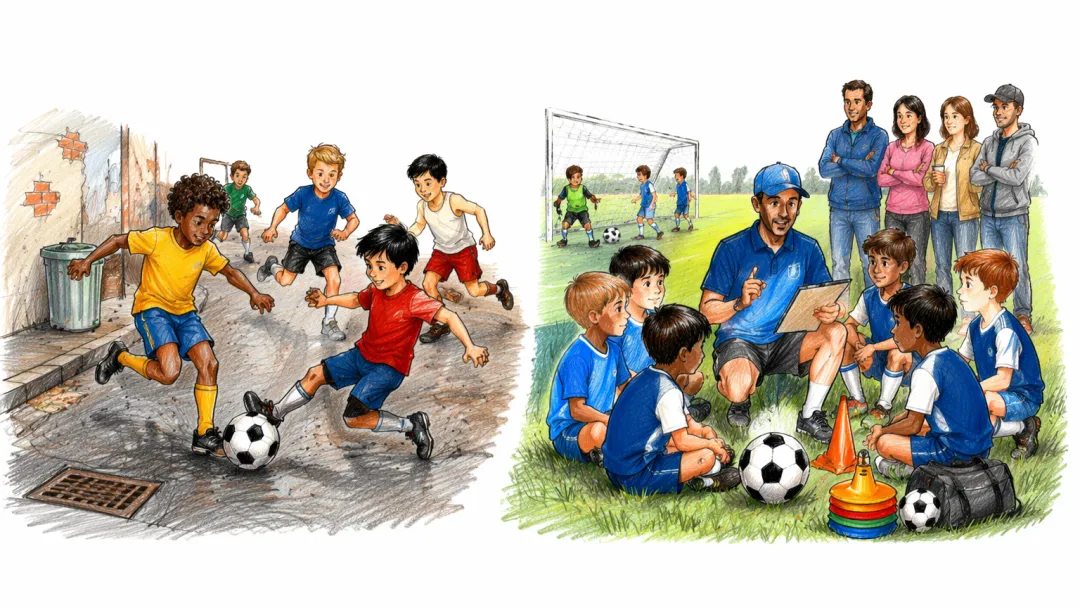
A Street soccer, as its name implies, is an informal variation of the sport, often played on the street, particularly in urban areas. There are many reasons for the widespread popularity of street soccer. Unlike youth soccer, its more formally organized counterpart, no large space is needed, and goal posts, corer markers, and marked lines, associated with the formal game, are typically absent, as are game officials or referees. Another attraction of street soccer is that it is played frequently and competitively, but does not necessarily require standard 11-a-side teams or fixed playing positions. Unlike in youth soccer, inexperienced street soccer players rarely learn from repetitive technical and tactical drills. instead, they learn from their poor performance in competition, unconscious of the skills they are nonetheless developing, and without older adults or coaches present. Players learn without effort through playing the game, and soon attain an almost natural feeling for the sport.
B However, there are lots of cities in the world today where conditions are such that street soccer is no longer possible. Congested traffic now dominates where games were once played. Parks and open fields are used as hangouts for older teenagers with other interests. Add to this the requirement in many localities for official permits to use public spaces and the managed schedules that many young people have today, and spontaneous play of any kind is hard to imagine.
C In spite of all these obstacles, which are probably solvable in most instances, there is another sociological explanation of why in many places street soccer doesn't enjoy the same popularity it once did. n his book How Soccer Explains the World, US writer Franklin Foer observes: But for all the talk of freedom, the 1960s parenting style had a far less relaxed side too. Like the 1960s consumer movement which brought seat belts and airbags to cars, the (youth) soccer movement felt like it could create a set of regulations that would protect both the child's body and mind from damage. Soccer leagues like the one l played in as a child handed out 'participation' prizes to every player, no mater how few games his (or her) team won Where most of the word accepts the practice of using your head to hit the ball as an essential element of the game, some (youth) soccer parents have worried over the potential for injury to the brain. An entire industry grew up to manufacture protective headgear. Even though very little medical evidence supports this fear, some youth leagues prohibited heading the ball altogether.
D A growing body of people don't believe street soccer involves a legitimate educational method. They argue that children need to be taught by experts, Youth soccer instruction now begins with four-year-olds, so that they will have an advantage as six-year-olds. This need to get ahead brings with it a fear of falling behind that only expert instruction can prevent. This type of instruction leaves no room for the trial and error approach of street soccer.
E One of the basic ideas of street soccer is that young players are assigned a particular role by a better player and are expected to play for the good of the team, Such an assignment runs counter to the idea of youth soccer that every child needs to learn every position and will benefit from doing so. in street soccer, you fill the role that you are best wiled to at a particular time. While this role assignment can change from game to game, the purpose is always the same: to get the best out of each individual at any given moment.
..................
Questions 14-19
Reading Passage has seven sections, A-G.
Which section contains the following information?
Write the correct letter, A-G, to boxes 14-19 on your answer sheet.
14 a contrast between the ways young players gain experience of playing different positions. ...........
15 examples outside sport of greater emphasis on individual safety. ...........
16 a description of methods of selection for leadership on soccer teams. ...........
17details of urban changes that discourage street soccer. ...........
18 a mention of the lesson that failure teaches street soccer players. ...........
19 an explanation of why youth soccer emphasizes the need for coaches. ...........
Questions 20 and 21
Choose TWO letters, A-E
Write the correct letters in boxes 20-21 on your answer sheet.
The list below gives some possible reasons for the popularity of street soccer. Which TWO of these reasons are mentioned by thewriter of the text?
A Many famous soccer players got their start in street soccer.
B Young people can begin playing street soccer at a very early age.
C You do not need elaborate facilities to play street soccer.
D Inexperienced street soccer players are not criticized for mistakes.
E Street soccer teams can have varying numbers of players.
Questions 22 and 23
Choose TWO letters, A-E
Write the correct letters in boxes 22 and 23 on your answer sheet.
The list below goes some possible results of the 1960s parenting style. Which TWO of these results are mentioned by FranklinFoer in the excerpt from How Soccer Explains the World?
A Participation in youth soccer became much more expensive.
B Some youth soccer leagues adopted more restrictive rules of play.
C Fewer young people joined youth soccer teams.
D Youth soccer players were sometimes rewarded for simply playing in games.
E Soccer equipment manufacturers directed advertising towards parents.

完整版原文+答案私信沫沫学雅领取~
机考题库和干货资料留言123~
更多雅思资料PDF评论区留言666~


