


很多七年级同学都吐槽:单词明明背了不少,一读阅读理解就发懵,要么纠结两个选项反复改,要么全靠感觉“蒙答案”,错题总是集中在主旨判断、细节定位上。
今天结合《少年素质教育报》七下期末模拟测试卷(一)里的游轮旅行、西伯利亚风物、狮狐寓言、特色新潮旅行4篇完整阅读真题,附原文、题目、答案和解析,再拆解考场实操技巧+日常积累方法,看完就能直接套用,告别盲目刷题。
一、先认4篇阅读文体,知己知彼好做题。
本次试卷4篇阅读覆盖期末高频4类文体,不同文体做题侧重点完全不一样:
1. A篇 游轮广告(应用文)
旅游商业宣传文,侧重行程、价格、配套服务,细节题占比极高,答案几乎都能在原文原句找到。
2. B篇 西伯利亚介绍(说明文)
地域风物科普文,讲解气候、生活环境,常考写作手法、主旨标题、细节信息提取。
3. C篇 狮子与狐狸(记叙文/寓言故事)。
趣味小故事,考情节理解、人物行为原因、正误判断,容易掉进“主观脑补”的陷阱。
4. D篇 新潮旅行方式+校园猫咪小程序(议论文+应用文)。
介绍多种旅行方式,搭配校园小程序阅读,兼顾简答和词义猜测题型。
二、真题原文+题目+答案解析
A篇 游轮广告
原文:
Do you need a holiday? How about spending some time on a cruise around the Caribbean Sea? We have three ships: the Crystal Queen, the Crystal Princess, and the Crystal Palace. Our seven-day cruise costs $2,000.
Day one — leave from Miami
Day two — a free day in Nassau, the capital of the Bahamas
Day three — near Haiti
Day four — free day in Puerto Rico and Antigua
Day five — a free day in Barbados
Day six — a free day in Port of Spain, Trinidad and Tobago
Day seven — travel to Caracas, Venezuela and then home
The price of your cruise includes all meals and drinks. Our cruise ships have every facility: a five-star restaurant, a library and also a gym.
If you like to go on a journey on other parts of the world, you can try our cruises in the Baltic Sea and the Mediterranean.
Our ships carry over 2,000 passengers, and we have almost 600 workers.
For more information, you can call us at 021-4455832.
题目+解析:
56. What may people do for fun on the cruise ship according to the text?
① Go fishing. ② Read different kinds of books. ③ Go shopping. ④ Watch a movie.
A. ①② B. ③④ C. ①③ D. ②④
答案:D
解析:原文提到游轮有 a library (对应②),五星级游轮普遍配备观影区域(对应④);文中未提及钓鱼、购物,排除①③。
57. Why does the writer write the text?
A. To ask us to visit the Caribbean Sea.
B. To show us something about a cruise.
C. To tell us what we can eat and drink on a cruise.
D. To tell us the history of some famous cruise ships.
答案:B
解析:本文是游轮旅行广告,介绍航线、价格、设施等信息,目的是介绍游轮旅行,A片面、C只是局部内容、D无中生有。
58. In which part of a newspaper can we read the text?
A. Travel. B. Culture. C. Music. D. Sports.
答案:A
解析:全文围绕游轮旅行展开,这类内容通常出现在报纸的Travel(旅行)版块。
B篇 西伯利亚介绍
原文:
Do you feel comfortable when cold? Many people may feel uncomfortable in very cold weather. But some people feel lucky because you won't feel that way in Siberia.
In most places in Siberia, the winter is very long and it's very snowy. Winter starts in early November and the snow will stay until May. The temperature is usually about -25℃. But it's sometimes much colder than that. When it's -35℃, children can't go to school. But they still get up early to go out and play in snow. And in spring and summer, it's usually about 20℃. In spring the snow melts and people don't often see snow.
You may think there is nothing but trees and snow in Siberia. Not many people live there now. But there are lots of forests, many trees grow very well. People living there have a lot of warm clothes. All the houses have heating equipment, so it's warm inside. In winter, people close the windows even during the daytime. They don't open them again before spring comes.
题目+解析:
59. How does the writer start the text?
A. By telling a story. B. By showing numbers.
C. By asking a question. D. By giving an example.
答案:C
解析:文章开篇用 Do you feel comfortable when cold? 提问引入话题,属于设问开头。
60. What's the weather like in spring and summer in Siberia?
A. Cool and sunny. B. Snowy and rainy. C. Windy and sunny. D. Windy and rainy.
答案:A
解析:原文提到春夏气温 usually about 20℃ ,积雪融化、不再常下雪,对应cool and sunny。
61. What's the best title for the text?
A. The People in Siberia B. The Trees in Siberia C. The Snow in Siberia D. The Weather in Siberia
答案:D
解析:全文介绍西伯利亚冬春夏的气温、降雪、气候特点,核心主题是西伯利亚的天气,其他选项只是局部内容。
C篇 狮子与狐狸寓言
原文:
Once upon a time, there was a lion. He was too old to kill any animal for his food. One day, he said to himself, "I must eat something, or I will die of starvation."
He kept thinking and at last an idea came to him. He decided to lie down in a cave and pretended to be ill. Then, those who came to ask about his health would become his food. The old lion put his plan into practice and it started working. Many of his visitors got killed.
One day, a fox came to visit the lion. As foxes are smart by nature, the fox stood at the mouth of the cave and looked about. His sixth sense worked and he came to know the truth. So he called out to the lion from outside and said, "How are you, sir?" The lion answered, "I am not feeling well at all. But why don't you come inside?"
Then the fox said, "I would love to go inside, sir! But on seeing all the footprints going into your cave and no one coming out, I'm probably better off here." Then the fox went off to tell the other animals.
题目+解析:
62. What problem did the lion have?
A. He had no friends to play with.
B. Other animals fought against him.
C. Other animals took away his food.
D. He was too old to find food.
答案:D
解析:原文首段提到 He was too old to kill any animal for his food ,狮子年纪太大没法捕猎获取食物。
63. What can we learn from Paragraph 2?
A. The lion was ill.
B. No one cared about the lion.
C. The lion's plan didn't succeed.
D. The lion killed his kind visitors.
答案:D
解析:第二段讲述狮子装病躲在洞穴,前来探望的访客都被它吃掉,对应“狮子杀害好心探望的访客”。
64. Which of the following is NOT right according to the text?
A. The fox found out that the lion was telling a lie.
B. The fox didn't go into the cave to visit the lion.
C. The fox understood that the lion had bad ideas.
D. The fox didn't tell the story to other animals.
答案:D
解析:原文结尾提到 Then the fox went off to tell the other animals ,狐狸把真相告诉了其他动物,D选项表述错误。
65. What does the underlined sentence mean?
A. There are dangerous animals.
B. The fox is a dangerous animal.
C. The lion is doing something wrong.
D. Believe the lion when doing something.
答案:C
解析:划线句指狐狸看出只有脚印进洞穴、没有脚印出来,暗示进去的动物都遇害了,说明狮子心怀歹念、正在做坏事。
D篇 特色旅行+校园猫咪小程序
原文:
Students may want to feed stray cats in school, but they may not know where to feed cats. To make school life better, students from Beijing Foreign Studies University (BFSU) made a WeChat mini-program called Bellwell. Now, cats can get enough food and people can know their home through the mini-program.
The mini-program is easy for students to use. The cards show the cats' photos and also have ID cards. Students can vote and send the students get the cards for food. If the students vote, the students can get the cards and so the cats might not get scratched and can be safe.
The group is also active on Weibo, Bilibili and Xiaohongshu. "We want to use cats to share the culture of our university. When we make money from these platforms, we will use it to feed the cats and help with their illnesses," said Zhou Hengguo, 20, who helped to open the mini-program. He is a member of the BFSU Love Cats Group. He said the mini-program is good for both the students and the cats. "Now the students can study well and the cats can get enough food. We hope we can give every small life a home," said Zhou. They hope they can add more cats near the university, but Zhou says, "We can't have much money, but we want to do our best to give every small life a home."
题目+解析:
66. Why did the students in BFSU make the mini-program?
A. To make money.
B. To give school cats a better life.
C. To record the platform to cat lovers.
D. To show stories about cats to people.
答案:B
解析:小程序的作用是方便学生投喂流浪猫,让校园猫咪获得食物、安全生活,初衷是改善校园流浪猫的生活。
67. Which of the following can be put in ▲?
A. They can know many cats from it.
B. A group of students works for it.
C. On it, every cat has an ID card.
D. Cat lovers can find pets on it.
答案:C
解析:后文紧接着介绍 The cards show the cats' photos and also have ID cards ,卡片带有猫咪照片和专属电子身份证,因此填入“每只猫咪都有一张身份证”衔接最通顺。
68. What does the underlined word "scratched" mean?
A. Caught. B. Lost. C. Pressed. D. Hurt.
答案:D
解析: scratched 后文并列 can be safe (保证安全),结合常识猫咪抓人会造成抓伤、受伤,词义等同于hurt(使受伤)。
69. What is Zhou Hengguo like?
A. Caring. B. Polite. C. Silly. D. Playful.
答案:A
解析:周恒国参与开发小程序照料流浪猫,想尽办法筹集资金给猫咪治病、给流浪小动物安家,能看出他非常有爱心。
70. What is the text mainly about?
A. A university to look after cats.
B. A way to start a mini-program.
C. A mini-program to take care of cats.
D. A group to raise money for cats.
答案:C
解析:整篇文章围绕北外开发的微信小程序展开,介绍小程序功能、用途,用来照料校园流浪猫,主旨是一款照顾猫咪的小程序。
71. How long did it take Nan Duoduo to climb the five famous places in China?
答案:Five days.
解析:原文提到 climbed the five most famous mountains in China in five days ,五天爬完五岳。
72. Why more and more people won't go to famous places on holiday?
答案:Because the famous places are too crowded.
解析:原文提到 don't want to go to those crowded famous places on holiday because they are too crowded ,网红景点假期人满为患,因此大家不愿前往。
73. What does the writer think of "stamp-collecting travel"?
答案:It's really special and meaningful.
解析:原文直接给出评价 It's really special and meaningful 。
74. Where do people usually collect stamps?
答案:At plenty of interestin
75. Which way of travelling do you like best according to the text? Why?
参考范文:I like reverse travelling best. Because I can stay away from crowded places, enjoy quiet scenery and relax myself freely.
三、考场黄金4步法,做题速度+正确率双提升
第一步:先看题干圈关键词,带着目标读文章(拒绝盲目通读)。
拿到阅读不要先从头到尾读完全文,优先只读所有小题的问题,圈出定位关键词:
专有名词:人名、地名、专有事物
数字时间:日期、时长、数值
疑问词:what/why/where/infer/main idea
第二步:原文精准定位,答案必有依据,杜绝自我脑补。
初中阅读90%题目,正确选项要么是原文原句,要么是同义改写,没有原文支撑的选项一律不选,这是避开错题的核心。
第三步:分题型击破,每种题有固定解题套路。
表格
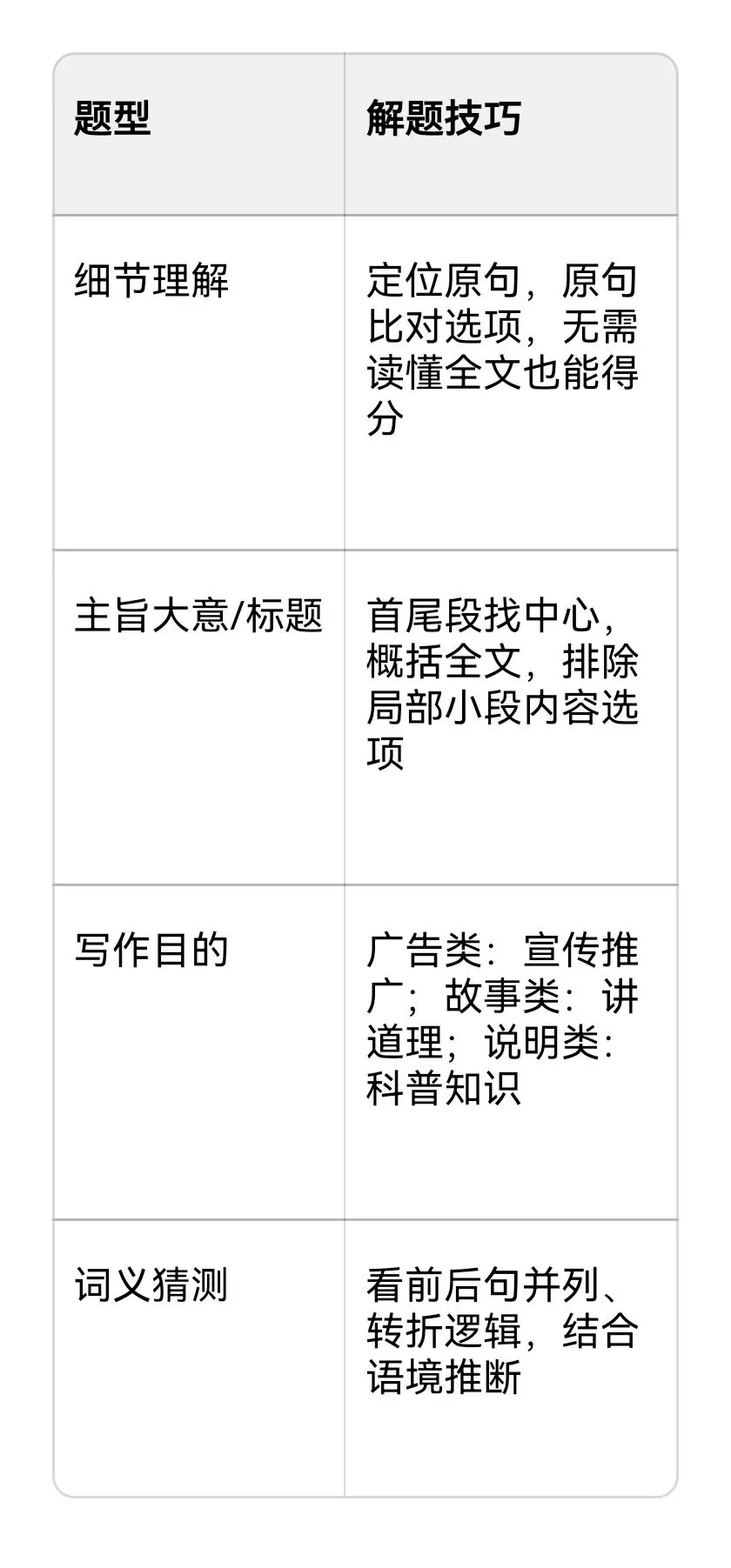
题型 解题技巧
细节理解 定位原句,原句比对选项,无需读懂全文也能得分
主旨大意/标题 首尾段找中心,概括全文,排除局部小段内容选项
写作目的 广告类:宣传推广;故事类:讲道理;说明类:科普知识
词义猜测 看前后句并列、转折逻辑,结合语境推断。
第四步:不确定题目二次回查,不要凭第一感觉乱蒙。
纠结两个选项时,不要凭直觉选,重新回到定位段落,找出能支撑选项的原句,没有原文依据果断排除,避免粗心丢分。
四、日常2个积累习惯,从根源减少读不懂
1. 优先积累阅读高频词,拒绝死啃整本单词表。
把做过试卷阅读里反复出现的词标注摘抄,早晚花5分钟翻看记忆,不用花费大量时间默写全部单词。
2. 拆解长难句,告别“单词都认识,句子读不通”。
先找主语+谓语动词抓住句子主干,剩余修饰内容顺读理解,每天拆解2道真题里的长句子,坚持一周,复杂句式理解能力明显提升。
五、错题复盘:提分最快的一步,很多同学忽略
做完阅读不是对完答案就结束,复盘才能避免同类题反复踩坑:
1. 每道错题标注错误原因,三选一归类:
① 生词不认识,看不懂句意 ② 定位错误,找错原文段落 ③ 主观脑补,脱离原文选答案
2. 把正确答案对应的原文原句划线摘抄,标注错误选项错在哪里;
3. 每周翻一遍错题,重做一次,保证同类题型二次作答完全正确。
💡 最后想说:英语阅读理解没有捷径,也不需要题海战术,做一篇吃透一篇,坚持两三周你会明显发现,纠结的选项变少,读文速度变快,原本的拉分项,慢慢变成稳定拿分的强项。

关注我 与您分享更多精彩
我是小龙妈,一个教育界的医生,一个男孩的妈妈。深耕育儿领域十余年,考取了家庭教育指导师,正面管教双讲师,心理咨询师,绘本阅读指导师,个人成长教练。我能帮你解决育儿难题、分析儿童天赋、个人成长规划、心理咨询、健康指导等。有需求的请加我私信a2461675832交流。
七年级下册人教版语文第一课《邓稼先》预习日记|用小关卡解锁知识晶体
【预习日记】七下人教版语文第二课《说和做》:从“何妨一下楼”到“口的巨人”,我这样拆解闻一多的双面人生
【考点清单】人教版七下语文第2课《说和做——记闻一多先生言行片段》考点清单+考题
【预习日记】七下人教版语文第三课《列夫·托尔斯泰》:从“平庸外貌”到“灵魂巨人”,我这样拆解茨威格的欲扬先抑
【考点清单】人教版七下语文第3课《列夫·托尔斯泰》(茨威格)考点清单+中考真题
【预习日记】人教版七下道德与法治第一单元第一课《青春正当时》
【预习日记】 冀教版七下数学|6.1 二元一次方程组:从“鸡兔同笼”到双变量思维
核心知识点&易错点清单|冀教版七下数学 6.1 二元一次方程组 (附练习题和答案)
【预习日记】七下人教版英语Unit 1《Animal Friends》Section A
【预习知识清单】人教版七下英语 Unit Animal Friends Section A
【预习日记】冀教版七下数学|解锁二元一次方程组的“消元魔法”
核心知识点&易错点清单| 冀教版七下数学 6.2 二元一次方程组的解法(附练习题和答案)
预习日记|七下人教版历史第6课:隋唐时期的中外文化交流——开放盛世的世界对话
预习日记|第16课《有为有不为》:解锁季羡林先生的“是非题”密码


