

第一部分:显性因果逻辑 (Explicit Causal Logic)
这类题目考查学生识别文中显性的逻辑标志,原文中往往带有明确的to do(表目的)、so that、because、making..(表结果)或aims to等结构。
1. 2022年乙卷阅读理解B篇
·原文线索:In 1916, two girls of wealthy families... traveled to a settlement in the Rocky Mountains to teach in a one-room schoolhouse... Why did they go then? Well, they wanted to do something useful.
·题目:24. Why did Dorothy and Rosamond go to the Rocky Mountains?
·A. To teach in a school. B. To study American history. C. To write a book. D. To do sightseeing.
·正答:A
·解读和解析:这道题相对简单,考查显性因果逻辑。正如您指出的,第一段中“to teach”这一不定式结构已经明确表述了她们前往落基山脉的目的,直接对应选项A。
2. 2022年全国I卷阅读理解D篇
·原文线索:They discovered that the upper and lower front teeth of ancient human adults were aligned, making it hard to produce labiodentals, which are formed by touching the lower lip to the upper teeth.
·题目:33. Why was it difficult for ancient human adults to produce labiodentals?
·A. They had fewer upper teeth than lower teeth. B. They could not open and close their lips easily.
· C. Their jaws were not conveniently structured. D. Their lower front teeth were not large enough.
·正答:C
·解读和解析:这道题考查显性因果逻辑。原文使用了明确的“making...分词结构来表达结果。题目针对结果(hard to produce)进行提问,学生只需利用显性的“making”结构寻找其主句内容(上下前牙是对齐的,即颌骨结构不便),即可得出答案C。
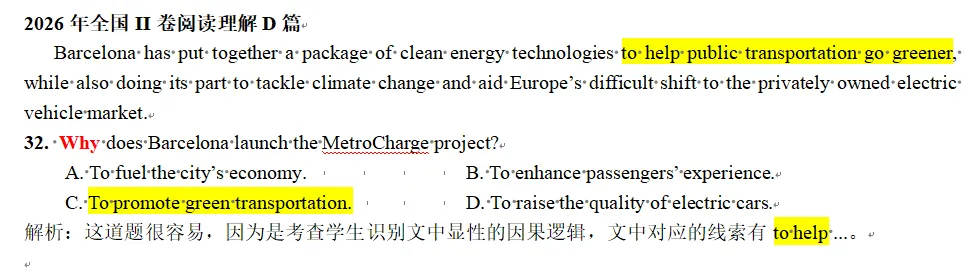
3. 2026年全国II卷阅读理解D篇
·原文线索:Barcelona has put together a package of clean energy technologies to help public transportation go greener, while also doing its part to tackle climate change and aid Europe’s difficult shift to the privately owned electric vehicle market.
·题目:32. Why does Barcelona launch the MetroCharge project?
·A. To fuel the city’s economy. B. To enhance passengers’ experience.
·C. To promote green transportation. D. To raise the quality of electric cars.
·正答:C
·解读和解析:这道题很容易,因为考查的是学生识别文中显性的因果逻辑。原文直接使用了“to help” 这一典型的不定式结构来表达目的,答案C(To promote green transportation)是线索句的同义替换。
4. 2026年1月浙江卷阅读理解B篇
·原文线索:If we’re covering friction, for example, I bring different tires into my classroom so that my students can conduct lab experiments with them to see how friction works in real-life applications.
·题目:25. Why does the author bring tires into the classroom?
·A. To teach an engineering skill. B. To explain the structure of a car.
·C. To share a real-life experience. D. To illustrate a scientific concept.
·正答:D
·解读和解析:这道题比较简单,考查显性因果逻辑。原文既使用了“so that”引导目的状语从句,又在从句中补充了“to see”,有着非常明显的表目的结构。
5. 2026年1月浙江卷阅读理解D篇
·原文线索:Created by Salk Fellow Talmo Pereira, SLEAP was initially designed to track animal movement in the lab.
·题目:33. Why did Pereira create SLEAP?
·A. To generate plant images. B. To conduct research on animals.
·C. To study climate patterns. D. To track features of root growth.
·正答:B
·解读和解析:这道题容易,考查显性因果逻辑。文中“designed to track”直接交代了被设计创造的初衷,明确揭示了原因。
6. 2025年全国I卷阅读理解B篇
·原文线索:Then I realized that the problem was the question itself. They could have written pages on the necessity of computers, but writing, in and of itself, simply didn’t strike them as important.
·题目:25. Why did the students perform poorly in writing their first essay?
·A. They were not given enough time. B. They had a very limited vocabulary.
·C. They misunderstood the question. D. They had little interest in the topic.
·正答:D
·解读和解析:考查显性因果逻辑。原文使用了直接指出病因的固定句式“the problem was”,紧接着给出了具体原因(写作本身对他们来说不重要),直接对应选项D。
7. 2025年全国二卷阅读理解D篇
·原文线索:For two weeks in March, Greenwich Village's Blue Hill restaurant was renamed wastED, and served items like fried skate cartilage, a juice pulp burger, and a dumpster diver's vegetable salad. Each dish was tailor-made to raise awareness regarding food waste.
·题目:33. Why did Blue Hill carry out the experiment?
·A. To customize dishes for guests. B. To make the public aware of food waste.
·C. To test a food processing method. D. To improve the UK's zero-waste systems.
·正答:B
·解读和解析:容易题,考查显性因果逻辑。原文直接使用“tailor-made to”结构说明了开展这项实验的目的,选项B是极度贴合的同义替换。
8. 2025年1月浙江卷阅读理解C篇
·原文线索:The concept was born when German city planners sought to plant large areas of parkland after World War II in a reproducible way that would need minimal maintenance.
·题目:29. Why was the idea of matrix planting introduced?
·A. To control weeds in large gardens. B. To bring in foreign species of plants.
·C. To conserve soil and water resources. D. To develop low-maintenance parkland.
·正答:D
·解读和解析:考查显性因果逻辑。原文使用动词短语“sought to (寻求/试图去)”显性引导了引入该理念的初衷。
9. 2024年全国甲卷阅读理解D篇
·原文线索:That’s why this issue of Writer’s Digest aims to help you figure out how to write the best ending for whatever kind of writing you’re doing.
·题目:15. Why does the author mention Peter Mountford and Elizabeth Sims?
·A. To give examples of great novelists. B. To stress the theme of this issue.
·C. To encourage writing for the magazine. D. To recommend their new books.
·正答:B
·解读和解析:这道题比较简单。文章不仅使用了“That's why”,而且在说明目的时使用了“aims to help”,属于双重显性因果逻辑标志。
10. 2024年新课标I卷阅读理解C篇
·原文线索:Audio and video can feel more engaging than text, and so university teachers increasingly turn to these technologies...
·题目:30. Why are audio and video increasingly used by university teachers?
·A. They can hold students' attention. B. They are more convenient to prepare.
·C. They help develop advanced skills. D. They are more informative than text.
·正答:A
·解读和解析:考查显性因果逻辑。原文中“and so”是非常直接的结果连词,由果溯因,其前面的“more engaging”完美对应选项A。
11. 2022年乙卷阅读理解D篇
·原文线索:First announced in April, 2016, the tax which applies to soft drinks containing more than 5g of sugar per 100ml, was introduced to help reduce childhood obesity.
·题目:32. Why was the sugar tax introduced?
·A. To collect money for schools. B. To improve the quality of drinks.
·C. To protect children's health. D. To encourage research in education.
·正答:C
·解读和解析:容易题。原文中有极其明确的“was introduced to help...” (引入是为了帮助...) 不定式表目的结构。
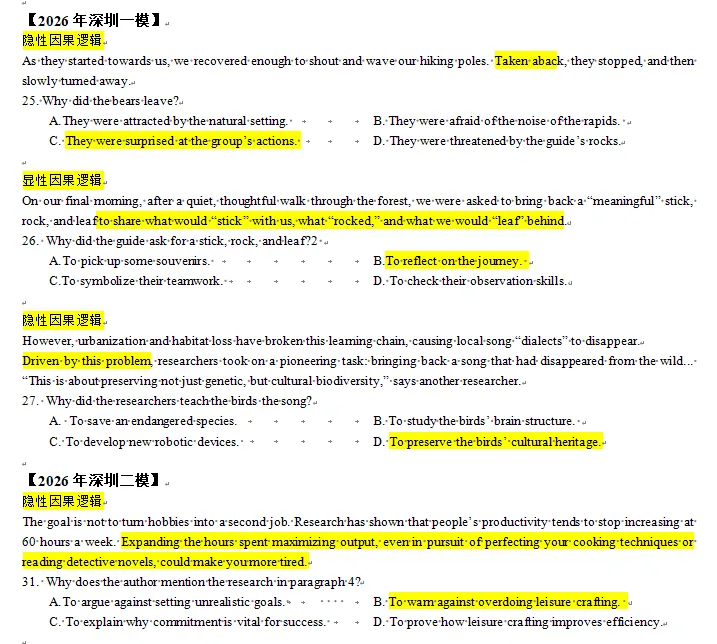
第二部分:隐性因果逻辑 (Implicit Causal Logic)
这类题目原文中没有直接的表因果/目的/结果的连词或结构,必须依靠上下文语境、动作行为内涵、代词指代、或语篇的论证关系来推导。
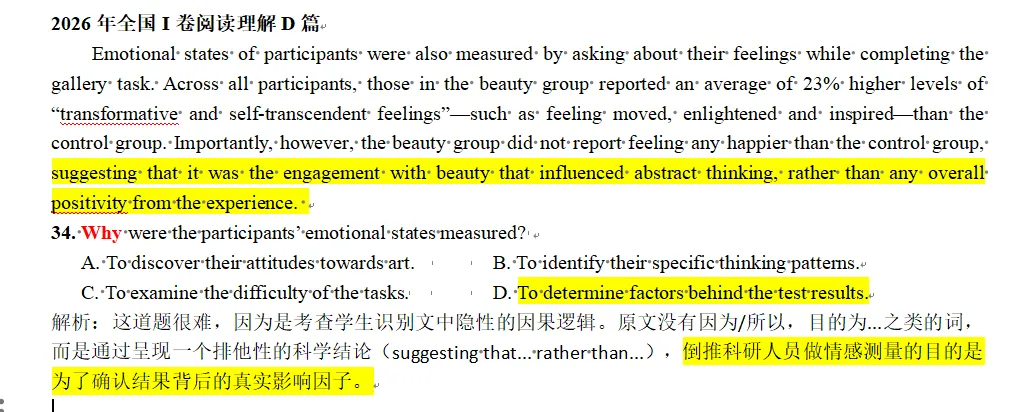
12. 2026年全国I卷阅读理解D篇
·原文线索:Importantly, however, the beauty group did not report feeling any happier than the control group, suggesting that it was the engagement with beauty that influenced abstract thinking, rather than any overall positivity from the experience.
·题目:34. Why were the participants’ emotional states measured?
·A. To discover their attitudes towards art. B. To identify their specific thinking patterns.
·C. To examine the difficulty of the tasks. D. To determine factors behind the test results.
·正答:D
·解读和解析:这道题很难,考查识别隐性的因果逻辑。原文没有明确说“to determine”,而是通过呈现一个排他性的科学结论(suggesting that... rather than...),需要学生倒推科研人员做测量的目的是为了确认结果背后的真实影响因子。
13. 2025年1月浙江卷阅读理解D篇
·原文线索:Martin’s study also found that creating a genderless object was difficult. For instance, if an object’s name was meant to sound genderless, like Miuu, participants would still assign a gender to it — they would assume Miuu was a "he" or "she".
·题目:34. Why is it difficult to create genderless objects?
·A. They cannot be mass-produced. B. Naming them is a challenging task.
·C. People assume they are unreliable. D. Gender is rooted in people’s mind.
·正答:D
·解读和解析:较难的隐性因果题。原文仅仅陈述了人们会不由自主给无性别物品分配性别这一“现象”(participants would still assign a gender to it),要求学生从现象的描述中,跨越文本字面,推理出本质原因在于“人的内在认知定势”。
14. 2024年新课标I卷阅读理解B篇
·原文线索:He tried muscle-relaxing drugs but found little relief. Then he tried acupuncture, an ancient Chinese practice, and was amazed that he improved after two or three treatments. What worked on a veterinarian seemed likely to work on his patients.
·题目:25. Why did Farber decide to try acupuncture on pets?
·A. He was trained in it at university. B. He was inspired by another veterinarian.
·C. He benefited from it as a patient. D. He wanted to save money for pet owners.
·正答:C
·解读和解析:隐性因果逻辑。因果关系潜藏在事情发展的先后顺序与人物的经验推导中(What worked on a veterinarian seemed likely to work on his patients)。
15. 2024年新课标I卷阅读理解B篇
·原文线索:Farber is certain that the holistic approach will grow more popular with time, and if the past is any indication, he may be right: Since 1982, membership in the American Holistic Veterinary Medical Association has grown from 30 to over 700.
·题目:27. Why does the author mention the American Holistic Veterinary Medical Association?
·A. To prove Farber’s point. B. To emphasize its importance.
·C. To praise veterinarians. D. To advocate animal protection.
·正答:A
·解读和解析:这是一道典型的通过“语篇结构(论点-论据)”来考查的隐性因果逻辑。举例的原因从来不在例子本身,而在其前面的核心论点。
16. 2024年新课标II卷阅读理解B篇
·原文线索:Do you ever get to the train station and realize you forgot to bring something to read? Yes, we all have our phones, but many of us still like to go old school and read something printed. Well, there’s a kiosk for that.
·题目:4. Why did BART start the kiosk program?
·A. To promote the local culture. B. To discourage phone use.
·C. To meet passengers’ needs. D. To reduce its running costs.
·正答:C
·解读和解析:隐性因果线索藏在代词短语“for that”之中。前文先抛出了旅客的需求,然后用“there is a kiosk for that”收尾。理解代词回指的上文需求,才是解开因果的钥匙。
17. 2024年全国甲卷阅读理解D篇
·原文线索:“I didn’t like the ending,” I said to my favorite college professor. ... I had just finished reading The Mill on the Floss by George Eliot, and I was heartbroken with the ending. Prof. Gracie, with all his patience, asked me to think about it beyond whether I liked it or not.
·题目:12. Why did the author go to Prof. Gracie?
·A. To discuss a novel. B. To submit a book report.
·C. To argue for a writer. D. To ask for a reading list.
·正答:A
·解读和解析:考查语境隐性因果。文中没有说明去找教授的目的,而是直接呈现了和教授讨论小说结局的客观场景,需要学生根据场景对人物动机进行推导。
18. 2023年新课标I卷阅读理解B篇
·原文线索:The task John set for himself was to remove harmful substances from some sludge. First, he constructed a series of clear fiberglass tanks connected to each other... After a few weeks, John added the sludge. He was amazed at the results.
·题目:25. Why did John put the sludge into the tanks?
·A. To feed the animals. B. To build an ecosystem. C. To protect the plants. D. To test the eco-machine.
·正答:D
·解读和解析:这道题很难,考查实验设计的隐性因果。向缸里加入污泥(added the sludge)这一具体动作本身没有紧跟 to do 结构,而是为了验证第一句话定下的宏观任务(The task... was to remove...)。需要学生在段落间建立动作与实验目标的闭环联系。
19. 2023年新课标II卷阅读理解D篇
·原文线索:The researchers then examined these submissions, coding experiences into different categories... Across the 320 submissions, a pattern of categories the researchers call a “nature language” began to emerge.
·题目:33. Why did the researchers code participant submissions into categories?
·A. To compare different types of park-goers. B. To explain why the park attracts tourists.
·C. To analyze the main features of the park. D. To find patterns in the visitors’ summaries.
·正答:D
·解读和解析:考查行为动机维度的隐性因果。没有显性连词,依据科研类文章的逻辑:“动作A”(coding)导致了“现象B”(a pattern began to emerge),那么做动作A的原因就是为了得出B。
20. 2023年全国甲卷阅读理解B篇
·原文线索:From the age of six, Terri, now 26, accompanied Derek to work during her school holidays. A day’s work was rewarded with £5 in pocket money.24
·题目:25. Why did Terri’s grandfather give her £5 a day?
·A. For a birthday gift. B. As a treat for her work. C. To support her DIY projects. D. To encourage her to take up a hobby.
·正答:B
·解读和解析:考查“词汇内隐因果”。因果逻辑被直接打包在动词 "rewarded"(作为对……的奖赏)中,不再使用显性的句法结构。
21. 2023年全国甲卷阅读理解C篇
·原文线索:Weiner starts each chapter with a scene on a train ride between cities and then frames each philosopher’s work in the context of one thing they can help us do better.
·题目:29. Why does the author list great philosophers in paragraph 4?
·A. To compare Weiner with them. B. To give examples of great works.
·C. To praise their writing skills. D. To help readers understand Weiner’s book.
·正答:D
·解读和解析:修辞目的隐性逻辑考查。没有明显的显性线索,学生必须理解局部行为(列举哲学家)和段落核心句(help us do better)之间的服务关系。
22. 2022年全国II卷阅读理解B篇
·原文线索:His father frequently amused the boy with a tablet computer which was loaded with colorful pictures that come alive when you poke them. He thought my storybook was like that.
·题目:25. Why did the kid poke the storybook?
·A. He took it for a tablet computer. B. He disliked the colorful pictures.
·C. He was angry with his grandpa. D. He wanted to read it by himself.
·正答:A
·解读和解析:考查隐性因果逻辑。完全脱离表因果的句法结构,仅仅是对人物产生错误认知的描述(“He thought...”),要求学生依靠上下文语境推理动作背后的心理动机。


