


---2026高考一卷答案解析(供参考)---
第一部分听力
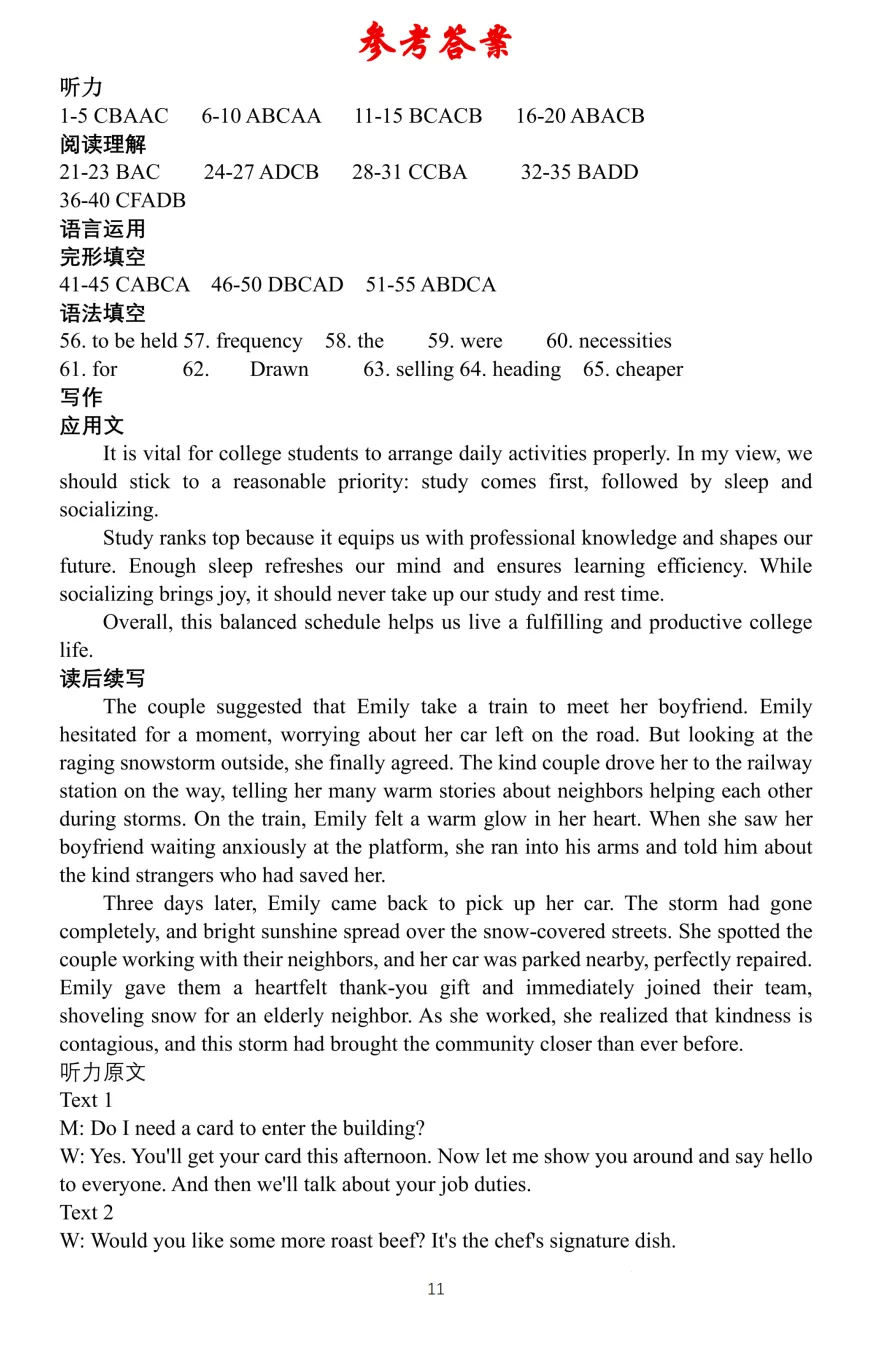
1-5 CBAAC 6-10 ABCAC
11-15 BCACB 16-20 ABACB
第二部分阅读
第一节
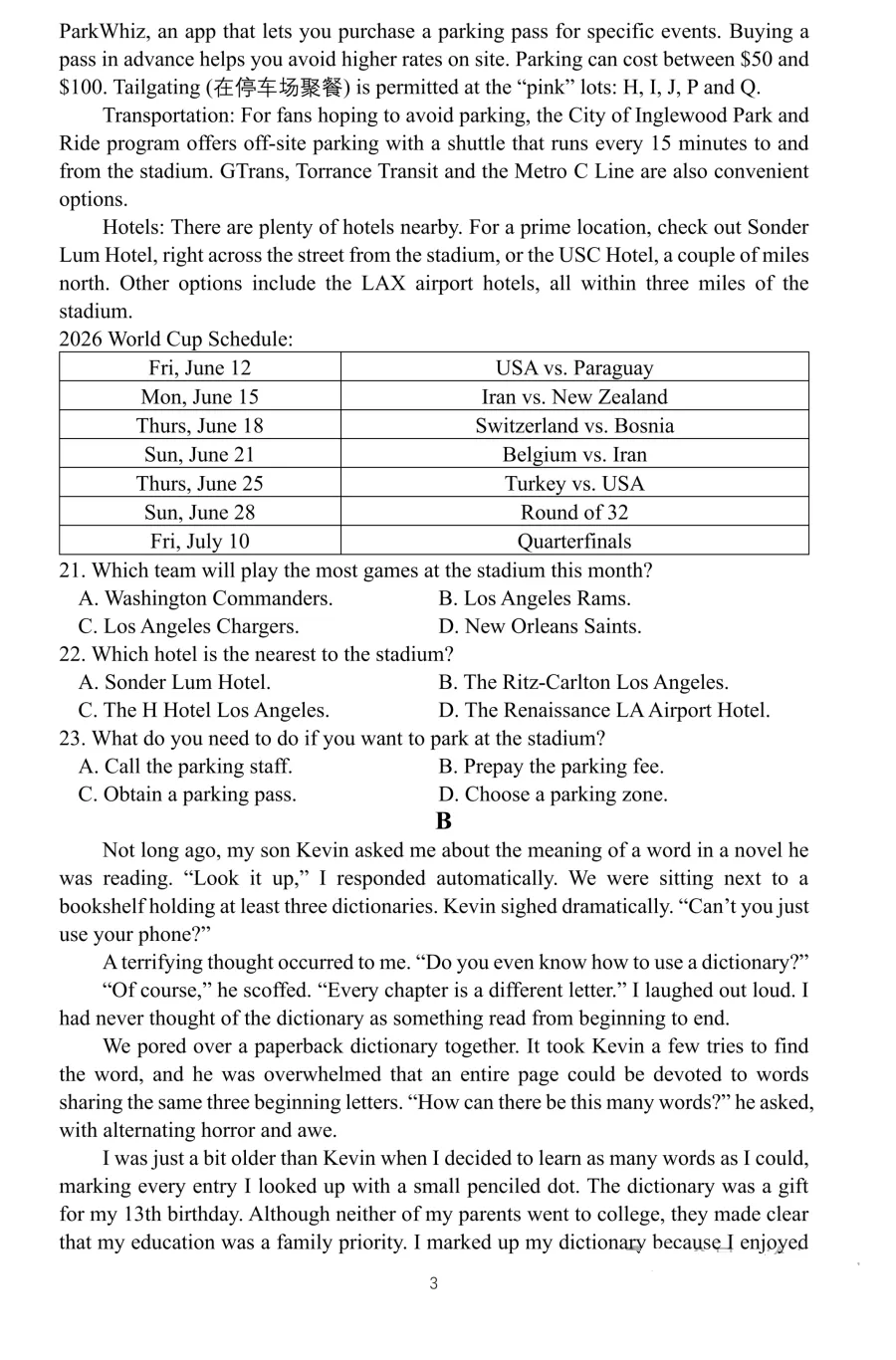
A篇:SoFi Stadium Events This Month
21.B.Los Angeles Rams.
解析:根据Upcoming Football Events表格,Los Angeles Rams出现在8月9日、8月16日和8月24日三场比赛中;Los Angeles Chargers出现在8月10日和8月16日两场比赛中。因此Rams本月比赛场次最多。
22.A.Sonder Lüm Hotel.
解析:文中明确提到"Right across the street, Sonder Lüm Hotel offers spacious rooms and a rooftop pool."(就在街对面),其他酒店分别描述为"a mile away"(一英里外)、"a short drive away"(短途车程)和"drive a little further"(再开远一点)。因此Sonder Lüm Hotel最近。
23.C.Obtain a parking pass.
解析:Parking部分指出"Make sure to download your parking pass to your smartphone before arrival"(确保在到达前将停车证下载到智能手机),且前文提到"guests must enter through the exact gate indicated on their color-coded digital parking pass"。因此停车需要获取停车证。
B篇:关于字典与学习的记叙文
24.A.Use electronic devices.
解析:第一段中Kevin说"But my screen time is off"(但我的屏幕时间用完了),并问"Can't you just use your phone?",说明他习惯用电子设备查词。
25.D.Astonished.
解析:第二段描述Kevin翻字典时"wide-eyed"(睁大眼睛)并惊叹"How can there be this many words?",表现出惊讶而非恼怒、失望或受鼓舞。
26.C.It bore witness to her efforts.
解析:第三段提到作者13岁收到第一本字典后"started marking every entry I looked up with a pencil to measure my progress"(用铅笔标记每个查过的词条以衡量进步),并持续多年。这说明字典见证了她的努力。A项错误,因为字典在大一末被盗,并未帮助她完成大学学业;B项错误,字典是给作者的礼物而非Kevin;D项未提及。
27.B.Motivation is what really matters.
解析:最后一段作者总结"It's not about the words themselves or how we learn them, but the wanting to know them, the curiosity and the appetite."(关键不在于单词本身或学习方式,而在于想知道的渴望、好奇心和求知欲)。这与"motivation"(内驱力)对应。
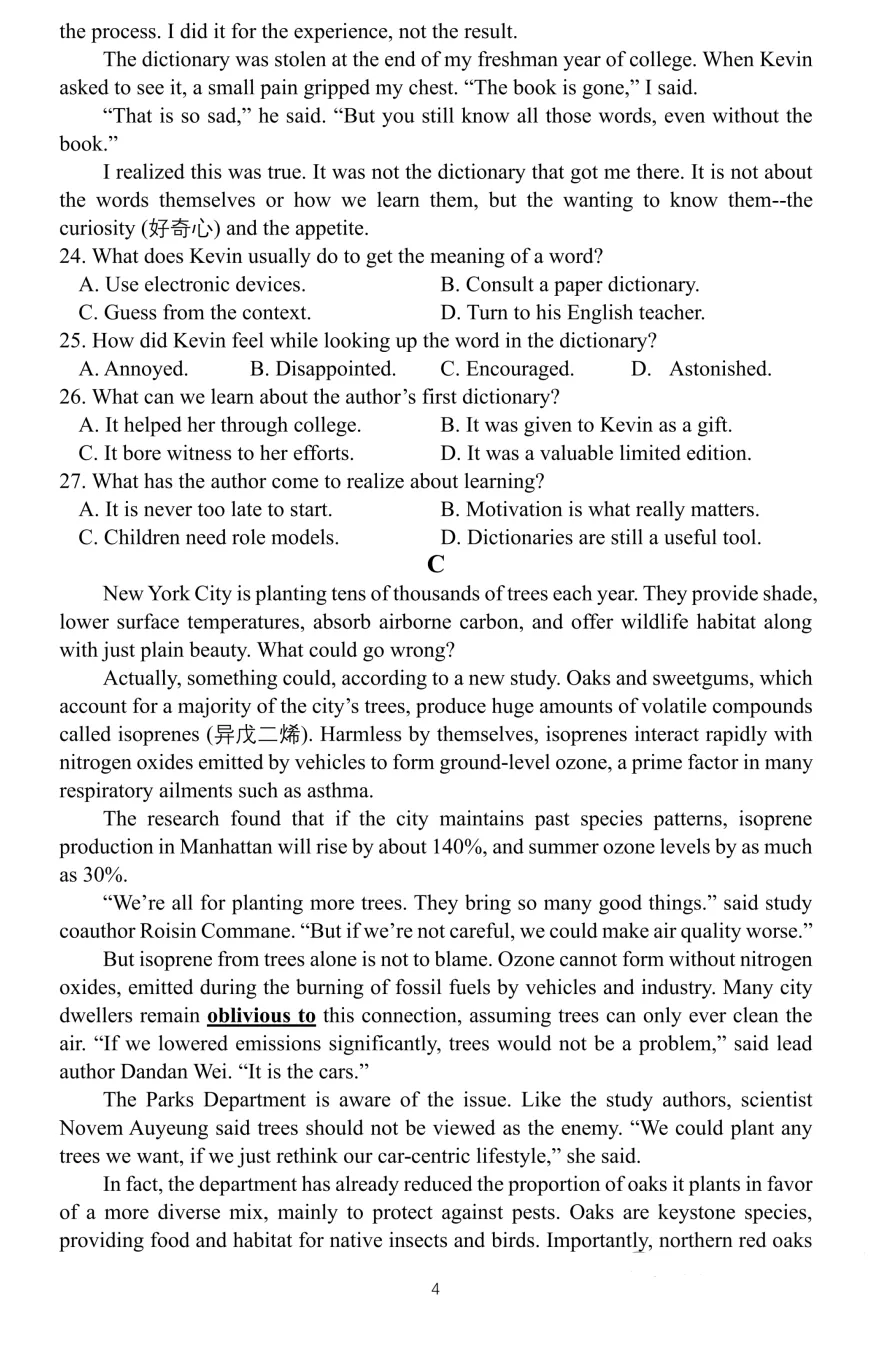
C篇:纽约市植树与异戊二烯排放
28.C.They harm people's health indirectly.
解析:第二段指出橡树和枫香树释放的异戊二烯本身无害,但与车辆、建筑和工业排放的氮氧化物反应后形成地面臭氧——"a major factor in many breathing problems"(许多呼吸问题的主要因素)。因此是间接危害健康。
29.C.Changing the species of trees in new plantings.
解析:第三段研究表明"if the city maintains past species patterns in new plantings"(如果城市在新种植中保持过去的物种模式),异戊二烯产量将大幅增加。言下之意是应改变新种植中的树种。Commane也明确表示"We're all for planting more trees"(支持多种树),但需谨慎,暗示不是停止种树或砍伐现有树木,而是调整物种选择。
30.B.Unaware of.
解析:第五段后文提到公园部门的研究人员"several years ago concluded that city trees did release isoprene"(几年前就得出城市树木确实释放异戊二烯的结论),说明他们"并非不了解"这个问题。"oblivious to"意为"对…… unaware/不知道"。
31.A.Reducing car use in daily life.
解析:Auyeung说"We could plant any trees we want to, if we just rethink our car-centric lifestyle"(只要重新思考以汽车为中心的生活方式,我们就可以种任何想种的树)。这暗示她倡导减少日常用车。
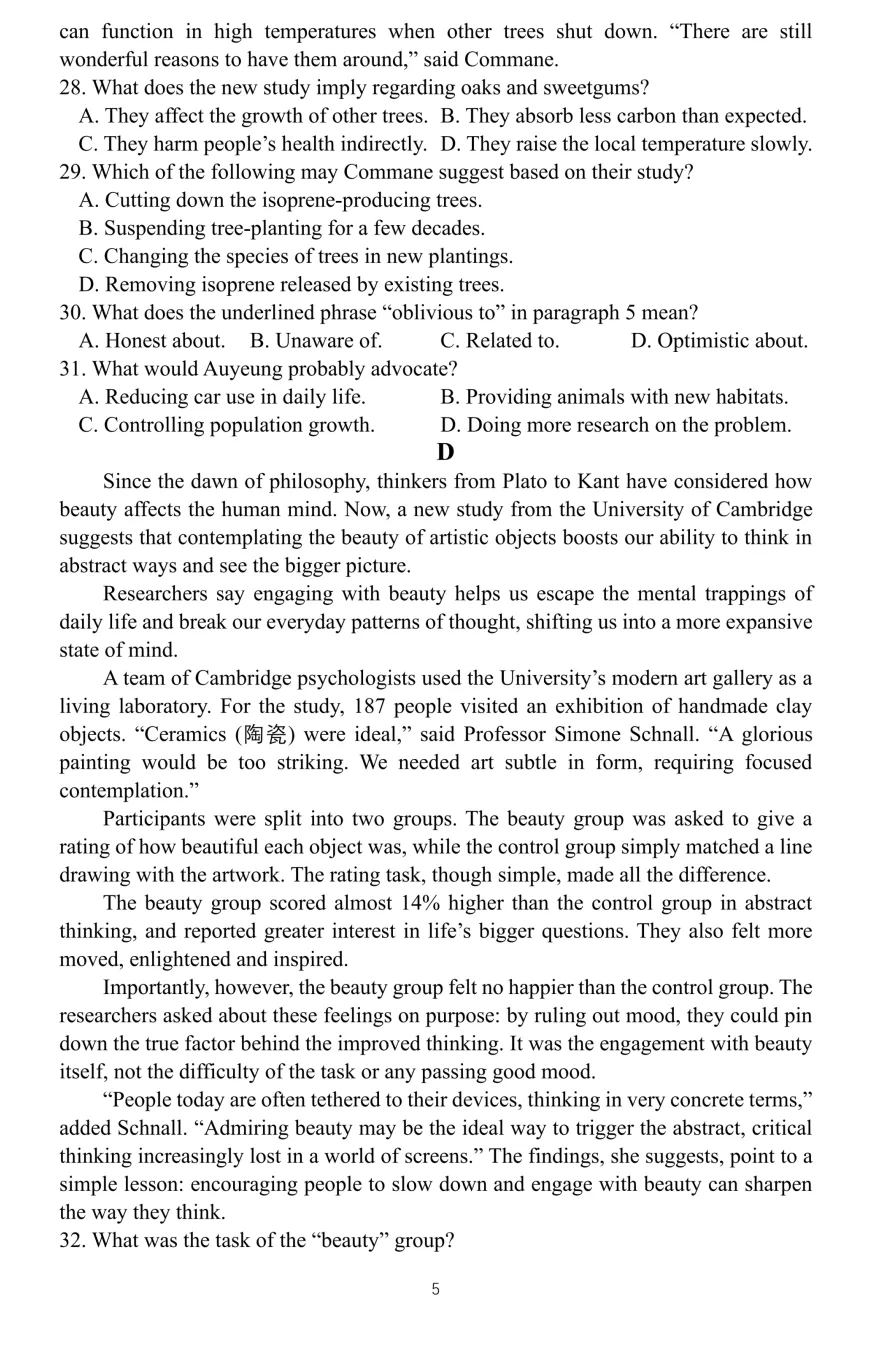
D篇:艺术欣赏与抽象思维
32.B.Give each piece a rating.
解析:第二段明确说明"the 'beauty' group was asked to actively consider and then rate the beauty of each object they viewed"("美感"组被要求积极思考并给每件物品的美感打分)。
33.A.Beauty group, with an artistic hobby.
解析:第三段指出美感组整体比对照组抽象思维得分高14%;"Among those, the effect was greater: those with an artistic hobby in the beauty group scored over 25% higher"(其中有艺术爱好的人效果更显著:美感组中有艺术爱好者比对照组有艺术爱好者平均分高出25%以上)。因此得分最高的是有艺术爱好的美感组成员。
34.D.To determine factors behind the test results.
解析:第四段测量情绪状态后发现美感组有更高的"transformative and self-transcendent feelings",但"did not report feeling any happier",由此得出"it was the engagement with beauty that influenced abstract thinking, rather than any overall positivity"(是对美的投入影响了抽象思维,而非整体的积极情绪)。这说明测量情绪是为了确定测试结果背后的因素。
35.D.It encourages abstract thinking.
解析:全文核心发现是主动欣赏美(给艺术品打分)能显著提升抽象思维能力,且最后一段总结"Admiring the beauty of art may be the ideal way to initiate the abstract cognitive processes."(欣赏艺术之美可能是启动抽象认知过程的理想方式)。
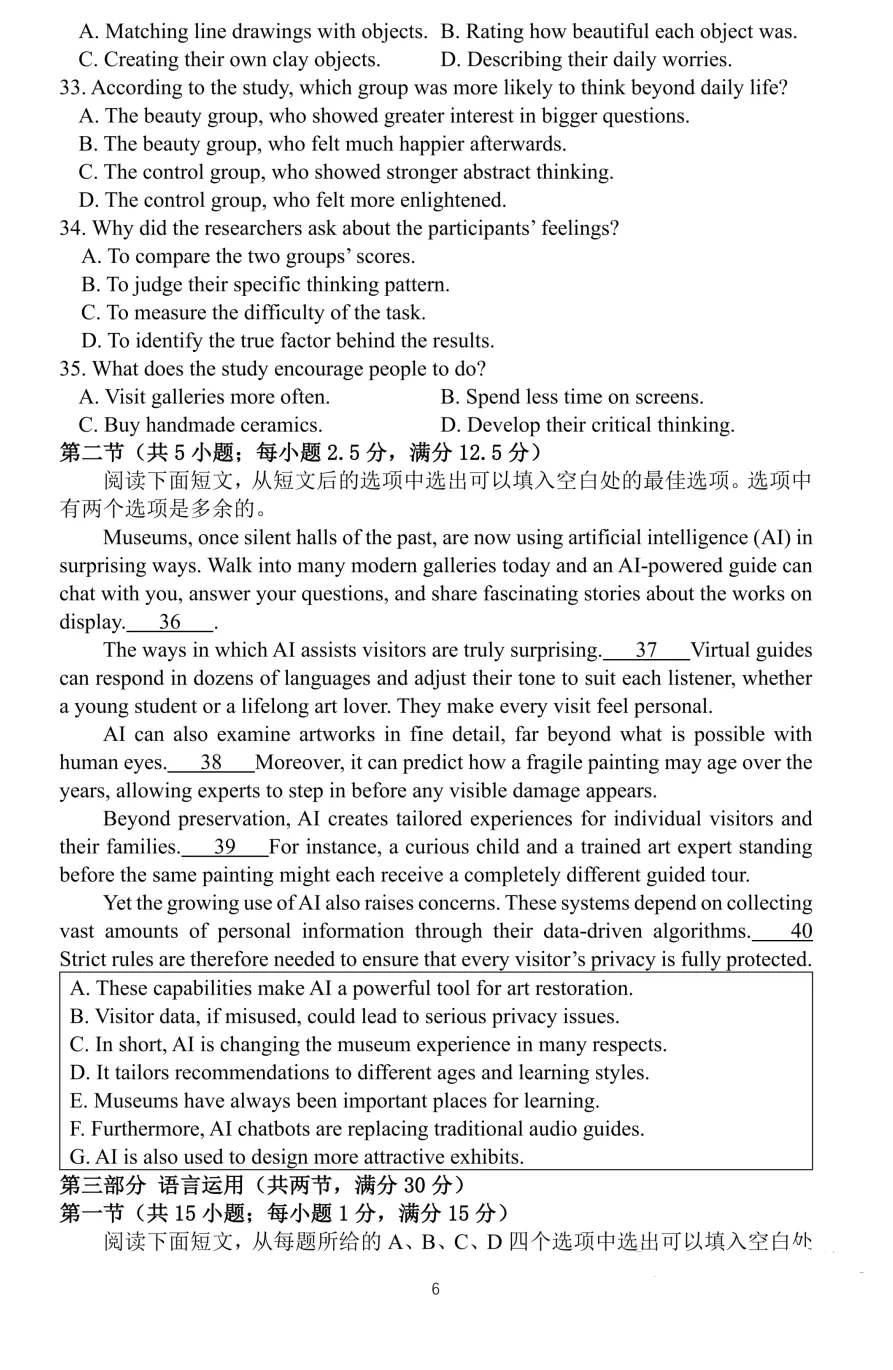
第二节(七选五)
36.C.In short, AI is redefining the museum in all respects.
解析:第一段总起,后文分述AI在个性化体验、文物保护、教育价值等方面的作用。C项"总之,AI正在全方位重新定义博物馆"承上启下,概括全文主旨。
37.F.Furthermore, AI-powered virtual guides are replacing traditional tour guides.
解析:后文"These digital assistants"(这些数字助手)指代F项中的"AI-powered virtual guides"(AI虚拟导游),且F项与前文"Smart recommendation engines"(智能推荐引擎)并列,同属AI提升参观体验的方式。
38.A.This capability allows for timely restoration.
解析:前文讲AI能识别人眼看不见的细微破损迹象(裂缝、变色),A项"这种能力使得及时修复成为可能"顺承前文,且与后文"predicting future decay patterns...take preventive measures"(预测未来破损模式……采取预防措施)构成递进。
39.D.It tailors learning experiences to different age groups and learning styles.
解析:本段主题是AI提升博物馆教育价值,后文举例"adjust their content and difficulty level based on the user's preferences and responses"(根据用户偏好和反应调整内容和难度)。D项"为不同年龄组和学习风格定制学习体验"与此呼应。
40.B.Visitor data collection also raises privacy issues.
解析:本段讲伦理挑战,后文"Strict policies should be established to protect visitors' information"(应建立严格政策保护访客信息)说明涉及隐私问题。B项"访客数据收集也引发隐私问题"引出后文。
第三部分语言运用
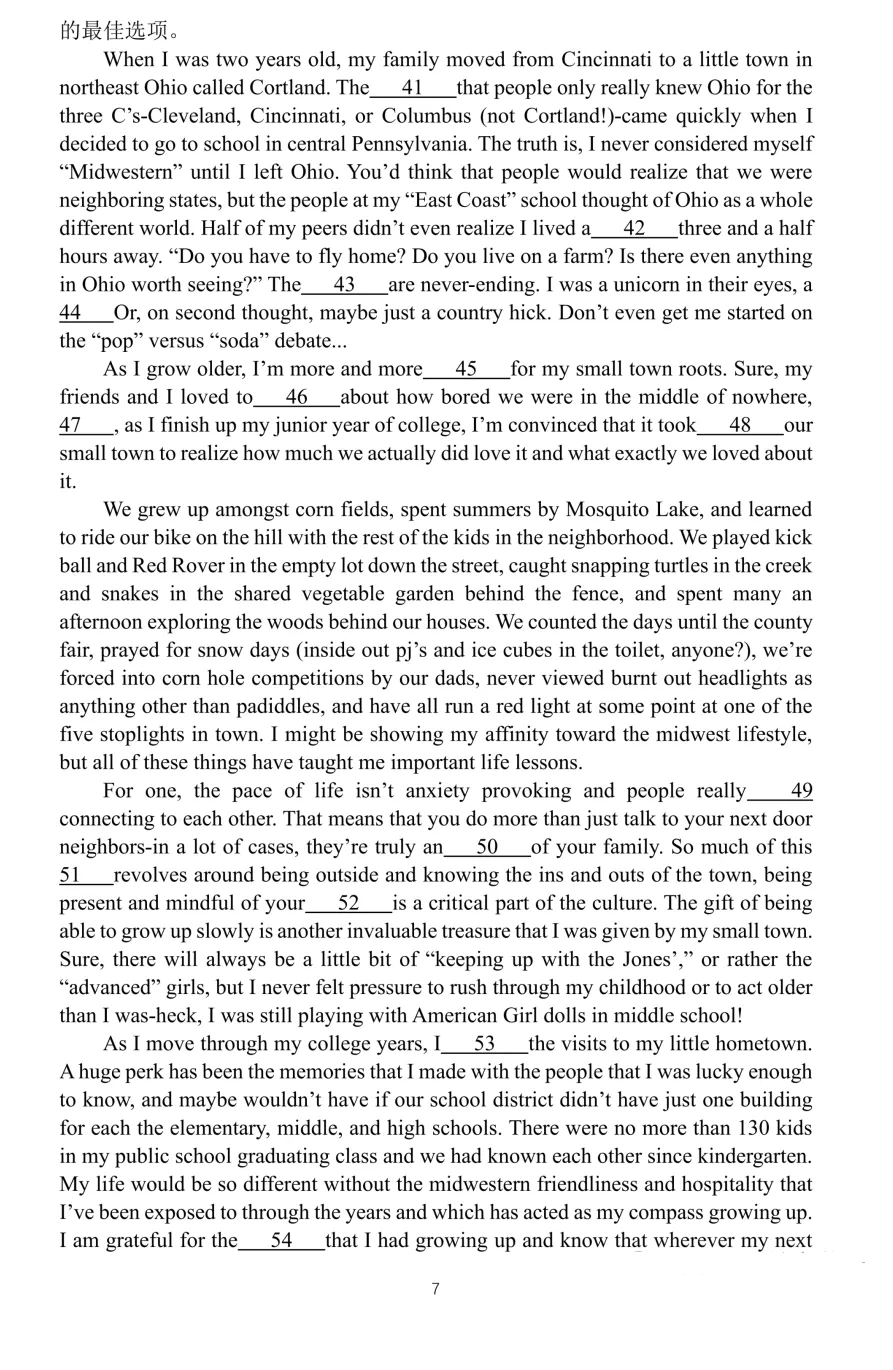
第一节(完形填空)
41.C.realization
解析:后文描述同学们对Ohio的无知让作者很快"意识到"人们对Ohio了解甚少。"the realization of..."(……的认识/意识到)符合语境。
42.A.only
解析:"only three and a half hours away"(只有三个半小时路程),用only强调距离其实很近,与后文同学把Ohio当作"完全不同的世界"形成对比。
43.B.questions
解析:前文列举"Do you have to fly home? Do you live on a farm?"都是同学们提出的问题。
44.C.novelty
解析:在同学们眼中,来自Ohio的作者是个"新奇事物/稀罕物",因为他们对Ohio一无所知。novelty(新奇的人或事物)符合语境。
45.A.thankful
解析:后文描述作者对小镇生活的珍视,"be thankful for"(感激)体现这种情感转变。
46.D.complain
解析:"how bored we were in the middle of nowhere"(在偏远地方有多无聊)是抱怨的内容,"complain about"(抱怨)符合。
47.B.however
解析:前文讲过去抱怨无聊,后文讲现在意识到多么热爱小镇,前后转折。
48.C.leaving
解析:"it took leaving our small town to realize how much we actually love it"(正是离开了小镇才让我们意识到多么热爱它),与作者去宾州上学的经历呼应。
49.A.value
解析:小镇生活节奏慢,人们"重视"彼此的联系。"value connecting to each other"(珍视相互联系)。
50.D.extension
解析:"an extension of your family"(家庭的延伸),指邻居就像家人一样亲近。
51.A.lifestyle
解析:后文描述的是小镇的"生活方式"——在户外、了解小镇的方方面面。
52.B.surroundings
解析:"being present and mindful of your surroundings"(活在当下并留意周围环境),与小镇生活方式中亲近自然、了解环境的特点一致。
53.D.look forward to
解析:随着大学时光流逝,作者越来越"期待"回小镇探亲。
54.C.experience
解析:"the experience that I had growing up"(成长过程中拥有的经历),涵盖前文描述的小镇生活体验。
55.B.trust
解析:"trust my small town roots to lead me in the right direction"(信赖小镇根基指引正确方向),体现对成长经历的珍视和依靠。
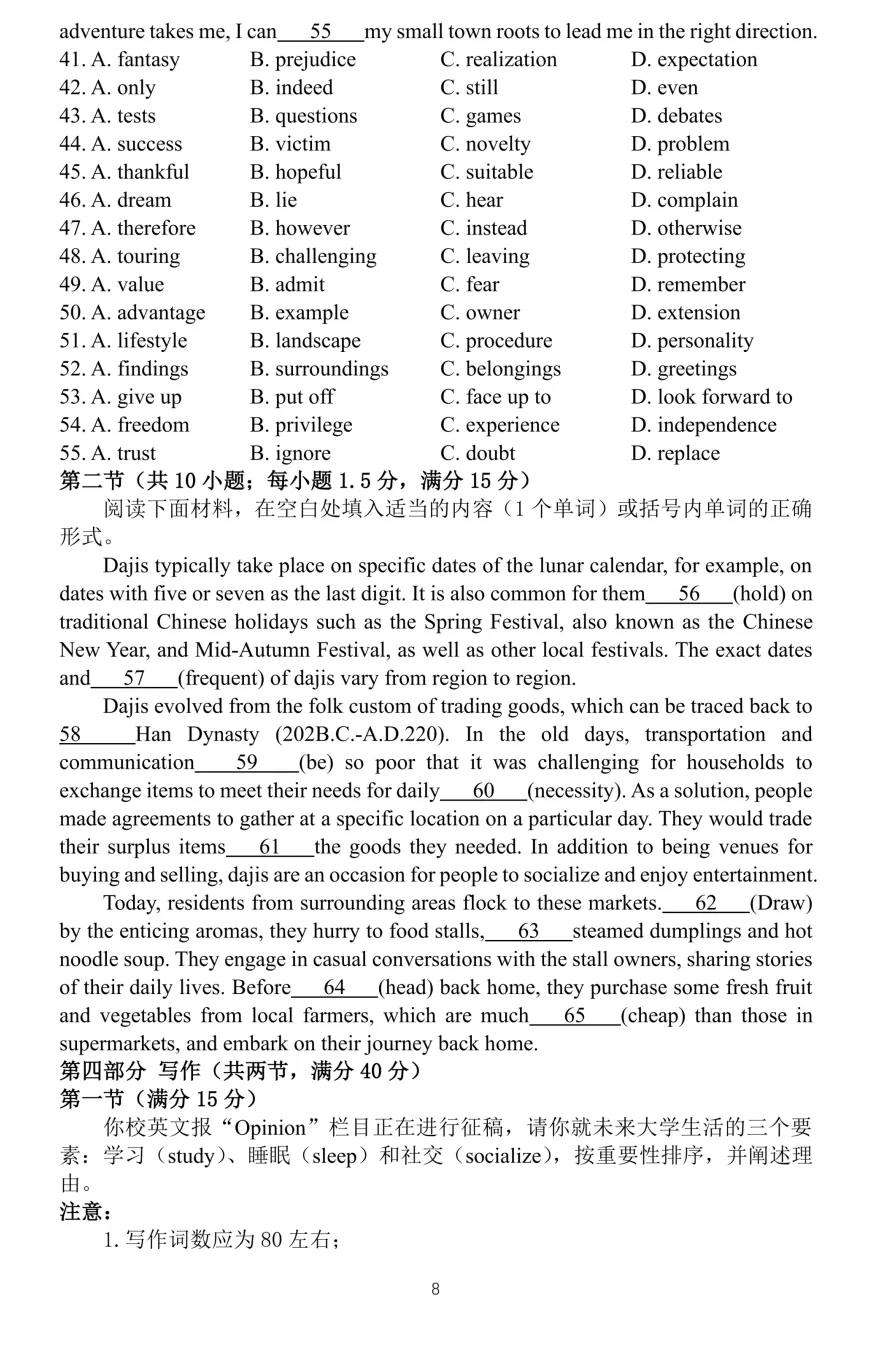
第二节(语法填空)
56.to be held
解析:"It is common for them to be held...",it作形式主语,真正主语是不定式;them指代daji,与hold是被动关系,故用不定式的被动式。
57.frequency
解析:and连接并列成分,与dates对应,需用名词形式frequency(频率)。
58.the
解析:"the Han Dynasty"(汉朝),朝代前加定冠词the。
59.were
解析:主语"transportation and communication"(交通和通信)为复数概念,时间状语"at that time"表明用一般过去时。
60.necessities
解析:daily necessities(日常必需品),necessity作"必需品"讲时常用复数。
61.for
解析:"trade their surplus items for what they needed"(用剩余物品交换所需物品),trade A for B(用A交换B)。
62.Drawn
解析:非谓语动词作状语,they与draw是被动关系(被香味吸引),用过去分词Drawn。
63.that/which
解析:定语从句修饰stands(摊位),关系词在从句中作主语,指物,用that或which。
64.heading
解析:before是介词,后接动名词heading。
65.cheaper
解析:后文有than,用比较级cheaper。
第四部分写作
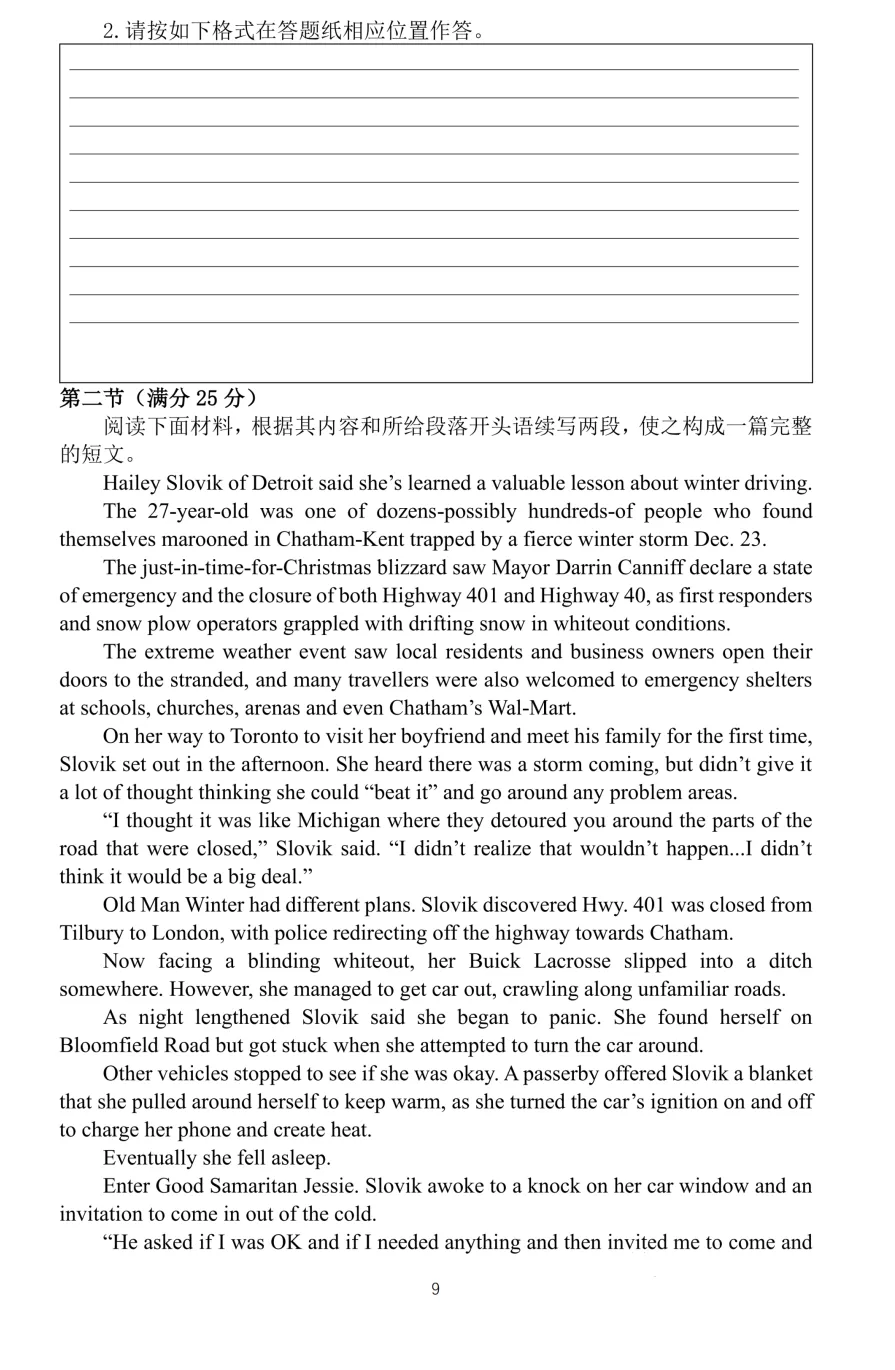
第一节(应用文)
Ranking My College Life Essentials
When it comes to ranking study, socializing, and sleep, I would put sleep first, study second, and socializing third.
Sleep is the foundation of everything.Without adequate rest, neither efficient learning nor enjoyable socializing is possible.A well-rested mind absorbs knowledge faster and maintains emotional stability.
Study ranks second because college is primarily an academic journey.However, studying effectively requires the physical and mental energy that quality sleep provides.
Socializing, while valuable for personal growth and networking, comes third.Meaningful connections can be built gradually, but they should not come at the cost of health or academic goals.
In short, prioritizing sleep ensures we have the capacity to excel in both study and social life.
第二节(读后续写)
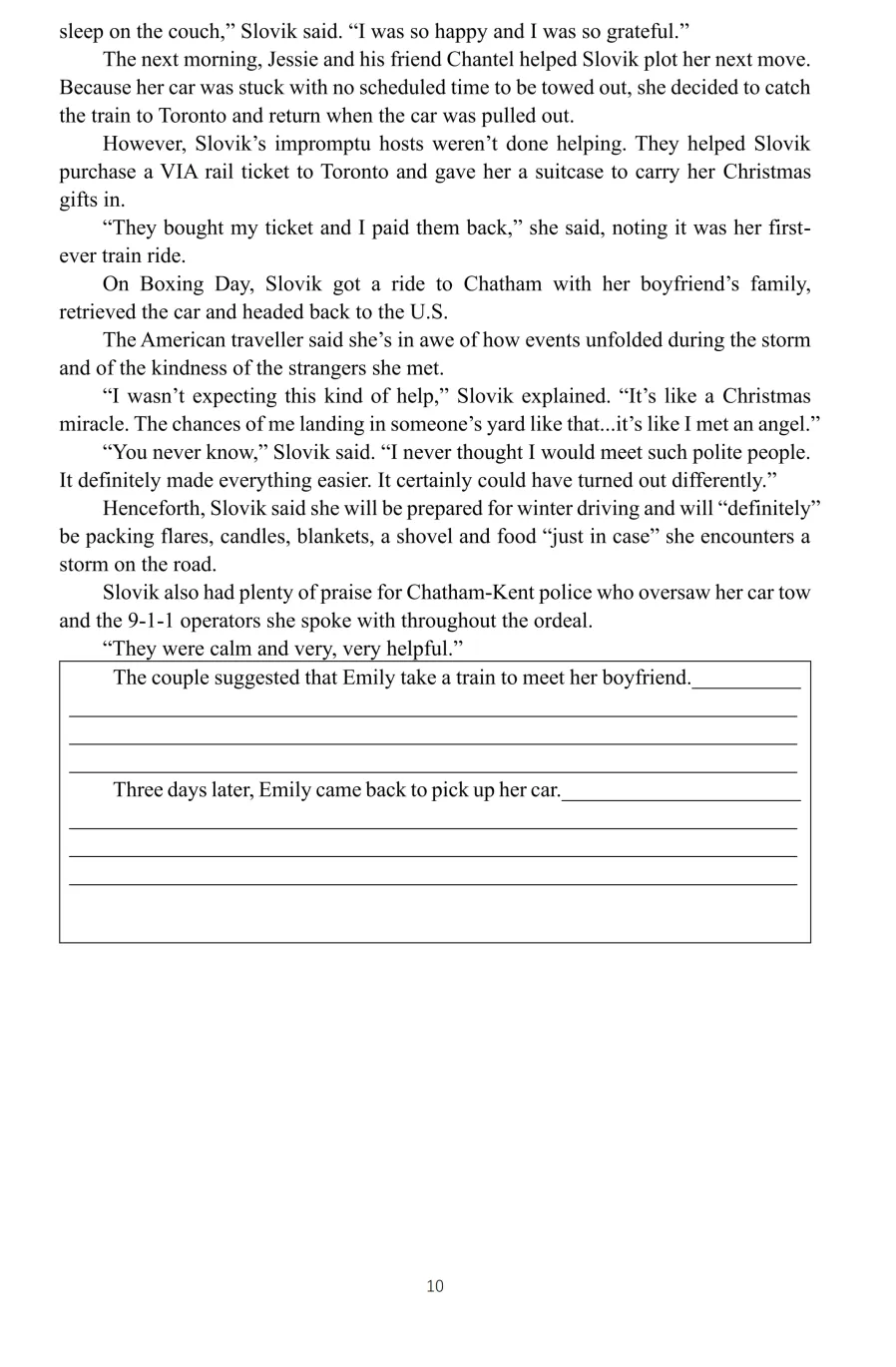
原文情节梳理
Emily 冒雪驾车前往多伦多和男友过圣诞,遭遇暴风雪,车辆滑入沟中被困、手机无信号,被当地夫妇 Daniel 和 Rachel 救下并带到咖啡馆。
续写思路
第一段:夫妇建议坐火车出行,主动帮忙联系车站、查询车次,还帮忙联系拖车处理车辆,Emily 十分感动,顺利搭乘火车前往目的地。
第二段:三天后圣诞结束,Emily 返程取车,专程登门感谢二人,二人热情接待,这段雪中的善意成为 Emily 难忘的回忆。
参考范文
Daniel and Rachel suggested that Emily continue her journey by train.They explained that the nearest train station was just a twenty-minute drive away, and trains to Toronto ran regularly even during the holiday season.While Daniel called a local towing company to arrange for Emily's car to be pulled from the ditch later, Rachel used her phone to check the train schedule and buy Emily a ticket.The couple then insisted on driving Emily to the station themselves.On the way, they shared stories about their own travel mishaps, making Emily laugh despite her exhaustion.At the station, Rachel hugged her tightly and slipped a small Christmas ornament into her hand."For your tree," she smiled.Emily boarded the train with tears of gratitude, realizing that strangers' kindness had become her most precious Christmas gift.
Three days later, Emily returned to get her car.The snowstorm had passed, leaving the landscape sparkling under clear blue skies.To her surprise, she found Daniel and Rachel waiting at the repair shop.They had been checking daily to ensure the car was properly fixed.After paying the reasonable fee, Emily followed them to their home for a warm lunch.Rachel's homemade soup and Daniel's terrible jokes made her feel like family.Before leaving, Emily took a photo with them beside her car, the little ornament now hanging from her rearview mirror.As she finally drove toward Toronto, she understood that the detour had led her to something far more meaningful than the shortest route ever could—the reminder that human connection can bloom even in the harshest winter.
---试题下载---
2026年普通高等学校招生全国统一考试(全国I卷)
第一节(共5小题;每小题1.5分,满分7.5分)
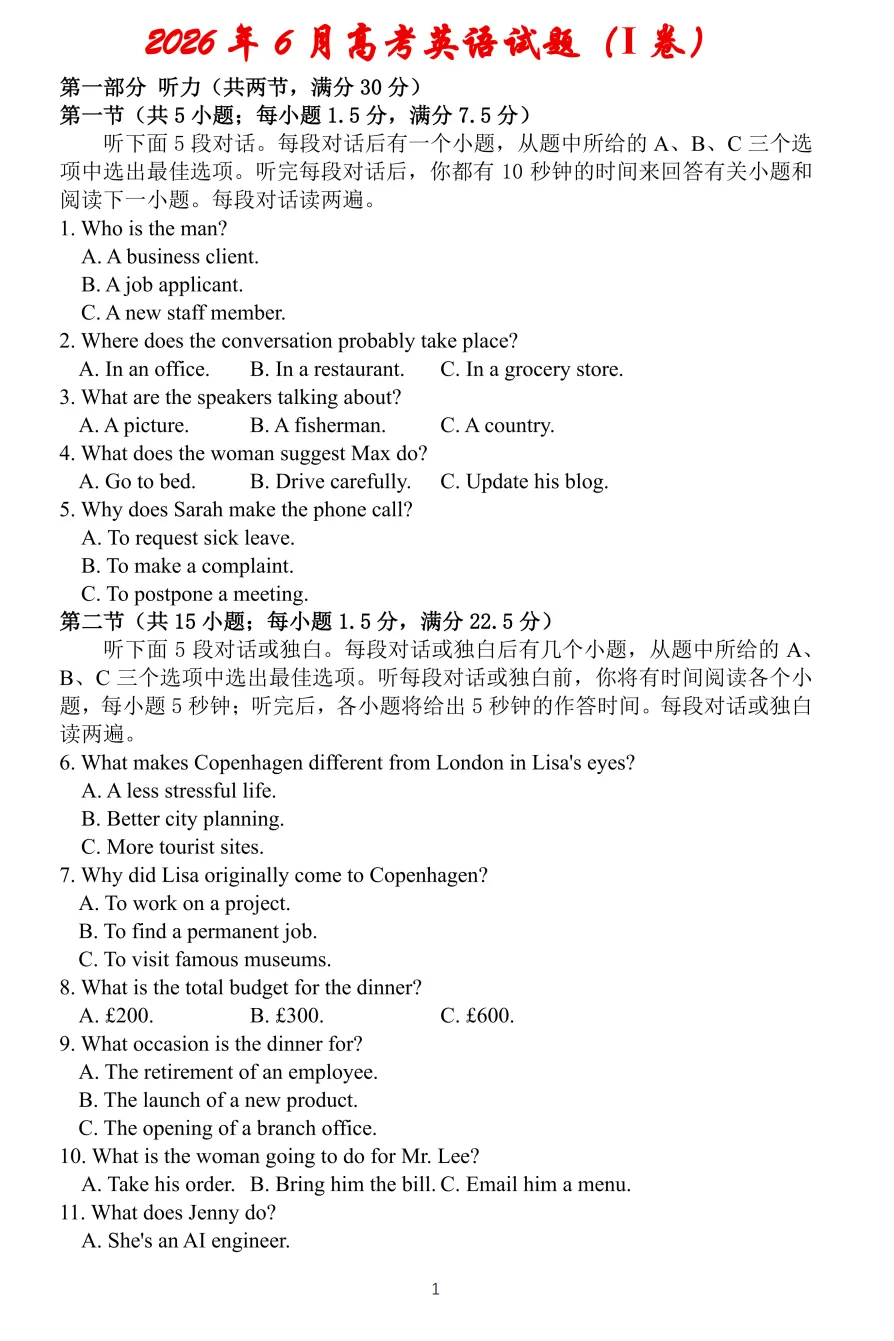
听下面5段录音。每段录音后有一个小题,从题中所给的A、B、C三个选项中选出最佳选项。听完每段录音后,你都有10秒钟的时间来回答有关小题和阅读下一小题。每段录音播放两遍。
1. Who is the man?
A. A business client.
B. A job applicant.
C. A new staff member.
2. Where does the conversation probably take place?
A. In an office.
B. In a restaurant.
C. In a grocery store.
3. What are the speakers talking about?
A. A picture.
B. A fisherman.
C. A country.
4. What does the woman suggest Max do?
A. Go to bed.
B. Drive carefully.
C. Update his blog.
5. Why does Sarah make the phone call?
A. To request sick leave.
B. To make a complaint.
C. To postpone a meeting.
第二节(共15小题;每小题1.5分,满分22.5分)
听下面5段录音。每段录音后有几个小题,从题中所给的A、B、C三个选项中选出最佳选项。听每段录音前,你将有时间阅读各个小题,每小题5秒钟;听完后,每小题将给出5秒钟的作答时间。每段录音播放两遍。
听第6段录音,回答第6、7题。
6. What makes Copenhagen different from London in Lisa’s eyes?
A. A less stressful life.
B. Better city planning.
C. More tourist sites.
7. Why did Lisa originally come to Copenhagen?
A. To look for a permanent job.
B. To do a short-term project.
C. To visit a famous museum.
听第7段录音,回答第8至10题。
8. What is the total budget for the dinner?
A. £200.
B. £300.
C. £600.
9. What occasion is the dinner for?
A. The retirement of an employee.
B. The launch of a new product.
C. The opening of a branch office.
10. What is the woman going to do for Mr. Lee?
A. Take his order.
B. Bring him the bill.
C. Email him a menu.
听第8段录音,回答第11至13题。
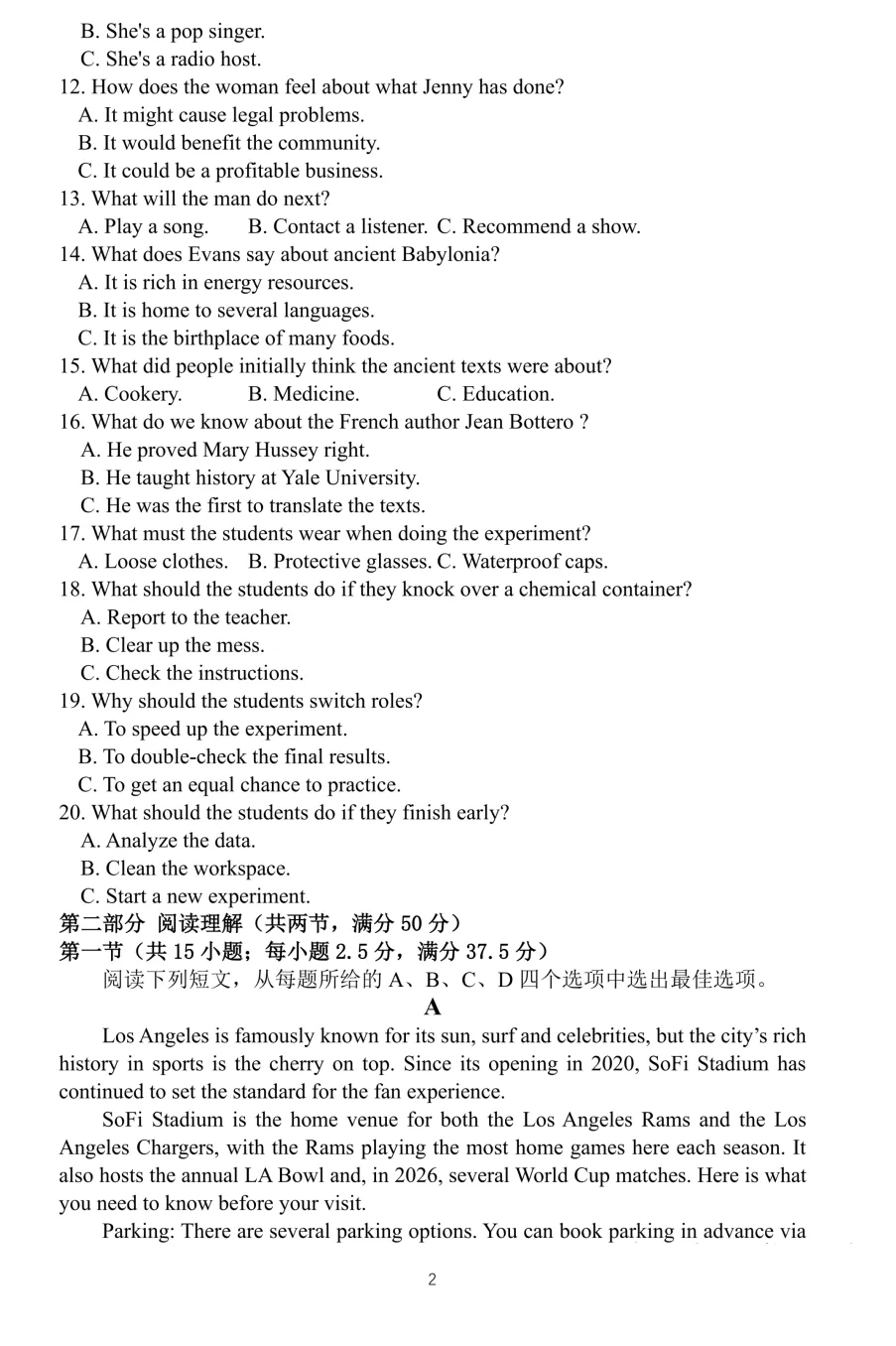
11. What does Jenny do?
A. She’s an AI engineer.
B. She’s a pop singer.
C. She’s a radio host.
12. How does the woman feel about what Jenny has done?
A. It might cause legal problems.
B. It would benefit the community.
C. It could be a profitable business.
13. What will the man do next?
A. Play a song.
B. Contact a listener.
C. Recommend a show.
听第9段录音,回答第14至16题。
14. What does Evans say about ancient Babylonia?
A. It is rich in energy resources.
B. It is home to several languages.
C. It is the birthplace of many foods.
15. What did people initially think the ancient texts were about?
A. Cookery.
B. Medicine.
C. Education.
16. What do we know about the French author Jean Bottéro?
A. He proved Mary Hussey right.
B. He taught history at Yale University.
C. He was the first to translate the texts.
听第10段录音,回答第17至20题。
17. What must the students wear when doing the experiment?
A. Loose clothes.
B. Protective glasses.
C. Waterproof caps.
18. What should the students do if they knock over a chemical container?
A. Report to the teacher.
B. Clean up the mess.
C. Check the instructions.
19. Why should the students switch roles?
A. To speed up the experiment.
B. To double-check the final results.
C. To get an equal chance to practice.
20. What should the students do if they finish early?
A. Analyze the data.
B. Clean their workspace.
C. Start a new experiment.
答案:1-5 CBAAC 6-10 ABCAC 11-15BCACB 16-20ABACB
听力文本材料
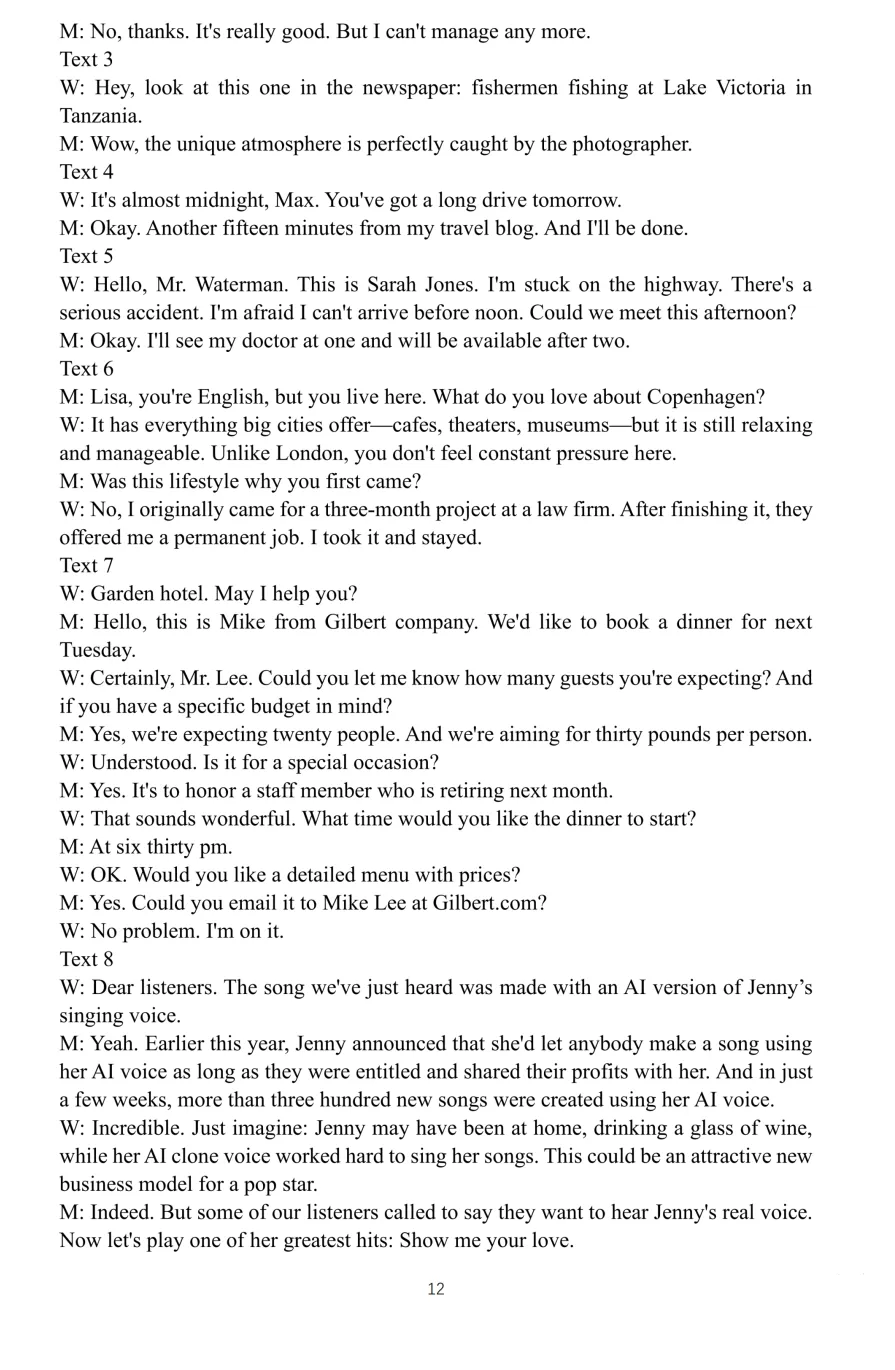
Text 1
M: Do I need a card to enter the building?
W: Yes. You’ll get your card this afternoon. Now let me show you around and say hello to everyone. And then we’ll talk about your job duties.
Text 2
W: Would you like some more roast beef? It’s the chef’s signature dish.
M: No, thanks. It’s really good. But I can’t manage any more.
Text 3
W: Hey, look at this one in the newspaper: Fishermen Fishing at Lake Victoria in Tanzania.
M: Wow! That’s awesome! I like the unique atmosphere caught by the photographer!
Text 4
W: It’s almost midnight, Max. You’ve got a long drive tomorrow.
M: Okay. Another fifteen minutes from my travel blog. And I’ll be done.
Text 5
W: Hello, Mr. Waterman. This is Sarah Jones. I’m stuck on the highway. There’s a serious accident. I’m afraid I can’t arrive before noon. Could we meet this afternoon?
M: Okay. I’ll see my doctor at one and will be available after two.
Text 6
M: Lisa, you’re English, but you live here. What do you love about Copenhagen?
W: It has everything big cities offer — cafes, theaters, museums — but it is still relaxing and manageable. Unlike London, you don’t feel constant pressure here.
M: Was this lifestyle why you first came?
W: No, I originally came for a three-month project at a law firm. After finishing it, they offered me a permanent job. I took it and stayed.
Text 7
W: Garden Hotel. May I help you?
M: Hello, this is Mike Lee from Gilbert Company. We’d like to book a dinner for next Tuesday.
W: Certainly, Mr. Lee. Could you let me know how many guests you’re expecting and if you have a specific budget in mind?
M: Yes, we’re expecting twenty people. And we’re aiming for thirty pounds per person.
W: Understood. Is this for a special occasion?
M: Yes. It’s to honor a staff member who is retiring next month.
W: That sounds lovely. What time would you like the dinner to start?
M: At six thirty p.m.
W: OK. Would you like a detailed menu with prices?
M: Yes. Could you email it to Mike Lee@Gilbert.com?
W: No problem. I’m on it.
Text 8
W: Dear listeners. The song we’ve just heard was made with an AI version of Jenny’s singing voice.
M: Yeah. Earlier this year, Jenny announced that she’d let anybody make a song using her AI voice as long as they were entitled and shared their profits with her. And in just a few weeks, more than three hundred new songs were created using her AI voice.
W: Incredible! Just imagine: Jenny may have been at home, drinking a glass of wine, while her AI clone voice worked hard to sing her songs. This could be an attractive new business model for a pop star.
M: Indeed. But some of our listeners called to say they want to hear Jenny’s real voice. Now let’s play one of her greatest hits: Show Me Your Love.
Text 9
M: Dr. Evans, you just said that these ancient texts are actually the recipes from ancient Babylonia. Can you tell us more?
W: Ancient Babylonia is home to many of the things that we use in our cooking today. I bet, about fifty percent of the energy you need every day comes from vegetables or animals that originated in this area.
M: Why have these texts taken so long to come to light?
W: These ancient texts have been known since the 1920s, but were thought to be medical texts. In the 1940s, Mary Hussey, an American scholar, suggested that they might be about food. But people didn’t believe her until French author, Jean Bottéro, in the 1980s was asked to write an article about cooking in the past. He had heard about the texts, so he went to Yale University, and found out that they were indeed about food.
Text 10
M: Before we begin today’s experiment, let’s review the lab rules. First, safety glasses must be worn at all times, even if you’re only watching. Second, never mix chemicals unless the instructions tell you to do so. Today we’re using a strong acid, which can cause serious burns if it touches your skin. If any chemical container is knocked over, don’t panic. Tell me immediately and I’ll handle the cleanup. Also, keep your hair tied back and avoid wearing loose clothes. We will work in pairs. One person will handle the tools while the other records the data. Switch roles after every three trials to ensure everyone gets practice. Remember, the goal is accurate data, not speed. If you finish early, do not start a new experiment. Instead, clean your workspace thoroughly.
Any questions? No? All right. Let’s have a safe and productive class.
2026年高考英语全国卷试题评析
2026年高考英语全国卷试题依据高校人才选拔要求和高中英语课程标准命制,通过精心选材、科学设题,聚焦学科关键能力,考查学生学科素养和思维品质,加强价值引领,服务高校人才选拔,正向引导高中英语教学。
一、坚持立德树人,引导学生德智体美劳全面发展2026年高考英语全国卷试题立足立德树人根本任务,深度融合中华优秀传统文化,将价值引领有机融入对关键能力和学科素养的考查之中。试题通过精心设计语篇和情境,厚植家国情怀、涵养人文底蕴、培育科学思维、融入体美劳教育理念,弘扬求真探索精神,倡导积极向上的道德品格与生活习惯,引导学生德智体美劳全面发展,筑牢成长根基。
1.厚植家国情怀,讲好中国故事
试题有机融入中华优秀传统文化,引导学生在掌握英语的同时讲好中国故事。全国Ⅰ卷语法填空语篇聚焦中国传统“大集”的起源与功能,描绘了集市上美食飘香、人群熙攘、物产丰富的场景,展现中国乡土社会的繁荣景象与独特风情。全国Ⅱ卷语法填空语篇讲述了一位澳大利亚女士学习太极拳的经历与感受,描述她努力领会“身心合一”“气”“丹田”等概念,体现了中华优秀传统文化的世界影响力。试题通过融通中外、彰显中华文明永恒魅力的素材,引导学生加深对中华文化的理解和认同,厚植家国情怀,坚定文化自信。
2.涵养人文底蕴,塑造道德品格
试题蕴涵人文关怀,引导学生养成优良道德品格与高尚人格。全国Ⅰ卷完形填空语篇讲述主人公离开故乡小镇后的感悟,传递出对乡土文化独特价值的深刻认识,以及对成长经历与故土滋养的真挚感恩。全国Ⅱ卷完形填空语篇描绘一位心怀作家梦想的年轻教师,在受到学生启发后毅然重返大学深造并最终圆梦成为知名作家的经历,有力诠释了勇于追逐梦想、永不言弃的积极人生态度与坚忍不拔的理想信念。试题通过这些源自生活、富有深意的叙事,引导学生涵养道德情操、塑造高尚人格。
3.弘扬科学精神,培育探究能力
试题紧扣科学探究与科技创新前沿,引导学生锤炼分析和探究能力,弘扬科学精神。全国Ⅰ卷阅读C篇聚焦特定树种释放的化学物质与汽车尾气结合可能造成对健康的影响及相关讨论,引导学生辩证地审视复杂问题,理解其多面性,并思考可持续的解决方案。全国Ⅱ卷阅读D篇介绍了巴塞罗那地铁列车利用再生制动系统进行能量回收,并创新性地将部分回收能量传输至车站地面充电桩的项目,生动诠释了科技创新驱动绿色交通的理念。试题通过逻辑严谨、启迪思维的语篇,致力点燃科学探究热情,引导学生养成敏锐的观察力和主动探究的科学精神。
4.融入体美劳教育,促进全面发展
试题贯彻五育并举教育理念,引导学生德智体美劳全面发展。全国Ⅰ卷阅读A篇介绍体育馆近期赛事与观赛实用信息,引导学生关注体育资讯,提高运动意识。全国Ⅱ卷写作第一节以外教将班级英语作文集结成册为情境,要求学生写出“建议配图”和“自荐承担画图工作”等内容,渗透语言表达与艺术创作相结合的理念。全国Ⅱ卷阅读第二节语篇探讨如何通过日常家务培养孩子做事情认真负责的品德,强调在劳动中培养责任感和毅力的重要性。试题通过贴近社会实际和生活经验的内容,引导学生养成健康意识,提升审美素养,理解劳动价值,实现全面发展。
二、聚焦关键能力,促进学生思维品质提升2026年高考英语试题严格依据普通高中英语课程标准和高校人才选拔要求,科学设计考查内容,强化对学生基础技能和综合运用能力的考查,促进学生思维品质发展。试题通过创设真实、多元、富有启发性的语言运用情境,有效激发学生的创新意识与潜能,为选拔具备优秀思维品质的拔尖创新人才提供全面、科学的评价依据。
1.强调关键能力,深化基础考查
全国卷的整体结构保持稳定,包括听力、阅读、语言运用和写作四个部分。试题严格遵循并落实普通高中英语课程标准的理念,以课程内容包含的主题、语篇、语言知识、文化知识、语言技能、学习策略等要素为基础,考查学生在具体交际情境中恰当、灵活地运用英语分析问题、解决问题的能力。例如,全国Ⅱ卷阅读B篇讲述一位百岁老人悉心守护著名建筑师所设计房屋的故事,四道小题聚焦阅读理解能力维度,考查依据上下文推断人物的情感态度、理解其行为背后的深层原因、辨识事物的关键特征以及基于文中信息进行合理推断和总结概括的能力。
2.注重思维品质,创新考查方式
试题强化素养导向,通过精心创设真实、多元且富有启发性的语言交际与认知场景,创新命题视角与任务设计思路,构造新颖而富有挑战性的问题情境,激发并深度考查学生的批判性思维和创新意识,为选拔具备优秀思维品质的拔尖创新人才提供有力支撑。例如,全国Ⅰ卷写作第一节以学校英文报征稿为情境,要求学生对未来大学生活中的学习、社交、睡眠三方面按重要性进行排序并阐述理由。任务具有高度开放性和思辨性,要求学生透过表面现象,批判性地审视不同生活维度的内在价值及相互关系,进行逻辑清晰、论证有力的观点阐述,重点考查学生基于价值判断进行理性选择、构建逻辑论证链的批判性思维能力。


