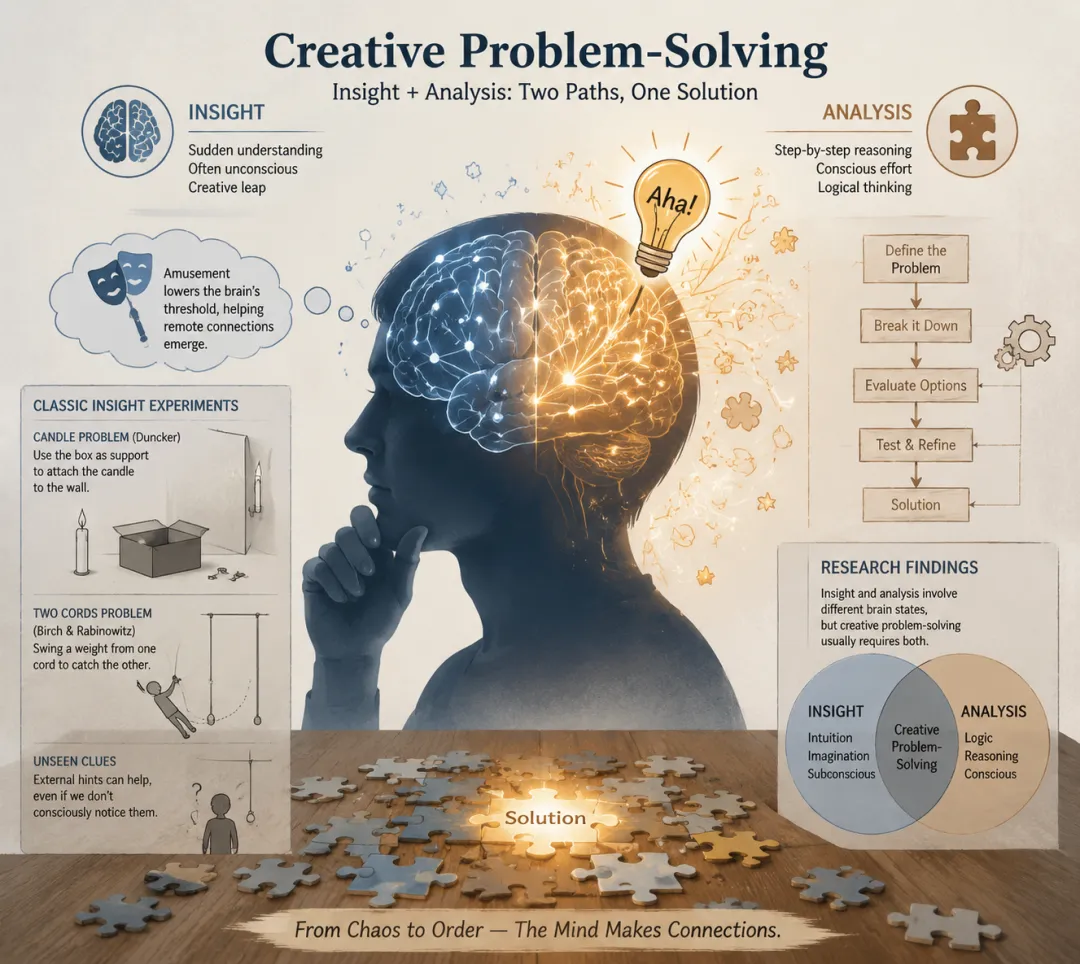

Creative Problem-Solving
Puzzle-solving is an ancient, universal practice, scholars say, and it depends on creative insight, or a primitive spark. Now, modern neuroscientists are beginning to tap its source
A In a recent study, researchers at Northwestern University in the United States found that people were more likely to solve word puzzles with sudden insight when they were amused, having just seen a short comedy routine. ‘What we think is happening,’ said Dr Mark Beeman, a neuroscientist who worked on the study, 'is that the humor, this positive mood, is lowering the brain's threshold for detecting weaker or more remote connections,' which enable people to solve puzzles.
B This suggests that the appeal of puzzles goes far deeper than the pleasant rush of finding a solution. The very act of doing a puzzle typically shifts the brain into an open, playful state that is itself a pleasing escape. Unlike the social and professional mysteries in the real world, puzzles are reassuringly solvable; but like any serious problem, they require more than mere intellect to crack. ‘It’s imagination, it's inference, it's guessing; and much of it is happening subconsciously,’ said Dr Marcel Danesi, a professor of anthropology at the University of Toronto, Canada. ‘It’s all about you, using your own mind, without any method or schema, to restore order from chaos,’ Danesi said. ‘And once you have, you can sit back and say, “Hey, the rest of my life may be a disaster, but at least I have a solution”.’
C For almost a century scientists have used puzzles to study what they call ‘insight thinking’, the leaps of understanding that seem to come out of the blue. In one experiment, the German psychologist Karl Duncker presented people with a candle, a box of pins, and the task of attaching the candle to a wall. About a quarter of the subjects thought to use the pins to tack the box to the wall as a support - some immediately, and others after failed efforts to tack wax to the wall. According to Duncker, the creative leap seems to have been informed by subconscious cues. In another well-known experiment, psychologists H.G. Birch and H.S. Rabinowitz challenged people to tie together two cords; the cords were hanging from the ceiling of a large room, too far apart to be grabbed at the same time. A small percentage of people solved it without any help, by tying something else to one cord and swinging it like a pendulum so that it could be caught while they held the other cord. In some experiments researchers gave clues to those who were stumped - for instance, by bumping into one of the strings so that it swung. Many of those who then solved the problem said they had no recollection of the clue, though it very likely registered subconsciously.
D All along, researchers have debated the definitions of insight and analysis, and some have concluded that the two are merely different sides of the same coin. Yet in an authoritative discussion of the research carried out so far, the psychologists Jonathan W. Schooler and Joseph Melcher concluded that the abilities most strongly correlated with insight problem-solving ‘were not significantly correlated’ with solving analytical problems. Either way, creative problem-solving usually requires both analysis and insight. Adam Anderson, a psychologist at the University of Toronto, Canada, argues that although when people are solving problems they may move back and forth between these abilities, they are truly different brain states.
Questions 14-19
Reading Passage 2 has six sections, A-F.
Which section contains the following information?
Write the correct letter, A-F, in boxes 14-19 on your answer sheet.
You may use any letter more than once.
14 a claim that people enjoy the process of doing puzzles as well as finding the answers .............
15 a review of studies that looked at the relationship between insight and analysis .............
16 the finding that people were less likely to solve puzzles after viewing uninteresting or disturbing material .............
17 a comparison between doing puzzles and dealing with life challenges .............
18 a description of a study where the subjects were given hints by those conducting the research
19 details of a study in which the focus shifted to mental activity before a puzzle is attempted .............
Questions 20-23
Look at the following statements (Questions 20-23) and the list of researchers below.
Match each statement with the correct researcher, A-E.
Write the correct letter, A-E, in boxes 20-23 on your answer sheet.
20 Solving a puzzle may help people facing difficulties feel better ................ .
21 Two distinctly separate functions of the brain are used when solving puzzles. ................ .
22 Some subjects were able to find a solution to the puzzle they were given without knowing how they had done it. ................ .
23 Seeing something funny helps people make links that may not be obvious at first. ................ .
List of Researchers
A Mark Beeman
B Marcel Danesi
C Karl Duncker
D Adam Anderson
E John Kounios