PART.01
文本阅读

大意:本文是一篇记叙文,主要讲述了作者在要求儿子查阅纸质词典时,回忆起了自己青少年时期通过标记词典努力学习的往事。作者最终意识到,学习的关键不在于工具或知识本身,而在于内心对知识的好奇心与渴望。
【原文出处】本文选自美国知名人文综合刊物《The American Scholar》官方网站于2024年1月18日发表的名为Hey Siri, Call Webster的文章:
https://theamericanscholar.org/hey-siri-call-webster/
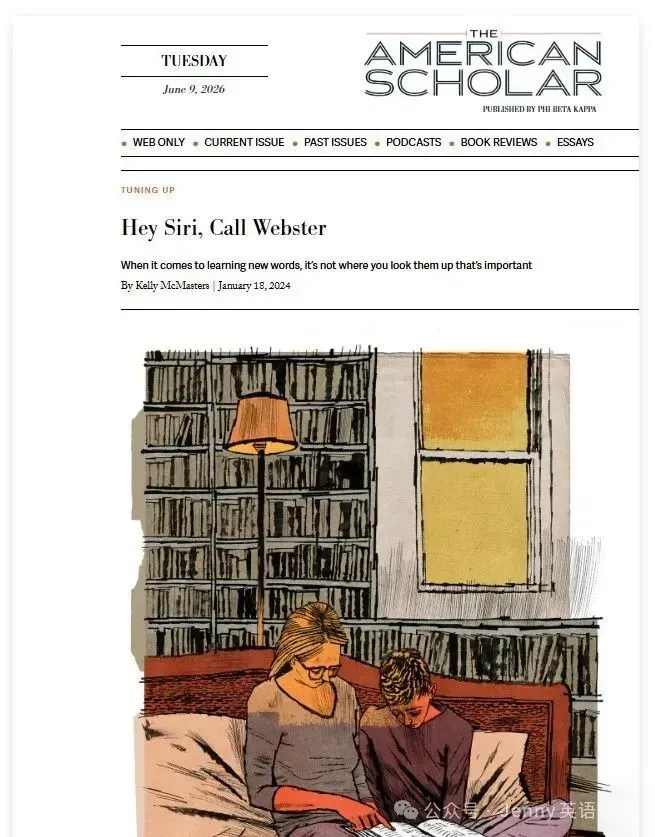
Not long ago, my fifth-grade son Kevin asked me about the meaning of a word in a novel. "Look it up," I responded. "But my screen time is off," he said. I looked pointedly at the bookshelf that held at least three dictionaries, and Kevin sighed (叹气) dramatically. "Can't you just use your phone?" he asked. Suddenly it occurred to me that he did not even know how to use a dictionary.
I took down one of the dictionaries, and we read it together for a few minutes before I handed it to him. It took him a few tries to find the word in question. While going through the pages, he kept saying, wide-eyed: "How can there be this many words?" After a while, he looked at me and asked, "Do you know all these words, Mom?" I smiled. "I definitely do not know all these words," I said. “But that's why this is one of my favorite books.”
I had my first dictionary as a gift for my 13 birthday. I decided that I wanted to learn as many words as I could and started marking every entry I looked up with a pencil to measure my progress. I continued to make these pencil marks for years, and when I went off to college, I packed that dictionary in my suitcase.
Kevin wanted to see the dictionary. I felt a small pain in my chest. The dictionary was stolen at the end of my freshman year of college. "That's so sad," he said, "but you still know all those words, even without the book.” I realized that this was true. I still made it through the next three years of college, even without the book. And it wasn't, ultimately, the dictionary that got me there—not really.
Now I understand that although my son may be learning differently, he is still learning. It's not about the words themselves or how we learn them, but the wanting to know them, the curiosity and the appetite.
PART.02
阅读理解

24. What does Kevin usually do to get the meaning of a word?
A. Use electronic devices.
B. Consult a paper dictionary.
C. Guess from the context.
D. Turn to his English teacher.
25. How did Kevin feel while looking up the word in the dictionary?
A. Annoyed.
B. Disappointed.
C. Encouraged.
D. Astonished.
26. What can we learn about the author's first dictionary?
A. It helped her through college.
B. It was given to Kevin as a gift.
C. It bore witness to her efforts.
D. It was a valuable limited edition.
27. What has the author come to realize about learning?
A. It is never too late to start.
B. Motivation is what really matters.
C. Children need role models.
D. Dictionaries are still a useful tool.
PART.03
重点单词

1. pointedly adv 刻意地
2. dramatically adv [熟词生义]夸张做作地
3. hand v [名词动化]递
4. wide-eyed adj (尤因惊讶或恐惧而)睁大眼睛地
5. entry n [熟词生义](词典等的)条目
6. measure v 衡量
7. ultimately adv 最终
8. curiosity n 好奇心
9. appetite n [熟词生义]欲望
PART.04
重点短语

PART.05
全文翻译

Not long ago, my fifth-grade son Kevin asked me about the meaning of a word in a novel. "Look it up," I responded. "But my screen time is off," he said. I looked pointedly at the bookshelf that held at least three dictionaries, and Kevin sighed (叹气) dramatically. "Can't you just use your phone?" he asked. Suddenly it occurred to me that he did not even know how to use a dictionary.
不久前,我读五年级的儿子 Kevin 问我一本小说里某个词的意思。“查一下,”我回答道。“可是我的屏幕使用时间已经关了,”他说。我特意地看了一眼书架上至少放着三本词典,Kevin 夸张地叹了口气。“你就不能用你的手机查吗?”他问。我突然意识到,他甚至不知道该怎么使用词典。
I took down one of the dictionaries, and we read it together for a few minutes before I handed it to him. It took him a few tries to find the word in question. While going through the pages, he kept saying, wide-eyed: "How can there be this many words?" After a while, he looked at me and asked, "Do you know all these words, Mom?" I smiled. "I definitely do not know all these words," I said. “But that's why this is one of my favorite books.”
我取下一本词典,我们一起读了几分钟,然后我把词典递给他。他试了好几次才找到那个词。在翻页的过程中,他一直睁大眼睛说:“怎么会有这么多词?”过了一会儿,他看着我问:“妈妈,这些词你全都认识吗?”我笑了笑。“我当然不是全都认识,”我说。“但这就是为什么这是我喜欢的书之一。”
I had my first dictionary as a gift for my 13 birthday. I decided that I wanted to learn as many words as I could and started marking every entry I looked up with a pencil to measure my progress. I continued to make these pencil marks for years, and when I went off to college, I packed that dictionary in my suitcase.
我的第一本词典是我13岁生日时收到的礼物。我决定要尽可能多地学习单词,并开始用铅笔在我查过的每个词条旁做标记,以此来衡量自己的进步。我连续多年一直做着这些铅笔标记,当我上大学时,我把那本词典装进了行李箱。
Kevin wanted to see the dictionary. I felt a small pain in my chest. The dictionary was stolen at the end of my freshman year of college. "That's so sad," he said, "but you still know all those words, even without the book.” I realized that this was true. I still made it through the next three years of college, even without the book. And it wasn't, ultimately, the dictionary that got me there—not really.
Kevin 想看看那本词典。我感到胸口有一丝疼痛。那本词典在我大学一年级结束时被偷了。“那太可惜了,”他说,“但即使没有那本书,你仍然记得所有那些词。”我意识到这是真的。即使没有那本书,我仍然顺利读完了大学接下来的三年。而且,归根结底,真正让我走到那一步的并不是那本词典——并非如此。
Now I understand that although my son may be learning differently, he is still learning. It's not about the words themselves or how we learn them, but the wanting to know them, the curiosity and the appetite.
现在我明白了,尽管我的儿子可能以不同的方式学习,但他仍在学习。重要的不是单词本身,也不是我们如何学习它们,而是想要去了解它们的那份好奇心与求知欲。
PART.06
阅读理解解析

24. What does Kevin usually do to get the meaning of a word?
A. Use electronic devices.
B. Consult a paper dictionary.
C. Guess from the context.
D. Turn to his English teacher.
24. Kevin 通常用什么方式查词?A. 使用电子设备。B. 查阅纸质词典。C. 根据上下文猜测。D. 向英语老师求助。
24. A 事实细节题 根据第一段 Kevin 的话 But my screen time is off…以及 Can't you just use your phone? 可知,Kevin 习惯使用手机查词,而非查阅纸质词典。electronic devices指电子设备,其中包括手机。
25. How did Kevin feel while looking up the word in the dictionary?
A. Annoyed.
B. Disappointed.
C. Encouraged.
D. Astonished.
25. Kevin 在词典里查词时感觉如何?A. 恼火的。B. 失望的。C. 受到鼓舞的。D. 惊讶的。
25. D 观点态度题 根据第二段中的 wide-eyed 以及 Kevin 的问句 How can there be this many words?和 Do you know all these words, Mom? 可知,Kevin 在查阅词典时被词条数量震撼,表现出惊讶的情绪。
26. What can we learn about the author's first dictionary?
A. It helped her through college.
B. It was given to Kevin as a gift.
C. It bore witness to her efforts.
D. It was a valuable limited edition.
26. 关于作者的第一本词典,我们可以了解到什么?A. 它帮助她完成了大学学业。B. 它作为礼物送给了凯文。C. 它见证了她的努力。D. 它是珍贵的限量版。
26. C 推理判断题 根据第三段 …started marking every entry I looked up with a pencil to measure my progress. I continued to make these pencil marks for years…可知,作者在词典上每个查阅过的词条旁做标记,并保持了这个习惯很多年,这些标记记录了作者逐词学习的过程与付出,C 项是对这一细节的准确概括。根据第四段,The dictionary was stolen at the end of my freshman year of college. 这本词典在作者大学一年级结束时被偷了,所以可以排除A和B选项,D选项文章中没提。
27. What has the author come to realize about learning?
A. It is never too late to start.
B. Motivation is what really matters.
C. Children need role models.
D. Dictionaries are still a useful tool.
27. 作者对学习有了什么认识?A. 学习永远不嫌晚。B. 动机才是真正重要的。C. 孩子需要榜样。D. 词典仍然是有用的工具。
27. B 推理判断题 根据最后一段最后一句 It's not about the words themselves or how we learn them, but the wanting to know them, the curiosity and the appetite. 可知,作者最终领悟到学习的核心不在于词汇本身或学习方式,而在于求知的内在动力——好奇心与求知欲,B项准确概括了这一核心思想。D项“词典仍是有用的工具”属强干扰项,文章虽讨论了词典,但作者的落脚点在人的内在动力,而非学习工具。