



本次写作共有三个话题
学生会如何改进来年工作的意见
大学生都应该被要求学习学术写作
如何充分利用校内资源促进学业发展
温馨提示
考前1-2周适合备考作文和翻译
考前1-2周适合备考作文和翻译
考前1-2周适合备考作文和翻译
听力、阅读依赖长期积累(词汇量、语感、阅读速度),短时间内难以显著提升。听力、阅读刷题到最后,正确率往往进入瓶颈期,再花时间提升有限。
作文有固定题型(议论文、图表、书信等)、固定框架、万能句型、话题素材、模板逻辑,通过背诵模板、功能句和范文,一两周内可覆盖几乎所有预测话题,加以背诵、仿写、纠错就能明显提升分数,投入时间和分数回报成正比。
作文有常见话题(教育、科技、社会、环境等),历年真题话题反复出现。最后一周集中背诵功能句、段落模板、话题素材,一篇素材可套用多个同类题目,背完就能直接考场使用。
作文可以快速掌握“套路”和高分结构。作文评分看重结构清晰(开头、主体、结论)、逻辑连贯(连接词)、语言多样性(同义替换、从句、倒装等)。最后一两周集中背诵作文模板(如“In contemporary society, … has sparked much debate.”)、功能句,连接词、主题词汇,能迅速提升卷面质量。
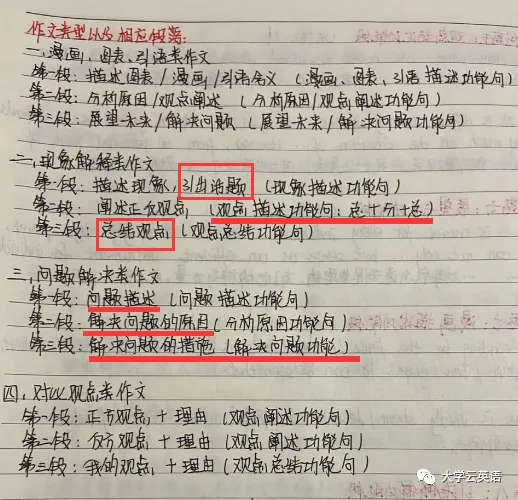
背诵5种常见题型的模板(观点对比、问题解决、现象解释、图表、名言评论)。
每天写2篇真题作文,对照范文修改,积累优秀短语。
按话题分类背诵素材,聚焦高频话题:个人素养(责任、毅力、体育精神、诚信)、校园学习、人际关系、科技、传统文化,整理自己的“万能功能句”,每个话题熟记 1 套段落表达。
限时30分钟写1篇,检查拼写和语法。
复习模板和功能句,保持语感。

四六级作文评分标准
一、评分原则
评分标准
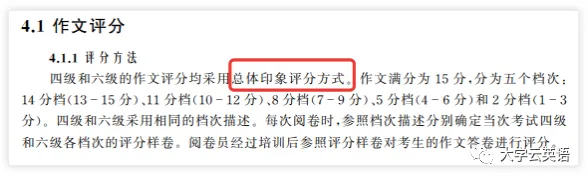
✔满分15分,分为五个档:
14分档(13-15分)
11分档(10-12分)
8分档(7-9分)
5分档(4-6分)
2分档(1-3分)
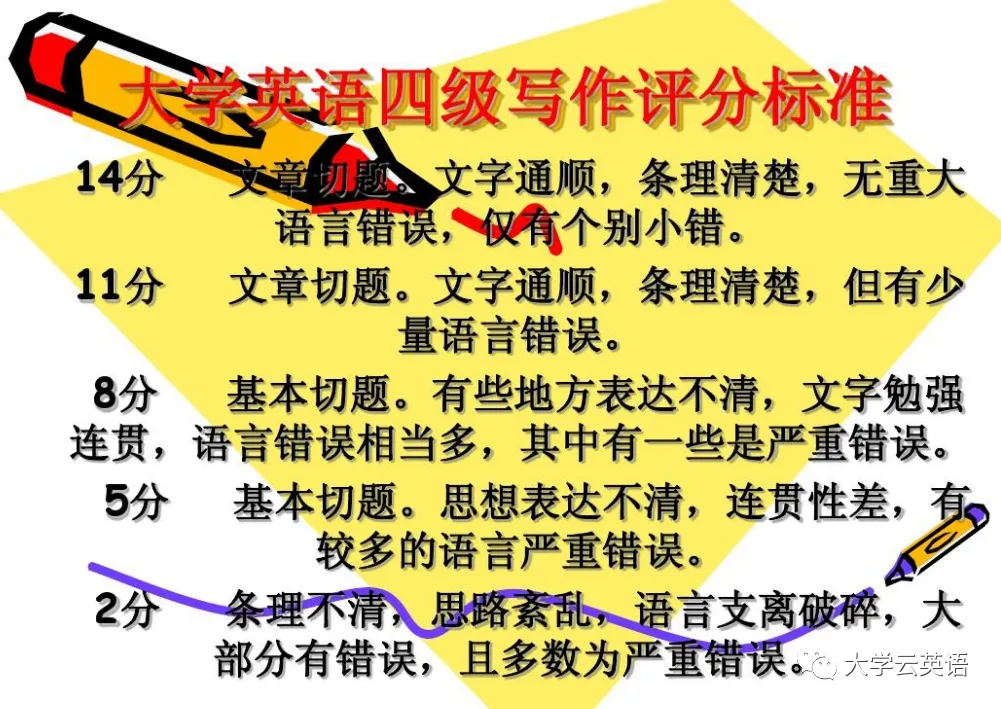
2 分——条理不清,思路紊乱,语言支离破碎或大部分句子均有错误,且多数为严重错误。
5 分——基本切题。表达思想不清楚,连贯性差。有较多的严重语言错误。
8 分——基本切题。有些地方表达思想不够清楚,文字勉强连贯;语言错误相当多,其中有一些是严重错误。
11 分——切题。表达思想清楚,文字连贯,但有少量语言错误。
14 分——切题。表达思想清楚,文字通顺,连贯性较好。基本上无语言错误,仅有个别小错。
注:白卷,作文与题目毫不相关,或只有几个孤立的词而无法表达思想,则给 0 分。
5. 字数不够 120 个,应酌情扣分,具体标准:
累计字数在 110~119 之间,扣 1 分;
累计字数在 100~109 之间,扣 2 分;
累计字数在 90~99 之间,扣 3 分;
累计字数在 80~89 之间,扣 4 分;
累计字数在 70~79 之间,扣 7 分;
累计字数<69,扣 9 分。
注:如题目给出主题句,祈使句,结束句,均不得计入所写字数;
只写一段者:0-4 分;只写两段者:0-9 分(指规定三段的作文)。
网友总结


话题一

题目
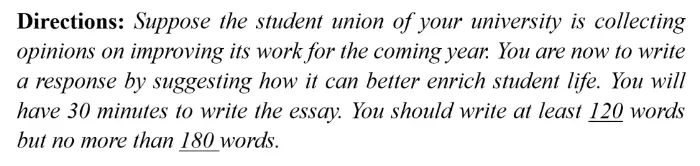
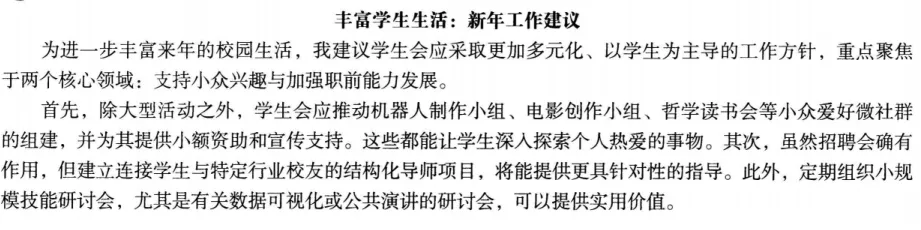
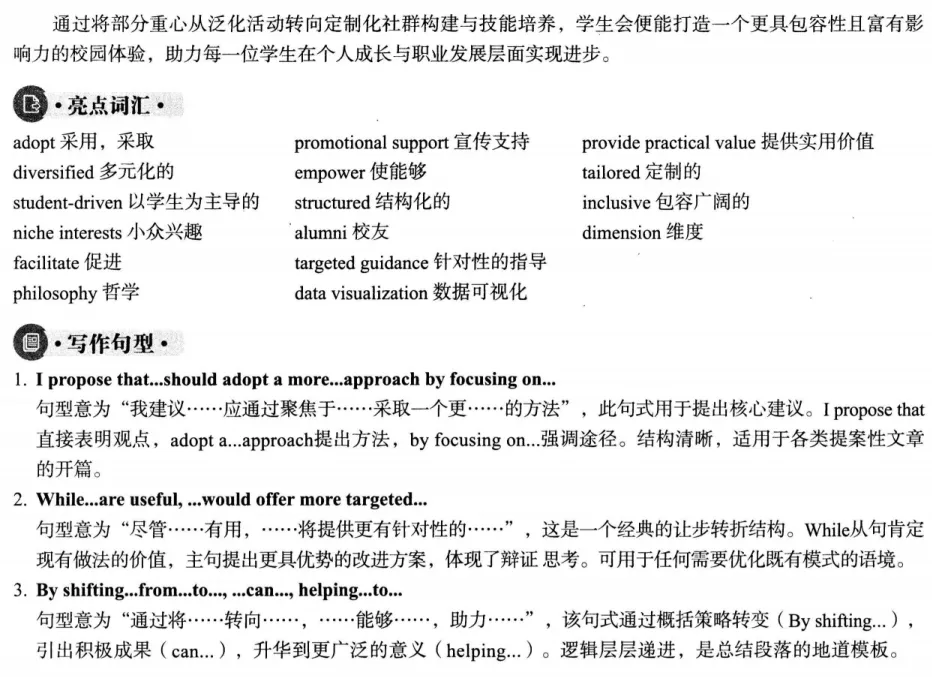
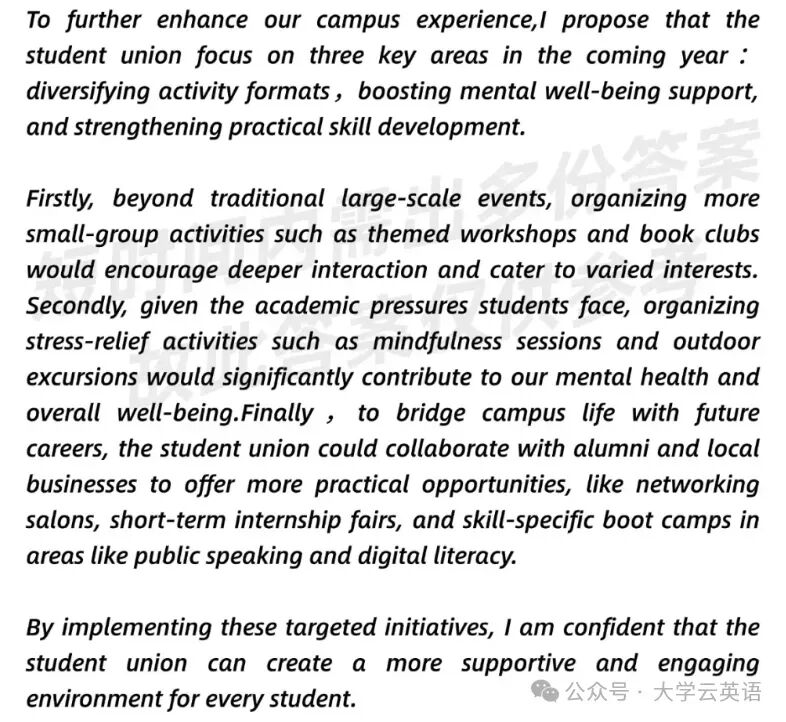
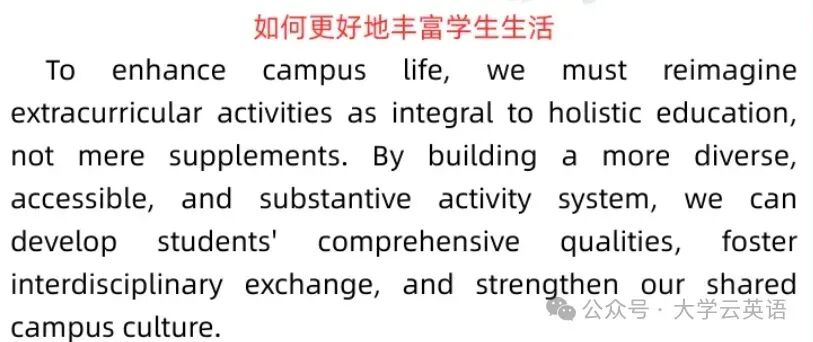
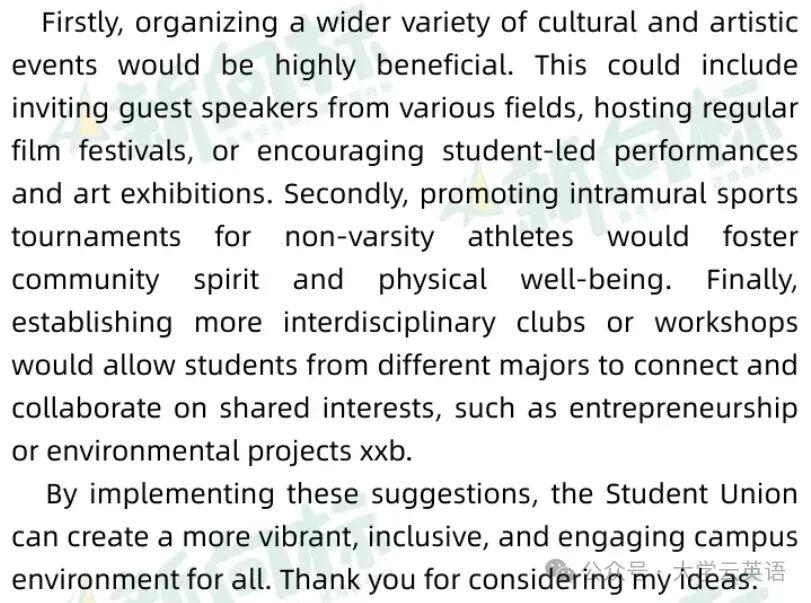
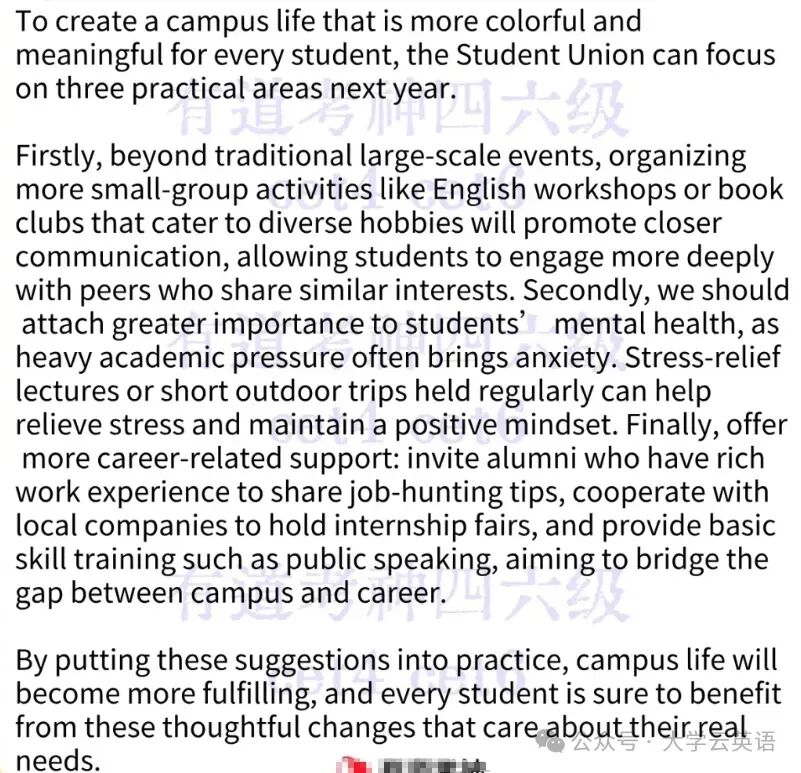
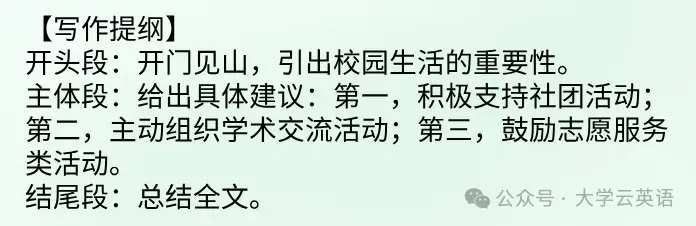
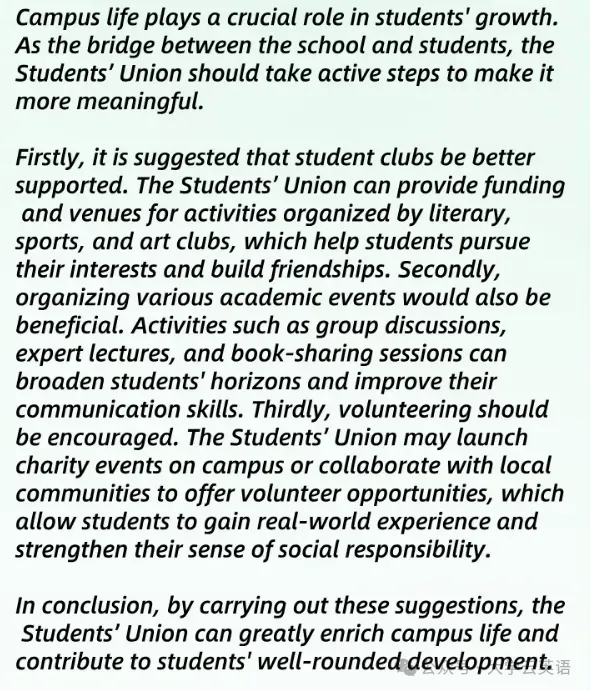
Directions:Suppose the student union of your university is collecting opinions on improving its work for the coming year. You are now to write a response by suggesting how it can better enrich student life. You will have 30 minutes to write the essay. You should write at least 120 words but no more than 180 words.
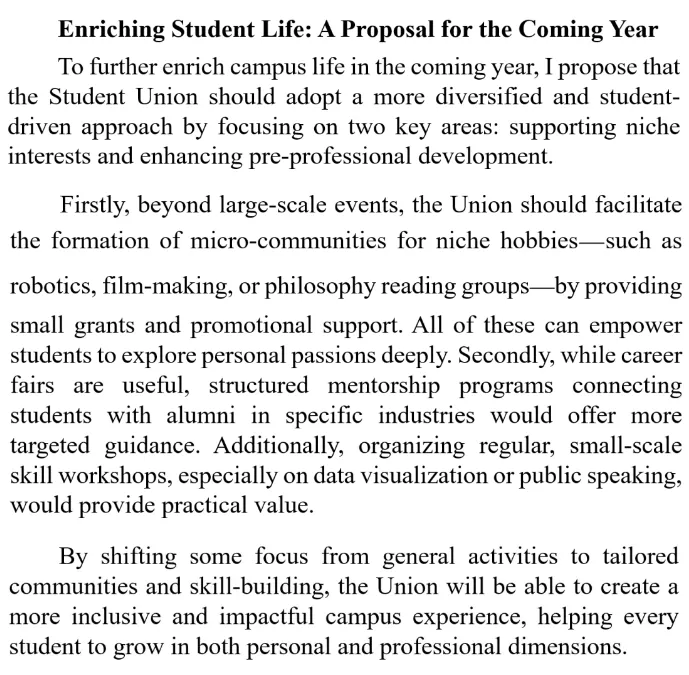
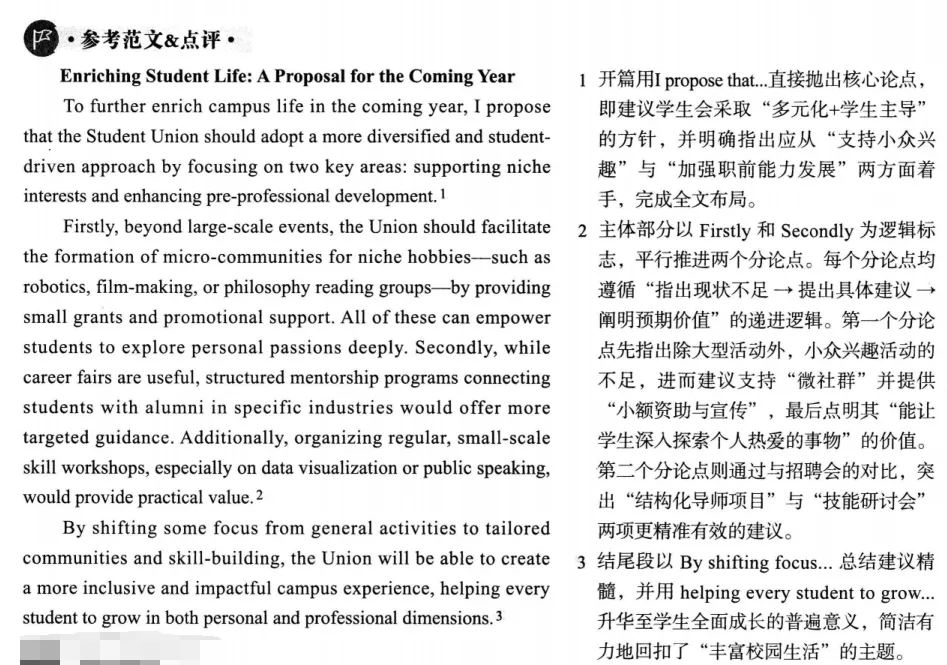
【题目翻译】假设你所在大学的学生会正在征集关于如何改进来年工作的意见。请你写一篇文章,提出建议,说明学生会如何能够更好地丰富学生生活。
范文1
重点词汇
enrich v.使丰富,充实 campus life n.校园生活 enhance v.提高,增强 contribute to v.有助于,促成 overall growth n.全面发展 academic seminar n.学术研讨会 boost confidence v.增强信心 cultural exchange n.文化交流 broaden understanding v.拓宽理解/视野 promote v.促进;提倡 teamwork skills n.团队协作能力 measure n.措施,方法 colorful and meaningful adj.丰富多彩且有意义的 campus community n.校园社区 【重点句型】
1.开头表明目的(万能开头句)
I am writing to offer some suggestions on...
(我写信是为……提出一些建议。)
解析:这是建议信、投诉信等应用文最经典的开篇句式,直接点明写作意图。
2.阐述重要性(递进结构)
An active student life not only enhances... but also contributes to...
(积极向上的学生生活不仅能够提升……,也有助于……。)
解析:使用“not only... but also...”结构,逻辑清晰地阐述事物的双重好处。
3.提出具体建议(主体段框架)
First, ... could be organized, such as..., which would help us...
Furthermore, ... should be promoted, like..., to...
Finally, ... could be arranged, like..., helping us...
(首先,可以组织……,例如……,这将帮助我们……。其次,应推广……,比如……,以……。最后,可以安排……,例如……,帮助我们……。)
解析:这是提出多条建议的黄金框架。
1) 使用“First,... ...Furthermore,... ...Finally, ... ...”使文章条理分明;
2)“could/should be +过去分词”的被动语态提建议,显得客观正式。
3)可使用“such as”或“like”进行举例。
4)灵活运用定语从句(which...)、不定式(to...)和现在分词(helping...)结构来说明建议益处,使句式丰富多样。
第一点,"which would help us gain useful skills outside class and boost our confidence in our studies"使用定语从句,说明组织更多的学术讲座的益处。
第二点,"to broaden our cultural understanding"使用不定式结构作目的状语,表明推广文化交流活动的目的。
第三点,"helping us stay healthy and build our teamwork skills"使用现在分词结构作状语,引出户外活动的积极影响。
4.总结与呼吁(经典结尾句)
I believe these measures will make... more...
(我相信这些措施将使……更加……。)
I hope you will find these suggestions helpful.
(希望您能觉得这些建议有所帮助。)
Let’s work together to build a more... community.
(让我们共同努力,建设一个更……的社区。)
解析:结尾先总结预期效果,再发出呼吁,完整有力,体现了积极合作的态度。
范文2

范文3
范文4
范文5
范文6

话题二

题目
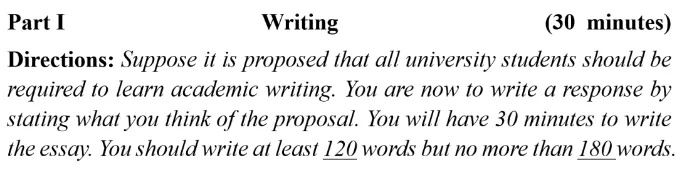
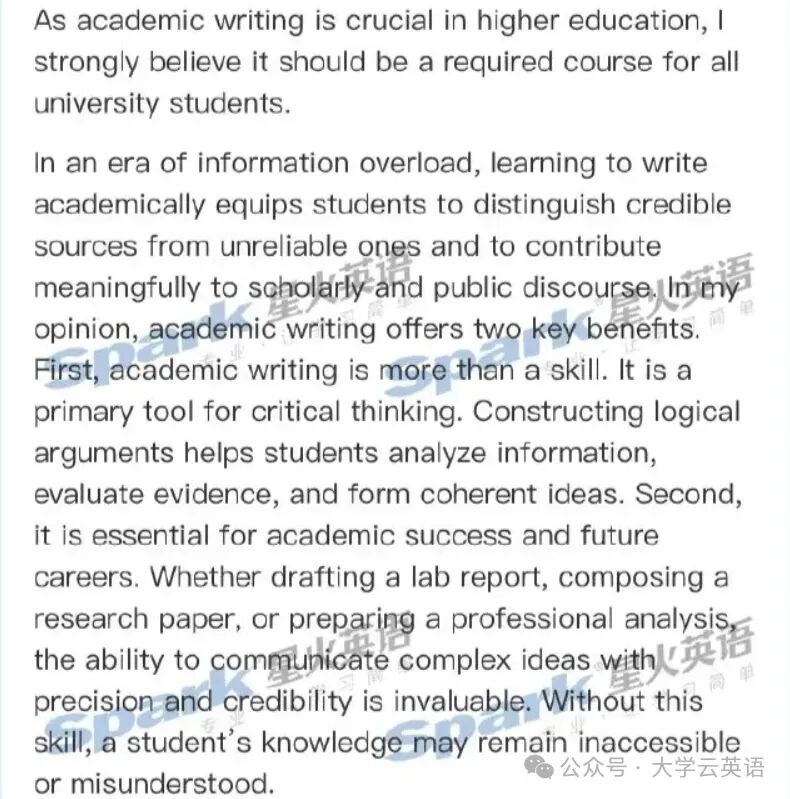
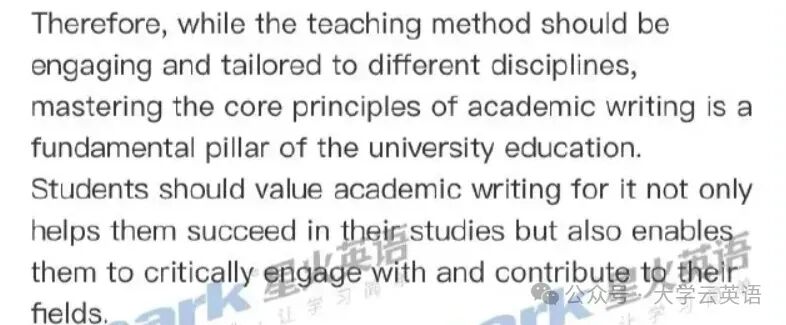
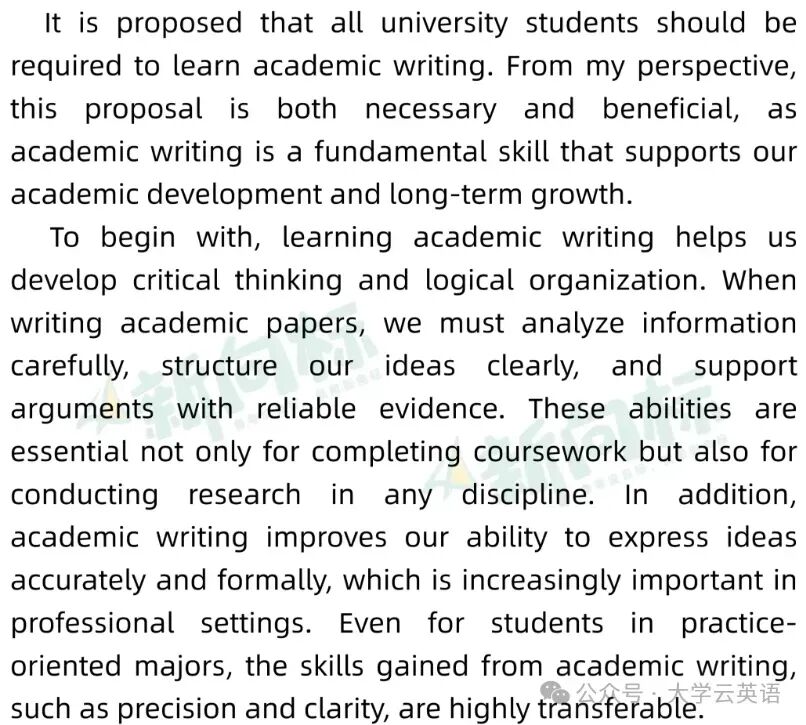
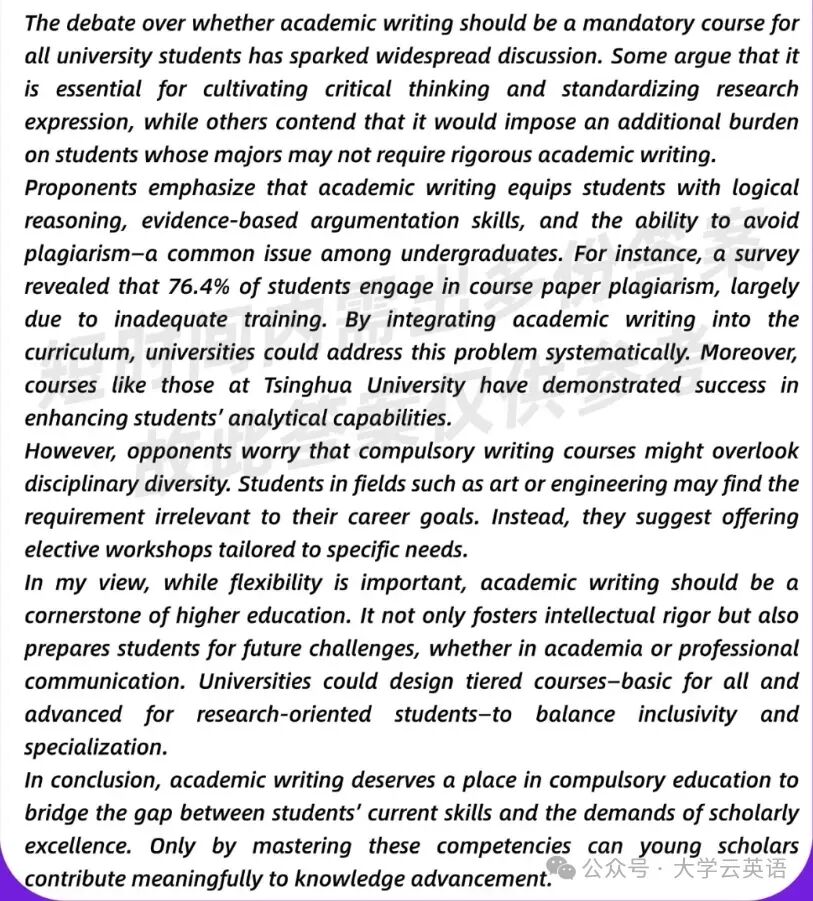
Direction:Suppose it is proposed that all university students should be required to learn academic writing. You are now to write a response by stating what you think of the proposal. You will have 30 minutes to write the essay. You should write at least 120 words but no more than 180 words.
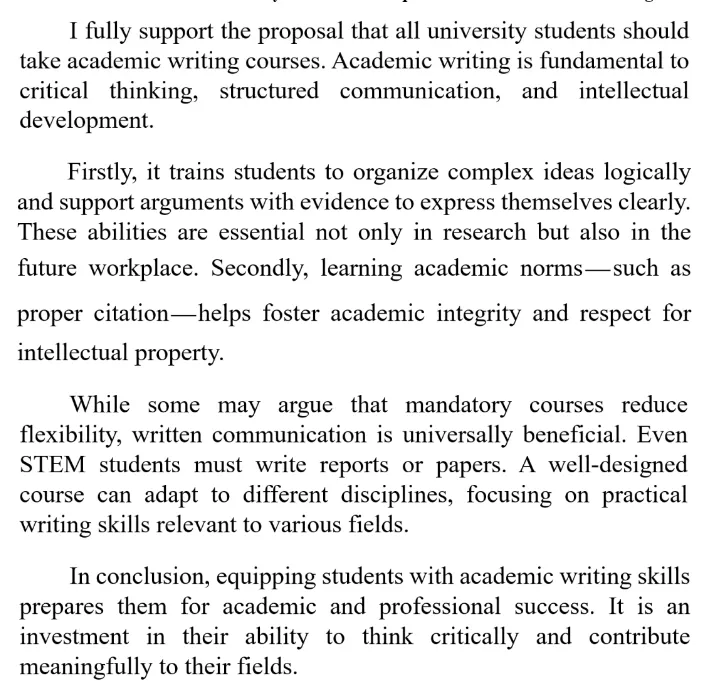
【题目翻译】假设有人提出:所有大学生都应该被要求学习学术写作。请你写一篇文章,表达你对这一提议的看法。
范文1
范文2
范文3
范文4
The proposal that all university students should be required to learn academic writing has sparked considerable debate. In my view, such a requirement is not only justified but essential for higher education.
To begin with, academic writing is fundamental to the development of clear and structured thinking. It compels students to organize ideas logically, evaluate evidence critically, and present arguments in a coherent manner. This process goes beyond mere expression; it shapes the way students analyze and understand complex issues across disciplines.
Furthermore, academic writing equips students with transferable skills that extend beyond the classroom. The ability to construct well-reasoned arguments and communicate them effectively is highly valued in professional environments, where clarity and precision are crucial. Without systematic training, many students struggle to meet these expectations.
Admittedly, some may argue that such a requirement increases academic pressure. However, with appropriate instruction, academic writing can be integrated progressively, making it both manageable and beneficial.
In conclusion, requiring all university students to learn academic writing is a necessary measure that strengthens both intellectual development and practical competence.
范文 5

话题三

题目
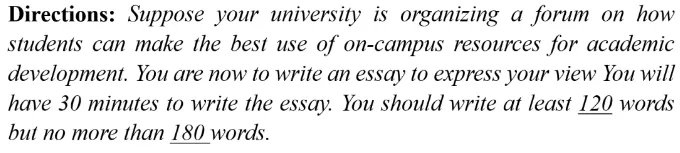
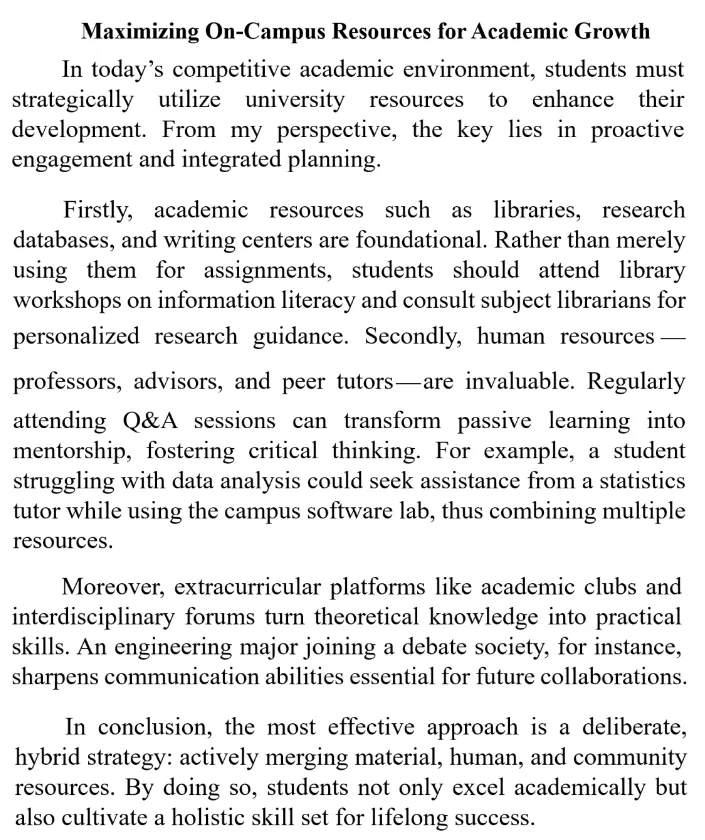
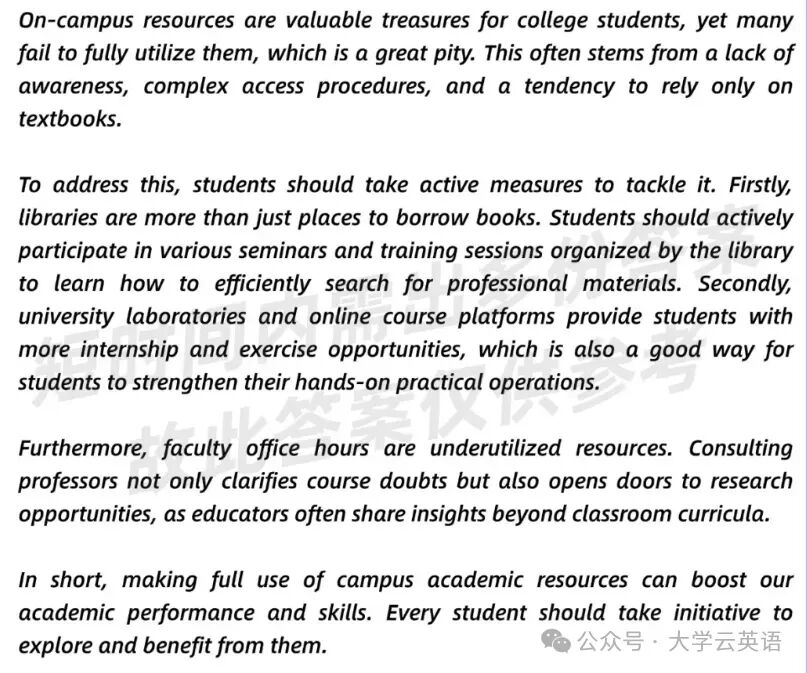
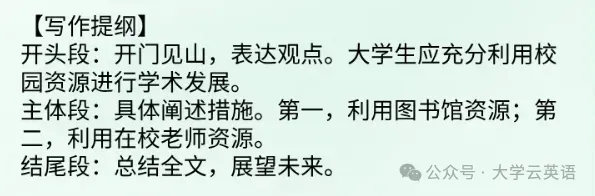
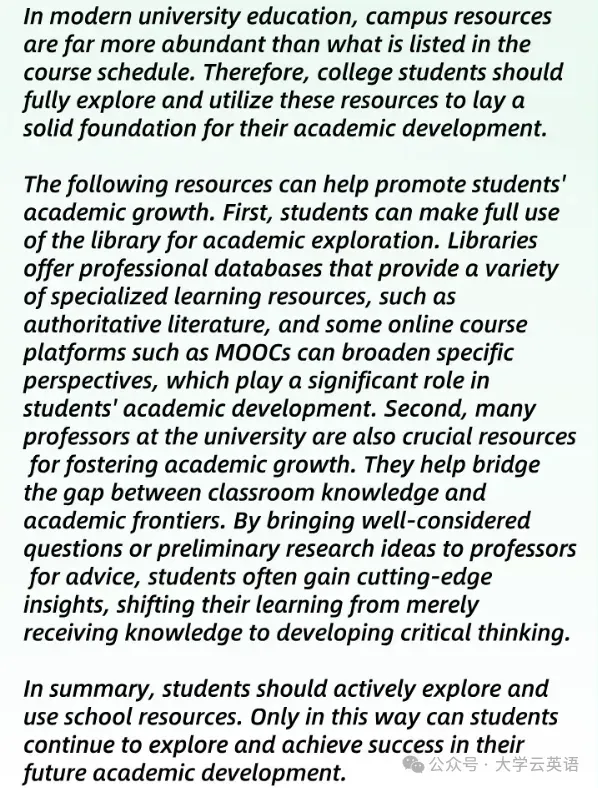
Directions:Suppose your university is organizing a forum on how students can make the best use of on-campus resources for academic development. You are now to write an essay to express your view. You will have 30 minutes to write the essay. You should write at least 120 words but no more than 180 words.
【题目翻译】假设你所在大学正在举办一个论坛,主题是学生如何充分利用校内资源促进学业发展。请你写一篇文章表达你的观点。
范文1
范文2
范文3
范文4
Every year, our university invests significantly in providing students with abundant academic resources. However, many remain underutilized. To fully harness these assets for academic growth, I believe students should adopt a strategic, three-pronged approach focusing on physical, digital, and human resources.
First and foremost, the library is the cornerstone of academic resources. Beyond being a quiet study space, it offers a treasure trove of books, specialized databases, and academic journals. Students should learn to use advanced search functions to locate relevant literature for their projects and papers. Secondly, digital platforms are indispensable. The university’s online learning portal often hosts recorded lectures, supplementary materials, and past exam papers. Actively engaging with these platforms can solidify classroom learning and provide valuable self-assessment tools. Finally, the most vital resource is often the people around us. Professors hold office hours for a reason, and teaching assistants are there to help. Forming study groups with peers can also transform individual weaknesses into collective strengths through discussion and explanation.
In conclusion, academic development on campus is not a passive process. It requires proactive exploration and integration of physical collections, digital tools, and human expertise. By consciously curating and utilizing these three dimensions of resources, we can transform our university experience from simply attending classes into a truly enriching intellectual journey, laying a solid foundation for future success.
范文5
Making full use of campus resources is essential for enhancing academic performance and achieving personal growth during university years. To maximize these opportunities, students can adopt the following practical approaches.
Firstly, the library serves as the cornerstone of academic development. Beyond borrowing books, students should actively utilize its digital databases, academic journals, and quiet study zones to conduct in-depth research and complete assignments with greater rigor. Secondly, participating in various academic activities—such as lectures, workshops, and seminars—helps broaden intellectual horizons and encourages critical thinking. These events often provide direct interaction with experts and peers. Thirdly, seeking guidance from professors and academic advisors is invaluable. Regular communication can offer personalized advice, inspire research ideas, and help navigate academic challenges.
By strategically using these resources, students can build a solid academic foundation, develop essential skills, and foster a lifelong passion for learning. Universities provide the tools, but it is each student‘s responsibility to engage with them actively and purposefully.
范文6
To achieve academic development, how students can make effective use of on-campus resources becomes increasingly significant. From my perspective, maximizing these resources requires both awareness and deliberate engagement.
To begin with, the library should not be viewed merely as a place for borrowing books, but as an integrated academic hub. Modern university libraries provide access to digital databases, scholarly journals, and research tools that are indispensable for in-depth study. Students who learn to navigate these resources efficiently are more likely to develop independent research capabilities.
In addition, institutional support services, such as writing centers and academic workshops, offer valuable opportunities for skill development. Rather than treating these services as remedial, students should regard them as complementary to formal instruction, where targeted feedback can refine both their writing and analytical abilities.
Equally important is the role of academic interaction with faculty members. Regular engagement during office hours or seminars allows students to clarify complex ideas and gain intellectual guidance beyond the classroom.
In sum, a proactive and purposeful approach to on-campus resources can significantly enhance both academic performance and intellectual growth.
▌信息:大学云英语综合整理编辑,转载请注明出处!
▌配图:来自网络,仅用于学习交流与研究。如有侵权,请联系我们删除
▌编辑:大学云英语



