

Reading
Module 1
Questions 1-10 of 35
Fill in the missing letters in the paragraph.
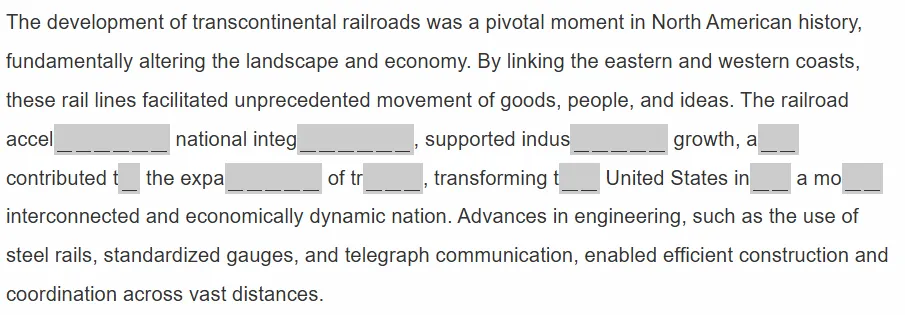
The development of transcontinental railroads was a pivotal moment in North American history, fundamentally altering the landscape and economy. By linking the eastern and western coasts, these rail lines facilitated unprecedented movement of goods, people, and ideas. The railroad accel_ _ _ _ _ _ national integ_ _ _ _ _ _ , supported indus _ _ _ _ _ growth, a_ _ contributed t_ the expa_ _ _ _ _ of tr_ _ _, transforming t _ United States in_ _ a mo_ _ interconnected and economically dynamic nation. Advances in engineering, such as the use of steel rails, standardized gauges, and telegraph communication, enabled efficient construction and coordination across vast distances.
Questions 11-20 of 35
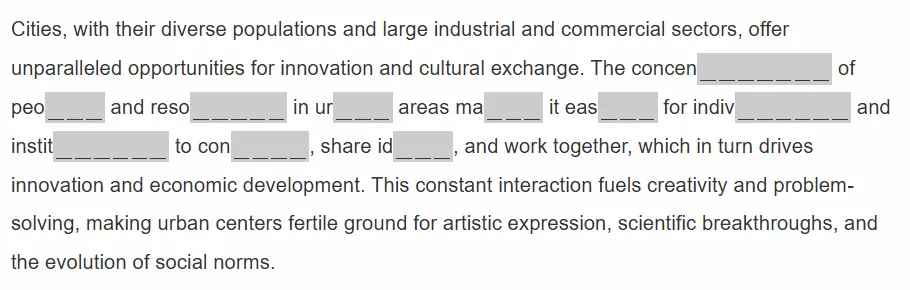
Cities, with their diverse populations and large industrial and commercial sectors, offer
unparalleled opportunities for innovation and cultural exchange.
The concen _ _ _ _ _ _ _ of peo _ _ _ and reso_ _ _ _ _ in ur_ _ _ areas ma_ _ _ it eas_ _ _ for indiv_ _ _ _ _ _ and instit_ _ _ _ _ _ to con_ _ _ _, share id_ _ _, and work together, which in turn drives to innovation and economic development. This constant interaction fuels creativity and problem-solving, making urban centers fertile ground for artistic expression, scientific breakthroughs, and the evolution of social norms.
Questions 21-22 of 35
Read a form.
Membership Application Form
First Name:
Last Name:
Address:
City:
Country:
Phone Number:
Email Address:
Annual Membership Type (Check one)
Individual - $50
Family - $90
Student - $30
Note:
Please read and agree to the terms and conditions before submitting. Thank you for your interest in joining our community.
Questions 21
Which membership type is offered at a reduced rate?
Individual
Family
Student
None
Questions 22
What is indicated about membership?
It includes an initial application fee.
It is valid for one year.
It provides lifetime benefits.
It is limited to residents of specific areas.
Questions 23-24 of 35
Read a course description.
Questions 23
All of the following would likely be homework assignments for this course EXCEPT
reading a chapter of Abelard's Ethics
doing research on the teachings of Buridan
preparing a presentation about a French philosopher
writing a paper about a modern French theologian
Questions 24
Which student satisfies all conditions required for enrollment in this course?
A junior who has completed PHIL 101
A junior with reading knowledge of French
A senior who has not completed PHIL 101
A first-year student who has completed PHIL 101
Questions 25-27 of 35
Read a text chain.
Sandeep Patel (10:00 A.M.)
Hey, are you coming to the concert tonight? I heard it's supposed to be amazing!
Fatima Khan (10:05 A.M.)
I would like to, but one of my classmates has been out sick all week and our report is due tomorrow.
Sandeep Patel (10:07 A.M.)
Oh no! That's a bummer.
Fatima Khan (10:10 A.M.)
Yeah, it is. Maybe next time. Are you going with anyone?
Sandeep Patel (10:12 A.M.)
Actually, I'm going with my cousin from Bangalore. He's visiting for the weekend.
Fatima Khan (10:15 A.M.)
That's nice. Hope you both have a great time!
Sandeep Patel (10:18 A.M.)
Thanks. If you finish early, you're welcome to join us.
Fatima Khan (10:20 A.M.)
I'll keep that in mind and let you know later if I'm coming after all.
Questions 25
Who is Sandeep going to the concert with?
His cousin
His classmate
Fatima
His friend
Questions 26
How does Sandeep most likely feel about Fatima's situation?
Happy
Relieved
Indifferent
Disappointed
Questions 27
At 10:05 a.m., what does Fatima most likely mean when she writes, "I would like to, but one of my classmates has been out sick all week and our report is due tomorrow"?
She feels too ill to go to the concert.
She will take next week off from work.
She does not think the concert will be enjoyable.
She is unlikely to be able to attend the concert.
Questions 28-30 of 35
CAMPUS RESEARCHERS 'CRACK' THE CONCRETE CODE
Researchers at the university have developed an affordable self-healing concrete. When cracks form, embedded microcapsules release a gap-sealing mineral solution. The prototype has already survived 50 freeze-thaw cycles in the lab, and now real-world testing is beginning on campus walkways, although students and faculty probably will not notice anything unusual beneath their feet.
Researchers predict huge benefits. “Our goal is to reduce costly repairs and extend building lifespans,” said lead researcher Dr. Elena Vargas. “Imagine bridges that fix themselves after storms.” Civil engineering professor Mark Chen called the innovation both practical and environmentally responsible. “This could revolutionize construction,” he said. “By minimizing waste and extending the life of materials, we’re saving money and reducing the environmental footprint.”
Larger trials are in the works, but for now campus walkways are a living laboratory, offering a glimpse into a future where concrete is resilient enough to heal itself.
Read a newspaper article.
Questions 28
What is the main topic of the article?
How students are learning about environmental responsibility
A debate over campus maintenance budgets
Campus research on a better building material
A plan to ban concrete use in new building projects
Questions 29
What is indicated about self-healing concrete?
It is activated by alternating exposure to heat and cold.
It uses liquid to reverse the effects of damage.
It was the product of a collaboration between two universities.
It is only suitable for indoor applications.
Questions 30
What can be inferred about the potential impact of self-healing concrete?
It will change the way bridges are designed.
It could significantly reduce costs for the maintenance of public infrastructure.
Its ultimate success will be determined by current trials on campus walkways.
It will have its greatest impact as a construction material for university buildings.
Questions 31-35 of 35
Navigating Gene Editing Ethics
Gene editing technologies, particularly CRISPR-Cas9, have transformed agricultural biotechnology by enabling precise modifications to plant genomes (genetic material). This allows scientists to enhance crop traits such as drought tolerance, pest resistance, and nutritional content without introducing foreign DNA (DNA from another species), distinguishing it from traditional genetic modification. For example, researchers have used CRISPR to develop rice varieties with improved yields and resistance to bacterial blight, a plant disease that is a major threat to global food security. In another case, gene-edited soybeans have been engineered to produce oil with reduced saturated fat and increased oleic acid—an unsaturated fat associated with heart health—making them more appealing for both consumers and food manufacturers.
Despite its promise, gene editing in agriculture raises important concerns. Unintended off-target effects, where edits occur in nontarget regions of the genome, could potentially alter plant metabolism or reduce resilience to environmental stress. Additionally, widespread adoption of uniform edited traits may diminish genetic diversity, making crops more vulnerable to future pests or diseases. Such outcomes highlight the need for comprehensive field testing and multi-season trials to mitigate risks before commercial release. Scientists must evaluate not just the intended trait but also how gene edits affect overall plant health and adaptability.
Questions 31
According to the passage, how is CRISPR-Cas9 technology superior to traditional genetic modification?
It is supported by more extensive research.
It is easier for scientists to implement.
Its modifications do not involve foreign DNA.
Its modifications are only temporary.
Questions 32
Why does the passage mention "soybeans"?
To illustrate CRISPR-Cas9's potential to improve the nutritional content of crops
To show that CRISPR-Cas9 technology works better in soybeans than in rice
To highlight the role of food manufacturers in agricultural biotechnology
To explain how crop traits relate to heart health
Questions 33
The passage mentions all of the following potential negative effects of gene editing in agriculture EXCEPT
a decreased ability to survive in harsh conditions
an increased chance of being harmed by pests
a greater likelihood of suffering from diseases
a higher risk of harming the wider environment
Questions 34
The word "diminish" in the passage is closest in meaning to
limit
reduce
stabilize
predict
Questions 35
Despite its promise, gene editing in agriculture raises important concerns. ◼︎ Unintended off-target effects, where edits occur in nontarget regions of the genome, could potentially alter plant metabolism or reduce resilience to environmental stress. ◼︎ Additionally, widespread adoption of uniform edited traits may diminish genetic diversity, making crops more vulnerable to future pests or diseases. ◼︎ Such outcomes highlight the need for comprehensive field testing and multi-season trials to mitigate risks before commercial release. Scientists must evaluate not just the intended trait but also how gene edits affect overall plant health and adaptability. ◼︎
There are four locations [◼︎] in the passage that indicate where the following sentence could be added.'"
One study about this danger cited the Irish Potato Famine, in which genetically similar varieties were all susceptible to late blight, causing a major catastrophe.
Where would the sentence best fit? Select a location [◼︎] to add the sentence to the passage."
Module 2
Questions 1-10 of 15
Archaeological evidence suggests that Homo sapiens first emerged in Africa approximately 300,000 years ago. These early humans were adept at utilizing the resources available to them, including plants and animals that supplied materials for food, clothing, and shelter. They crafted to _ _ _ from st _ _ _ and ani_ _ _ bones a_ _ adapted th_ _ _ hunting techn_ _ _ _ _ to t_ _ changing clim_ _ _ _ and lands_ _ _ _ _ , thus ensu_ _ _ _their survival. As they migrated out of Africa, they encountered diverse environments, leading to cultural and technological innovations.
Questions 11-15 of 35
The Power of Music
Music is often hailed as a universal language. Philosophers and neuroscientists alike have explored music's power to convey emotions without words. While lacking the precision of spoken language, music uniquely evokes complex emotions, a phenomenon attributed to its simultaneous engagement of various brain regions. This interplay not only stirs emotions but also triggers memories and bodily responses, making music a profound medium of expression.
Historically, figures like the ancient Greek philosopher Aristotle argued for music's ethical influence, positing that different musical modes could either promote virtue or incite vice. Modern research, however, leans toward music's role in emotional regulation rather than moral alteration. Researchers have investigated how music interacts with human psychology beyond mere enjoyment. For instance, studies have shown that listening to slow-tempo classical music can reduce anxiety levels in patients before surgery, demonstrating music's therapeutic potential.
Surprisingly, the ability to perceive emotions in music transcends cultural contexts. Studies reveal that individuals worldwide can discern emotions like joy or sorrow in music, suggesting an innate human aptitude for musical expression. This universality has sparked inquiries into music's evolutionary role, raising questions about whether music is merely an art form or a crucial aspect of human development.
Questions 11
The word "interplay" in the passage is closest in meaning to
interaction
interpretation
interval
intervention
Questions 12
It can be inferred that music is similar to language in that music
matches the precision of written language
engages only those areas of the brain that language engages
has rules that are very similar to the rules of spoken language
is a medium of expression that conveys complex emotions
Questions 13
Why does the author mention ancient Greek philosopher Aristotle?
To point out that music was once thought to have a significant moral influence
To support the point that music is a powerful tool for emotional regulation
To identify the person who founded the academic field known as music theory
To suggest that ancient philosophers had a more nuanced understanding
Questions 14
Why does the author mention "patients before surgery"?
To demonstrate that the ancient Greek understanding of music was incorrect
To argue that emotional states affect the enjoyment of music
To provide an example of how music regulates emotions
To suggest that slow-tempo classical music can lead to anxiety
Questions 15
According to the passage, the existence of an innate human aptitude for musical expression suggests that
music should only be seen as a form of art
music may have played an important role in human development
music that expresses joy is more universally appreciated than music that expresses sorrow
music is not understood in the same way across different cultures
Listening
Module 1
Q1:
The class is exciting.
Yes, I study with Sarah.
It's been a few years now.
I've enjoyed my time here.
Q2:
The soccer coach is really good.
I love to sing, but I'm too busy.
Practice is the key to success.
I hear that the chef is excellent.
Q3:
I've never missed one.
I was able to park on campus.
Yes, they're arriving on time for class.
Tomorrow night sounds great.
Q4:
Maybe four or five total.
Who will be teaching it?
The advanced mathematics course.
Yes, it should be fun.
Q5:
The website would probably be the best resource.
It's been a while since I went hiking with the outdoor adventure club.
Do you think camping is a good way to relax?
I've been taking swimming lessons in the morning before classes.
Q6:
I learned that in my cooking class at the university.
I remember something similar to that.
They serve warm bread with every meal.
I have to study for my exam tomorrow, unfortunately.
Q7:
You are welcome here, too.
It was the only one with enough space.
I will receive the product tomorrow.
Yes, I was there.
Q8:
Sure, in three days.
Thanks for letting me know.
No, I can't go.
There's one in the student center.
Q9:
I completely agree.
Meeting start times vary.
Meetings are important.
In the conference room.
Q10:
I'll turn the hamburgers over in a minute.
Actually, it's pretty heavy.
As soon as I've cleaned up.
I can open it for you.
Q11:
The student bookstore should have it.
The customer is always right.
I usually call them directly.
It's very bright in here, isn't it?
Q12:
My door is always open.
There should be enough storage space.
I'll need to look up the hours online.
The campus bookstore has great reviews.
Conversation, Announcement, and Academic Talk
You will listen only one time and then answer questions.
In an actual test, the clock will indicate how much time you have to answer.
Q13-14
Q13:
What is the man most likely preparing for?
A ski holiday
A camping trip
A vacation at the beach
A hike in the mountains
Q14:
What does the woman offer to do?
Visit a store with the man
Lend the man a pair of shoes
Join the man on an adventure
Introduce the man to a store's owner
Q15-16
Q15:
Why has the woman not bought tickets yet?
She no longer wants to visit an attraction.
She has been unable to connect to a website.
She wanted more information about prices.
She was waiting for further instructions from the man.
Q16:
What will the woman most likely do next?
Purchase tickets
Check her calendar
Contact her classmates
Call the sculpture garden
Q17-18
Q17:
What is the woman interested in?
A music concert
A theater play
A comedy show
A movie screening
Q18:
What does the man say about the performers?
They are local artists.
They are mostly new performers.
They are a mix of well - known and new performers.
They are well known around the world.
Q19-20
Q19:
What will happen in the kitchen starting this week?
Food that is past its expiration date will be removed.
Sponges and dish soap will be provided for residents.
Dirty dishes in the sink will be thrown away.
The custodial staff will clean the refrigerator.
Q20:
What does the speaker suggest about unlabeled items in the kitchen?
They are considered the speaker's property.
They are replenished on a daily basis.
Everyone shares responsibility for them.
Everyone is welcome to use them.
Q21-22
Q21:
What is the announcement mainly about?
A store opening
A financial seminar
A job opportunity
An updated schedule
Q22:
What does the speaker indicate about the coffee mugs?
Their design makes them highly practical.
They will be unavailable before 10 a.m.
They are given for free with a book purchase.
They are popular university souvenirs.
Q23-24
Q23:
What question would someone in the audience most likely ask?
What are the environmental benefits?
Should public universities be free to attend?
Should a law be passed to lower the legal driving age?
What are the impacts of social media on children?
Q24:
What does the speaker imply that audience members may be inspired to do?
Propose a law
Join a club
Submit a contest entry
Vote on the debate winner
Q25-28
Q25:
What is the location of the artwork by Robert Smithson that the speaker discusses?
A forest
A lake
A mountaintop
A desert
Q26:
What does the speaker emphasize about the physical nature of Spiral Jetty?
It was constructed using materials meant to resist weathering.
It was designed without consideration of its surrounding environment.
It requires frequent human maintenance to preserve its form.
It is shaped by its ongoing interaction with its natural environment.
Q27:
What does the speaker imply was Smithson's attitude toward art museums?
He believed that they were the only way to give large numbers of people access to great art.
He felt that they were necessary to preserve artworks from the effects of time.
He felt that they limited people's experience of art.
He believed that they should be located far from big cities.
Q28:
Why does the speaker mention that Spiral Jetty is mainly known through photographs and movies?
To point out that Smithson was an artist of wide-ranging talents
To emphasize the enormous fame that the work enjoys
To introduce a criticism that is made of the work
To suggest that Smithson's views about Land Art changed since he created the work
Q29-32
Q29:
What about Jacob Lawrence does the speaker mainly discuss?
The difficulties he faced during the Great Migration
A series of paintings that is representative of his work
How he was influenced by other African American painters
How his style changed during his career
Q30:
What is the speaker's attitude toward The Migration Series?
Disappointed that it is not widely known today
Confused about the purpose of including many panels
Impressed by this accomplishment early in Lawrence's career
Surprised by the information that Lawrence provided in the captions
Q31:
Why does the speaker mention Harriet Tubman?
To describe a method that Lawrence used to paint human figures
To emphasize Lawrence's involvement in social activism
To introduce a point about African Americans in Northern cities
To provide an example of an important African American figure that Lawrence painted
Q32:
What does the speaker imply about Jacob Lawrence's critics?
They thought a child had painted some of his artworks.
They believed that The Migration Series was his best work.
They did not value work that seemed less artistically advanced.
They did not appreciate his earliest paintings as much as his later ones.
Module 2
Q1:
Yes, the weather was perfect.
No, in the science building.
I may be running a little late.
She said to come by after dinner.
Q2:
It started last Monday at noon.
The seminar is about environmental science.
I just saw the changes this morning.
It's located on the east side of campus.
Q3:
Your advisor probably has more information.
From noon to 3 p.m.
Yes, he just entered the graduate research program.
Those boxes shipped out last week.
Q4:
What does the man imply about his current job?
The wages are too low.
The shifts are too long.
It offers employees discounted textbooks.
It requires him to work on weekends.
Q5:
What does the woman suggest about her friend Paul?
He is happy working at a bookstore.
He would be a good source of information.
He was not admitted to the university.
He struggles to balance work and school.
Q6:
What does the man imply about his travel plans?
He wants to minimize the cost.
He will spend one week in Chicago.
He has already purchased tickets.
He prefers to travel by train.
Q7:
What feeling does the man express at the end of the conversation?
He is confident that he will be ready to start the new semester.
He is hopeful that he can take all the classes he wants.
He is worried about returning to campus so late.
He is concerned that he might miss his train.
Q8:
What is the talk mainly about?
Changes in the design of ships
Advances in navigation techniques
Common trade routes during ancient times
The effects of early navigation on several cultures
Q9:
According to the speaker, how did Pytheas guide his ship?
By following ocean currents and wind patterns
By consulting maps created by earlier explorers
By using a magnetized needle to determine direction
By observing cues on land, on the sea, and in the sky
Q10:
What does the speaker say about the magnetic compass?
It was originally invented to assist with land travel.
It was primarily used to navigate familiar coastal routes.
It quickly replaced the need for all other navigational tools.
It allowed explorers to navigate oceans with greater confidence.
Q11:
Why does the speaker mention Vasco da Gama and Ferdinand Magellan?
To show how early explorers predicted weather conditions
To highlight the dangers of sailing without instruments
To emphasize the impact of navigational tools on exploration
To describe the role of trade in early exploration efforts
Q12:
What is the main purpose of the talk?
To introduce a new style of documentary
To outline the process of making a film
To compare two significant documentaries
To contrast two kinds of nonfiction films
Q13:
What attitude does the speaker express when she discusses documentaries?
She is pleased that documentaries inspire viewers to travel to unfamiliar places.
She is disappointed that documentaries are becoming less popular.
She is concerned that viewers are too trusting of documentaries.
She is frustrated that many documentaries try to tell complicated and confusing stories.
Q14:
Why does the speaker mention Forest of Bliss?
To give an example of a film with elaborate production
To give an example of an ethnographic film
To illustrate the popularity of films about nature
To illustrate the importance of directors in filmmaking
Q15:
According to the speaker, how might researchers prepare to make ethnographic films?
By coming up with a dramatic story they want to tell
By learning the filming techniques of the culture they are studying
By spending a long time living within a particular culture
By analyzing news footage about a particular culture
Writing
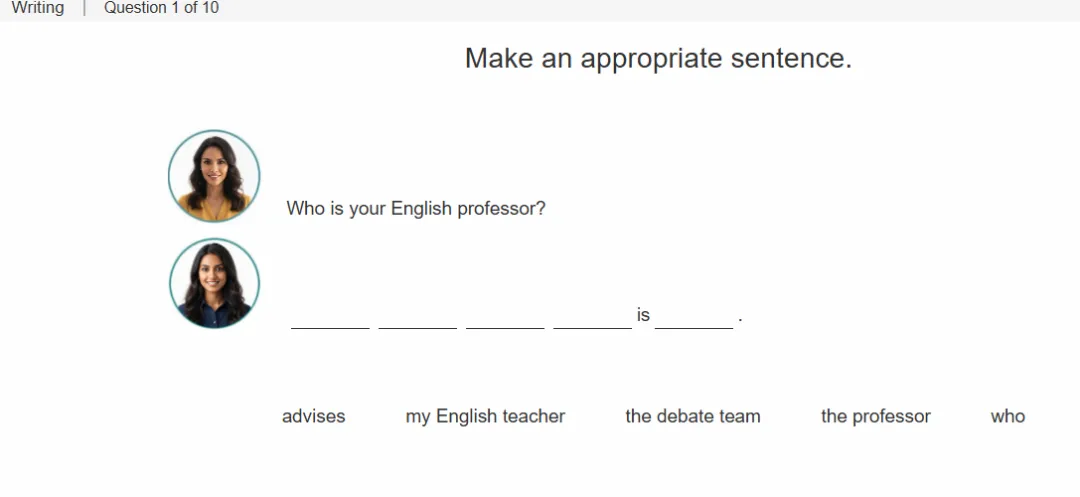
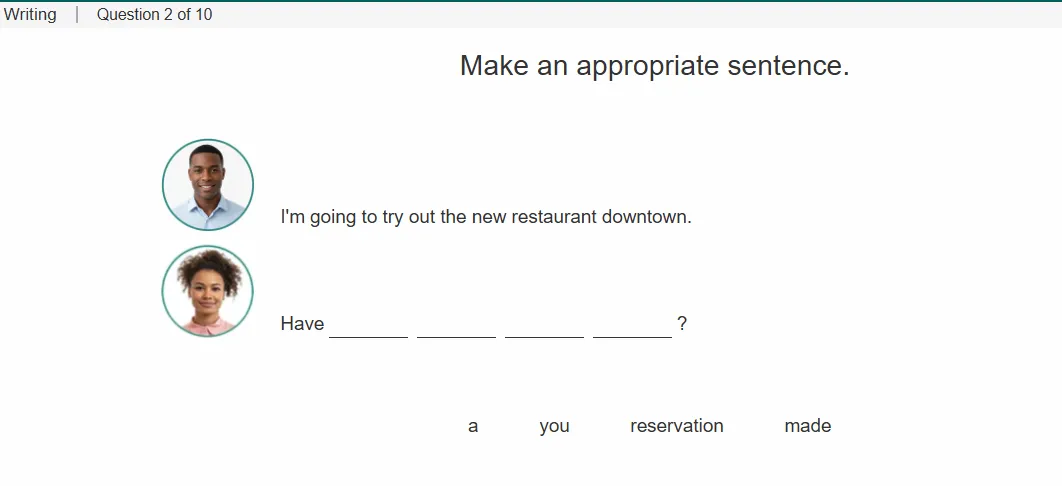
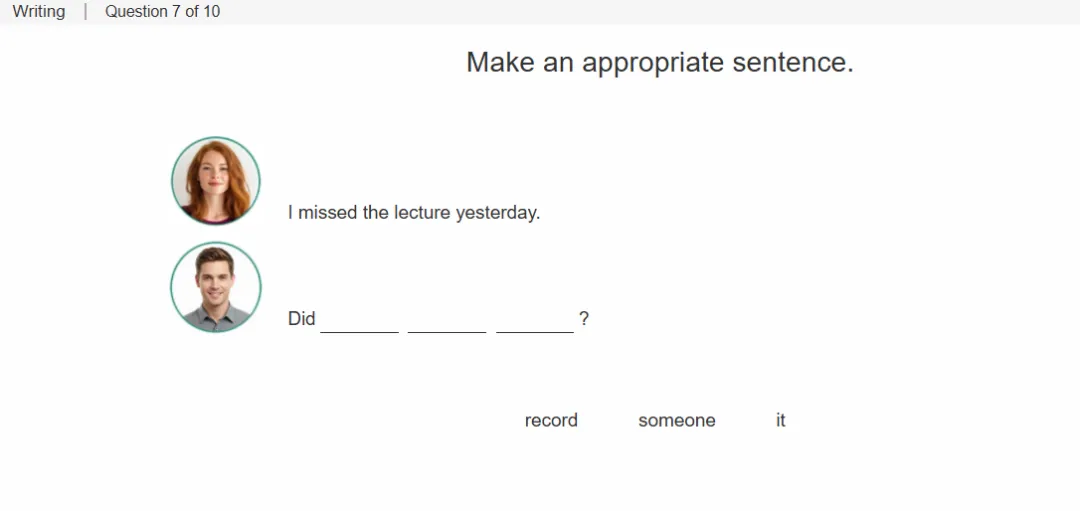
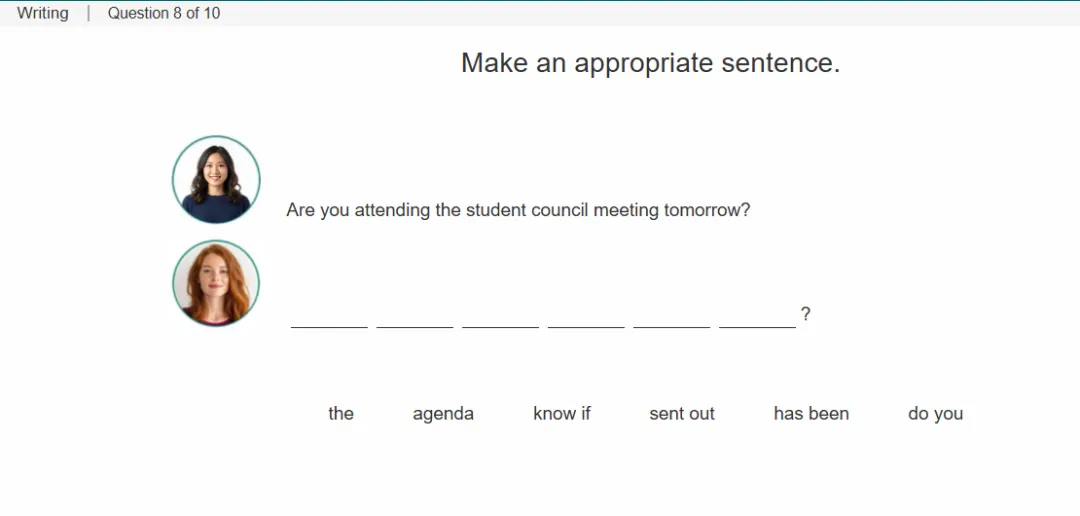
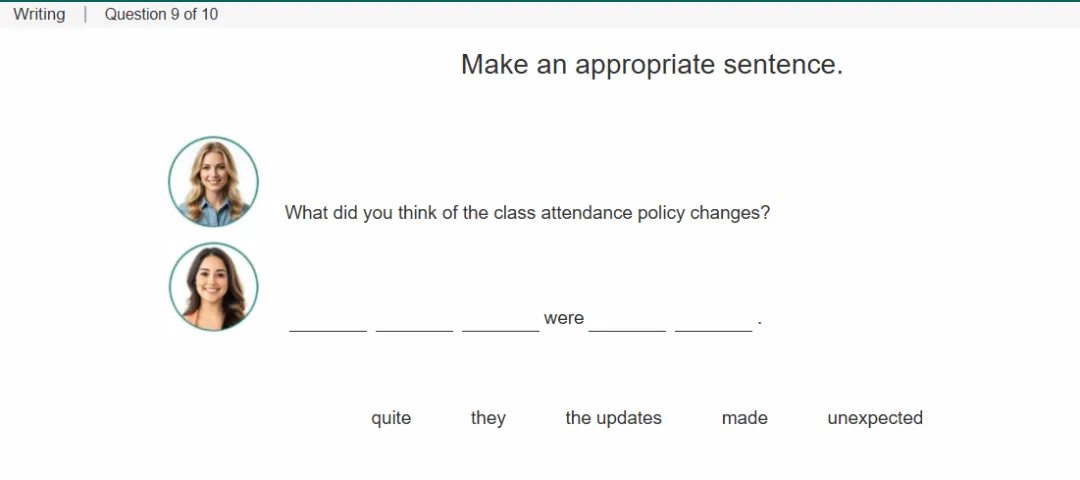
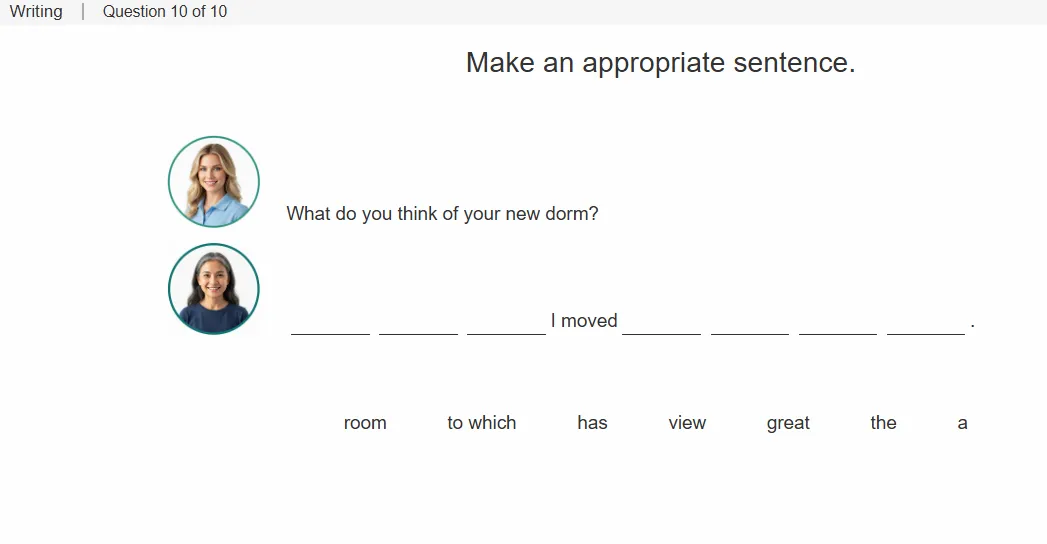
Build a Sentence
Move the words in the boxes to create grammatical sentences.
A clock will show you how much time you have to complete this task.
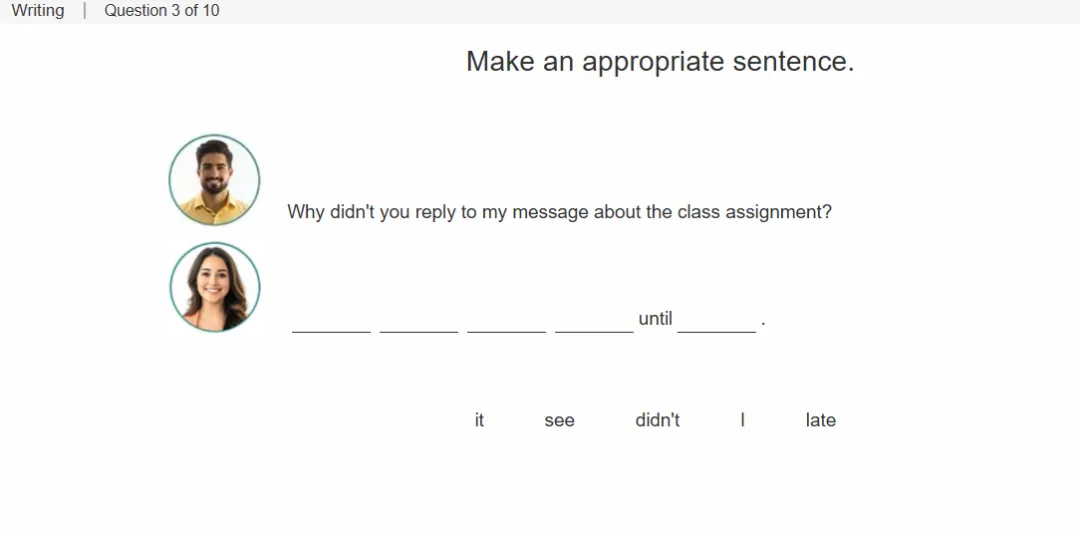
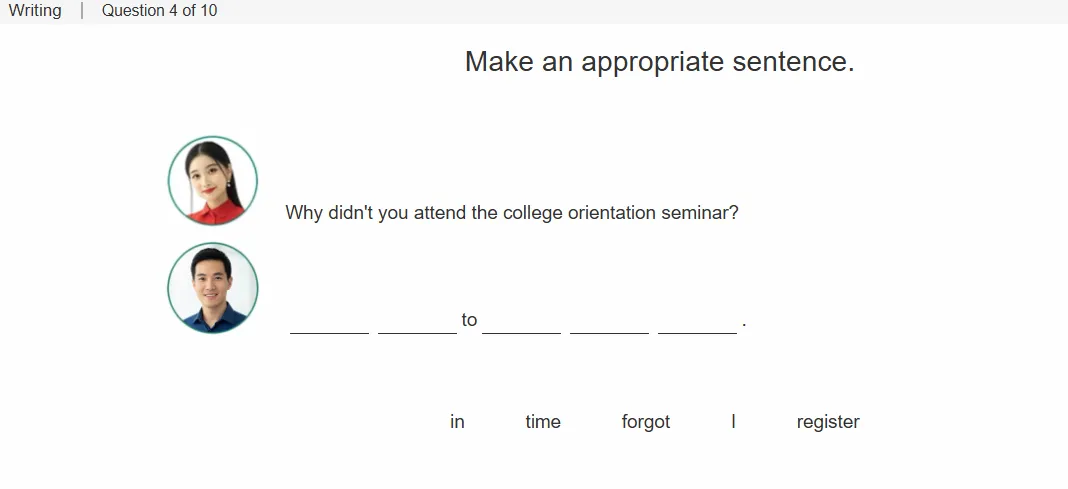
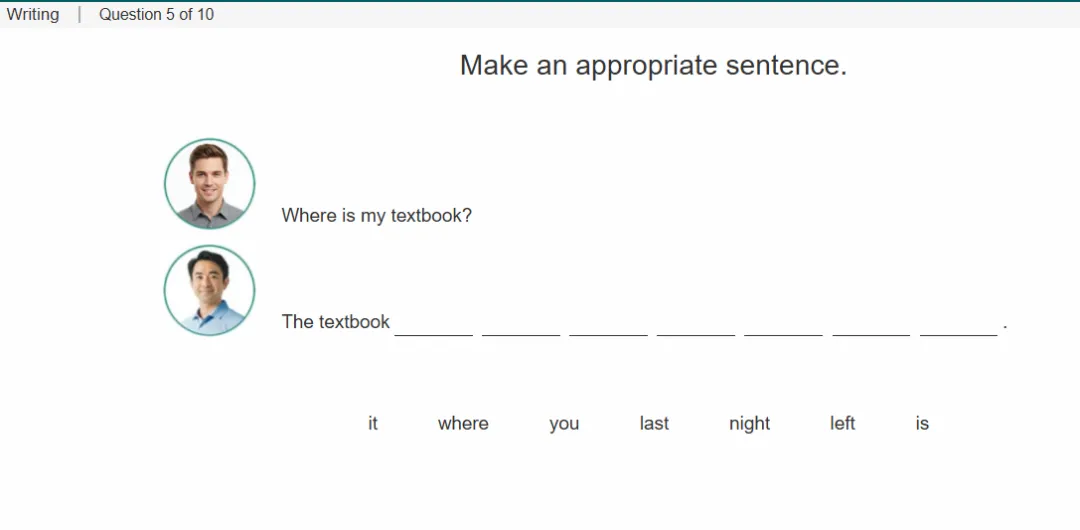
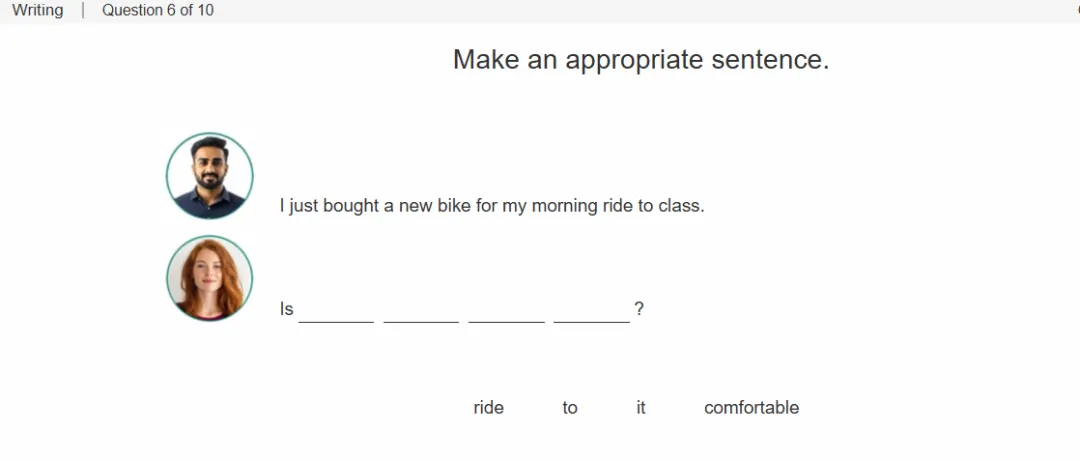
Write an Email
You will read some information and use the information to write an email.
You will have 7 minutes to write the email.
Q1
You recently visited a community center that offers various recreational activities. You want to provide feedback on the community center to its manager, Mr. Larson.
Write an email to Mr. Larson. In your email, do the following:
Describe what you enjoyed about the community center.
Identify a recreational activity that the community should add to its current offerings.
Explain why adding this activity would benefit community members.
Write as much as you can and in complete sentences.
Your Response:
To: Mr. Larson
Subject: Suggestion for a community center
Q2
Your professor is teaching a class on media. Write a post responding to the professor's question.
In your response, you should do the following.
Express and support your opinion.
Make a contribution to the discussion in your own words.
An effective response will contain at least 100 words.
Professor Achebe
Social media platforms often use algorithms, which are sets of rules computers follow to make decisions, to show users content they might like or find interesting. This customization means everyone's experience is unique, but it also raises concerns. Some argue it helps users find what they enjoy faster, while others worry it might limit exposure to diverse perspectives and create echo chambers. What do you think? Does the customization of social media through algorithms have negative effects?
Kelly
I believe overreliance on algorithms can negatively affect our online experiences. It limits the joy of stumbling upon new content randomly. This organic discovery often leads to learning about diverse topics and viewpoints, which algorithms might filter out, creating a narrow view of the world.
Andrew
Personalization algorithms on social media are beneficial, especially for small creators. They help these groups gain visibility among users who have shown interest in similar content. This customization enables users to discover new content they're likely to enjoy, supporting smaller creators who might otherwise be overlooked.
Speaking
http://www.tuonindefu.com/?p=13436


