

为什么是这道题?
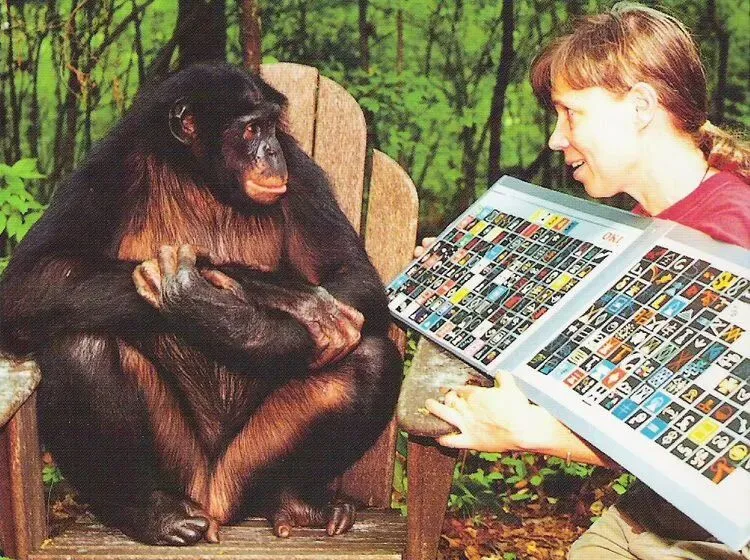
2026 年 2 月,科学界传来一条让所有研究"想象力"的人愣住的消息——一只名叫 Kanzi 的倭黑猩猩,跟着研究者玩起了"假装的茶话会"。研究者递空杯,假装倒果汁、假装放葡萄,Kanzi 真的能跟着玩,追踪根本不存在的食物,正确地指向空杯子里"该有的东西"。
这是科学家第一次在非人类身上确认"假装"的能力——一种过去被认为只属于人类幼儿的高级心智活动。这种"有名字的动物 + 反直觉认知发现 + 可升华为人生哲学"的题材,正是命题人最爱的取材方向。
模拟题原文
When a small child pours pretend tea from an empty teapot and asks her toy bear if he wants "more sugar," something quietly amazing is happening. She is imagining—holding in her mind something that isn't really there. For a long time, scientists believed only humans could do this. Animals, they said, can solve problems and learn tricks, but they cannot pretend.
Then they met Kanzi.
Kanzi is a male bonobo (倭黑猩猩) who has lived with researchers for most of his life. He learned to point at hundreds of symbols to "speak" with humans. In February 2026, scientists published a new study about him in the journal Scientific Reports. This time, they didn't ask Kanzi to solve a puzzle. They invited him to a pretend tea party.
The researchers handed Kanzi an empty cup and acted as if they were pouring juice into it. They held out an empty hand and acted as if they were passing him a grape. They wanted to see what Kanzi would do. The result surprised everyone. Kanzi reached for the invisible grape. He looked into the empty cup as if checking the level of juice. When asked where the imaginary food was, he pointed correctly, again and again.
He wasn't fooled. He knew there was nothing there. But he chose to play along. He understood the game, kept track of the made-up juice and grapes, and treated them as if they were real. That, scientists say, is imagination.
The study is small—just one bonobo—but its meaning is large. For years, "pretending" was a line drawn between humans and every other animal. Kanzi has now stepped across it. As one researcher noted, perhaps imagination isn't a gift only humans were born with. Perhaps it's something older, deeper, and shared with the cousins we have on this planet. The space inside a mind may be bigger than we thought.
题目(每题 2 分,共 8 分)
1. What did Kanzi do during the tea party?
A. He drank real juice from an empty cup.
B. He pointed at where the invisible food should be.
C. He refused to take part in the game.
D. He tried to steal grapes from the researchers.
2. What does the underlined phrase "play along" in Paragraph 5 mostly mean?
A. Follow the game as if it were real.
B. Play music with the researchers.
C. Hide his real feelings from people.
D. Run after the other bonobos to play.
3. Why does the writer begin with a child pouring pretend tea?
A. To compare child behavior with that of toy bears.
B. To introduce the kind of imagination the study tests.
C. To remind readers to play more with younger family.
D. To show that children are smarter than bonobos.
4. What is the writer's main idea?
A. Bonobos should be raised by human families.
B. Kanzi is smarter than any other animal alive.
C. Imagination may not belong to humans alone.
D. Tea parties are an important way to study animals.
答案 1. B 2. A 3. B 4. C
01 · 解题策略
核心抓三句话:第 1 段末"they cannot pretend"(立靶)、第 5 段末"That, scientists say, is imagination"(金句)、末段"imagination isn't a gift only humans were born with"(升华)。
02 · 源头分析
源头是 2026 年 2 月发表于《Scientific Reports》的研究。Kanzi 是一只跟人类研究者共处近 40 年的倭黑猩猩,能用词汇板(lexigram)"说"几百个词,是动物认知史上最有名的"语言学生"之一。这次研究第一次把"假装"这条曾经被认为只属于人类的认知线推到了非人类那一边。和项目里 Veronika("不是天才,是机会")、裂唇鱼("小不代表内心小")形成"重新理解智慧"的三联画。
03 · 做对题,更做对人
进入初中以后,很多人会被一句话拦住:"别幼稚了"。喜欢的玩具被收起来、爱看的动画片被嘲笑、写小说画漫画被说"不务正业"。好像长大就等于把想象力关进抽屉。
但 Kanzi 提醒你——想象力不是幼稚,是一种很深的能力。它能让你看见还不存在的东西:还没解出的题、还没写出的故事、还没走通的路。所有"成事"的人,都是先在脑子里把它"假装"过一遍。
不要因为长大,就让自己变得不会假装。
长大不是失去想象力——是悄悄把它藏好。


