



一、试题总体分析
1. 选题题材
| 题型 | 题材 |
|---|---|
| 语法选择 | 童话/寓言故事(女孩与树精) |
| 完形填空 | 情感成长类(女孩与小猫) |
| 阅读理解A | 励志成长(作家追梦) |
| 阅读理解B | 历史人物(徐霞客) |
| 阅读理解C | 科技说明(AI智能体 OpenClaw) |
| 阅读理解D | 活动通知(BrainFest 脑科学展) |
| 阅读填空 | 自然科普(彩虹形成原理) |
| 语篇填词 | 动物科普(树懒) |
| 完成句子 | 广州文化(广交会) |
| 书面表达 | 建议信(“Charming Guangzhou”文旅活动) |
2. 生词与词组(部分示例)
| 生词/词组 | 含义 |
|---|---|
| scarce | 缺乏的 |
| cloak | 斗篷 |
| braid | 辫子 |
| shelter | 庇护所 |
| adoption | 采用 |
| uneasy | 不安的 |
| bend | 弯曲 |
| clumsy | 笨拙的 |
| survive falls | 从跌落中幸存 |
3. 语法知识点
| 语法点 | 题号示例 |
|---|---|
| 形容词原级/比较级/最高级 | 1 |
| 非谓语动词(to do) | 2 |
| 时态(将来时、过去时) | 3, 8 |
| 冠词(a/an/the) | 4 |
| 副词修饰动词 | 5 |
| 宾语从句连接词 | 6 |
| 情态动词(must) | 7 |
| 不定代词 | 9 |
| 介词(across) | 12 |
| 连词(but) | 13 |
| 反身代词 | 14 |
| 定语从句(whose) | 15 |
4. 难点总结
语法选择:语境理解要求高,尤其是情态动词、代词、连词的选择。
完形填空:情感线索明显,需把握主人公情绪变化。
阅读理解:篇幅较长,推理题、词义猜测题较多。
语篇填词:首字母提示,需结合上下文语义和词性。
完成句子:固定搭配和句型结构(如被动语态、感叹句)。
书面表达:建议信结构 + 内容拓展能力。
2026年广州中考海珠二模答案解释
第一部分:语法选择(1-15)
英文原文
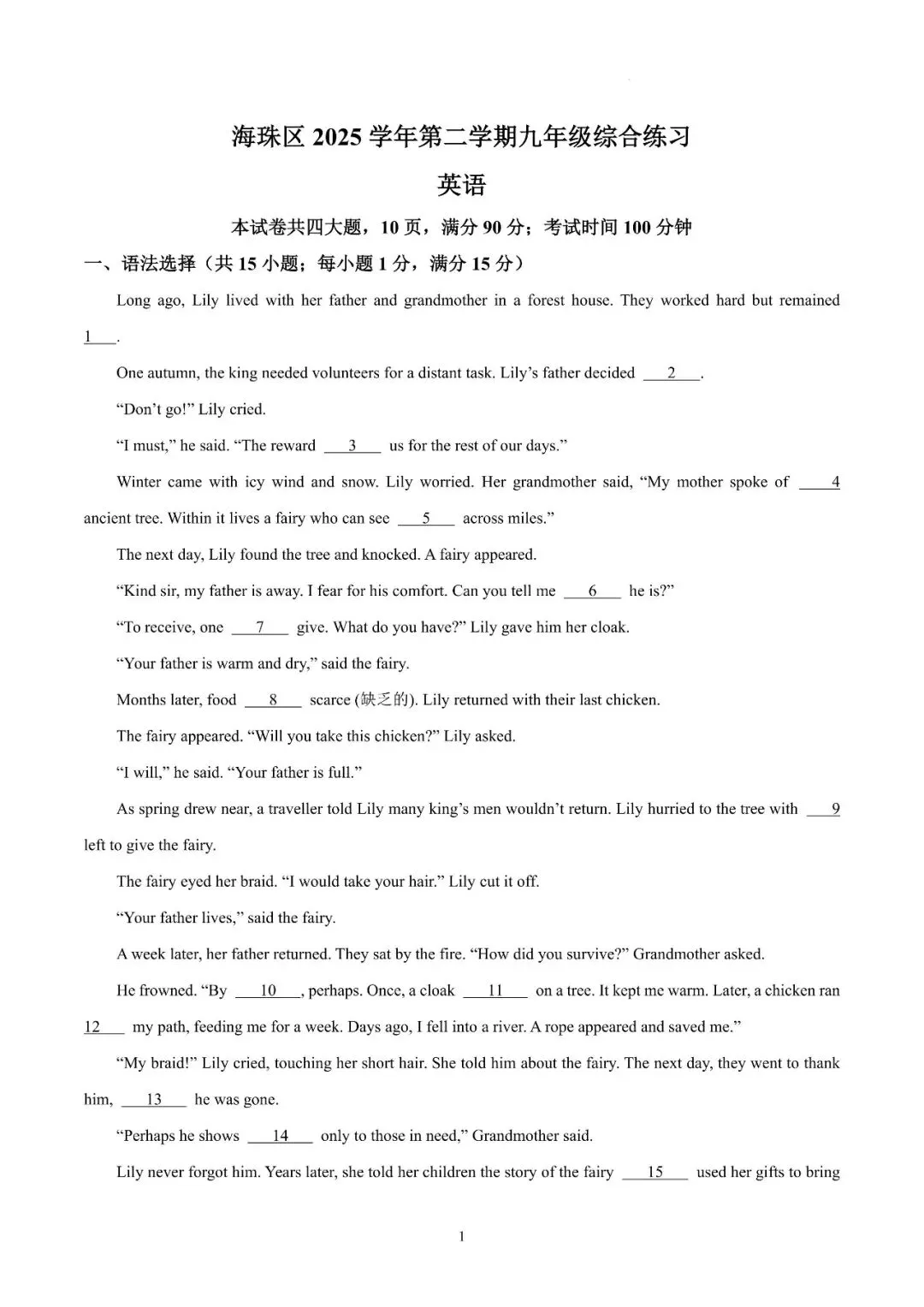
Long ago, Lily lived with her father and grandmother in a forest house. They worked hard but remained poor.
One autumn, the king needed volunteers for a distant task. Lily's father decided to go.
"Don't go!" Lily cried.
"I must," he said. "The reward would feed us for the rest of our days."
Winter came with icy wind and snow. Lily worried. Her grandmother said, "My mother spoke of an ancient tree. Within it lives a fairy who can see clearly across miles."
The next day, Lily found the tree and knocked. A fairy appeared.
"Kind sir, my father is away. I fear for his comfort. Can you tell me where he is?"
"To receive, one must give. What do you have?" Lily gave him her cloak.
"Your father is warm and dry," said the fairy.
Months later, food became scarce. Lily returned with their last chicken.
The fairy appeared. "Will you take this chicken?" Lily asked.
"I will," he said. "Your father is full."
As spring drew near, a traveller told Lily many king's men wouldn't return. Lily hurried to the tree with nothing left to give the fairy.
The fairy eyed her braid. "I would take your hair." Lily cut it off.
"Your father lives," said the fairy.
A week later, her father returned. They sat by the fire. "How did you survive?" Grandmother asked.
He frowned. "By magic, perhaps. Once, a cloak was found on a tree. It kept me warm. Later, a chicken ran across my path, feeding me for a week. Days ago, I fell into a river. A rope appeared and saved me."
"My braid!" Lily cried, touching her short hair. She told him about the fairy. The next day, they went to thank him, but he was gone.
"Perhaps he shows himself only to those in need," Grandmother said.
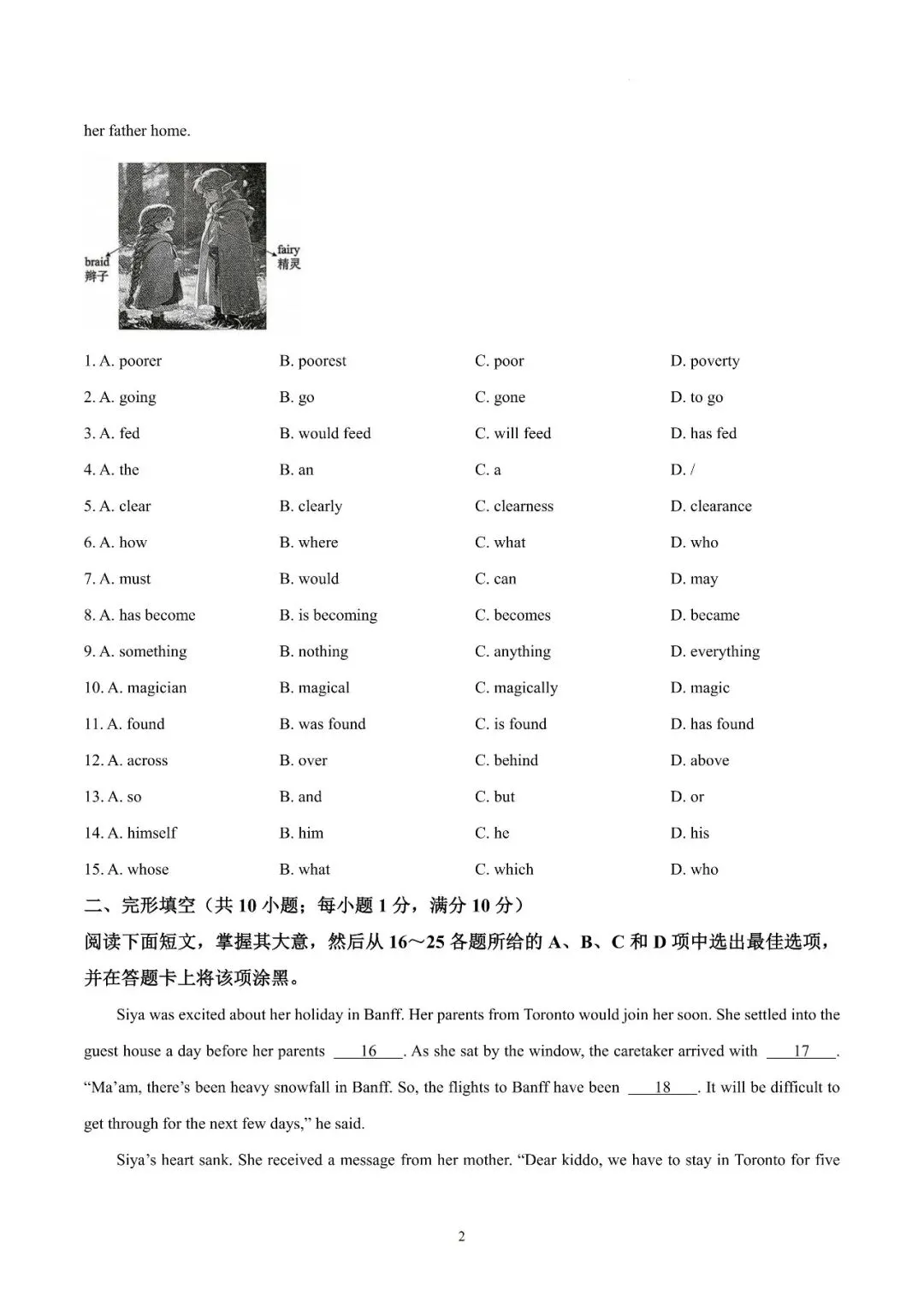
Lily never forgot him. Years later, she told her children the story of the fairy who used her gifts to bring her father home.
中文翻译
很久以前,莉莉和她的父亲、祖母住在一间林间小屋里。他们辛勤劳作,却仍然贫穷。
一年秋天,国王需要志愿者去完成一项遥远的任务。莉莉的父亲决定去。
“别去!”莉莉喊道。
“我必须去,”他说,“赏金会养活我们余生。”
冬天带着寒风和大雪来临。莉莉很担心。祖母说:“我的母亲提到过一棵古树。树里住着一个精灵,他能清楚地看到数英里之外。”
第二天,莉莉找到了那棵树并敲了门。一个精灵出现了。
“好心的先生,我的父亲出门在外。我担心他的冷暖。你能告诉我他在哪里吗?”
“要想得到,必须付出。你有什么?”莉莉把她的斗篷给了他。
“你的父亲又暖和又干爽,”精灵说。
几个月后,食物变得匮乏。莉莉带着家里最后一只鸡回来了。
精灵出现了。“你愿意收下这只鸡吗?”莉莉问。
“我愿意,”他说。“你的父亲吃饱了。”
春天临近时,一个旅行者告诉莉莉,国王的许多士兵不会回来了。莉莉匆匆赶到树边,已经没有任何东西可以给精灵了。
精灵看着她的辫子。“我想要你的头发。”莉莉剪掉了它。
“你的父亲活着,”精灵说。
一周后,她的父亲回来了。他们坐在火边。“你是怎么活下来的?”祖母问。
他皱起眉头。“也许是靠魔法。有一次,一件斗篷出现在树上,让我保持温暖。后来,一只鸡横穿了我的路,给我提供了一周的食物。几天前,我掉进了河里,一根绳子出现救了我。”
“我的辫子!”莉莉摸着自己的短发喊道。她把精灵的事告诉了父亲。第二天,他们去感谢精灵,但他已经不在了。
“也许他只向需要帮助的人现身,”祖母说。
莉莉从未忘记他。多年后,她给孩子们讲了这个精灵的故事——那个用她的礼物把父亲带回家的精灵。
逐题解析
1. A. poorer B. poorest C. poor D. poverty
正确选项:C. poor
解析:
句子结构:remained + 形容词(系动词remain后跟形容词作表语)。
A poorer:比较级,需有比较对象,文中无。
B poorest:最高级,需有范围,无。
C poor:形容词原级,符合。
D poverty:名词,不能直接作表语。
2. A. going B. go C. gone D. to go
正确选项:D. to go
解析:
decide to do sth. 固定搭配。
A going:动名词,decide后不接。
B go:动词原形,decide后不接。
C gone:过去分词,错误。
3. A. fed B. would feed C. will feed D. has fed
正确选项:B. would feed
解析:
主句谓语said为过去时,宾语从句中“赏金会养活我们”是过去将来时。
A fed:一般过去,不符合将来意义。
C will feed:一般将来,不能用于过去时主句后的宾语从句(除非主句现在时)。
D has fed:现在完成,时态不符。
4. A. the B. an C. a D. /
正确选项:B. an
解析:
ancient tree 第一次提到,用不定冠词;ancient以元音音素/ei/开头,用an。
A the:特指,前文未提。
C a:冠词正确但音素错误。
D /:零冠词,不可数或复数场合,这里单数可数名词需冠词。
5. A. clear B. clearly C. clearness D. clearance
正确选项:A. clear
解析:
see clear 固定短语,意为“看得清楚”,clear作副词修饰see。
B clearly:也是副词,但see clearly侧重于“清晰地看”,而see clear更口语化且符合语境(看穿数英里)。此处原文用了can see clearly across miles,但选项给的是clear,根据常见搭配,see clear亦可。实际上原题选项A为clear,根据教材常用表达,选A。
C clearness:名词。
D clearance:名词(清除)。
6. A. how B. where C. what D. who
正确选项:B. where
解析:
宾语从句:can you tell me ___ he is? 询问地点,用where。
A how:方式,不合。
C what:什么,缺宾语。
D who:谁,主语是he,不搭配。
7. A. must B. would C. can D. may
正确选项:A. must
解析:
精灵说“要想得到,必须付出”,表示义务或必要,用must。
B would:意愿或过去将来。
C can:能力。
D may:可能或允许。
8. A. has become B. is becoming C. becomes D. became
正确选项:D. became
解析:
上下文为过去时叙述(Months later, food...),用一般过去时became。
A has become:现在完成,不用于明确过去时间。
B is becoming:现在进行。
C becomes:一般现在。
9. A. something B. nothing C. anything D. everything
正确选项:B. nothing
解析:
上下文:莉莉已经没有东西可给了(with nothing left to give)。
A something:有东西,相反。
C anything:任何东西,用于否定句或疑问句,此处肯定句表“没有任何东西”需用nothing。
D everything:一切,不符。
10. A. magician B. magical C. magically D. magic
正确选项:D. magic
解析:
by magic 固定短语,“通过魔法”。
A magician:魔术师(人)。
B magical:形容词,by magical不成立。
C magically:副词,by magically错误。
11. A. found B. was found C. is found D. has found
正确选项:B. was found
解析:
主语a cloak与find之间为被动关系,且故事为过去时,用一般过去时被动。
A found:主动过去,错误。
C is found:现在时被动。
D has found:主动现在完成。
12. A. across B. over C. behind D. above
正确选项:A. across
解析:
ran across my path “横穿我的路”,表示从一边到另一边。
B over:越过(上方)。
C behind:在后面。
D above:在上方。
13. A. so B. and C. but D. or
正确选项:C. but
解析:
他们去感谢精灵,但他已经不在了——转折关系。
A so:因果。
B and:并列。
D or:选择。
14. A. himself B. him C. he D. his
正确选项:A. himself
解析:
shows himself “现身”,反身代词作宾语,表示“展示他自己”。
B him:宾格,但show him意为“展示他(别人)”,不合逻辑。
C he:主格。
D his:物主代词。
15. A. whose B. what C. which D. who
正确选项:D. who
解析:
定语从句先行词the fairy(指人),从句中used前缺主语,用who。
A whose:表示所属。
B what:不能引导定语从句。
C which:指物。
第二部分:完形填空(16-25)
英文原文
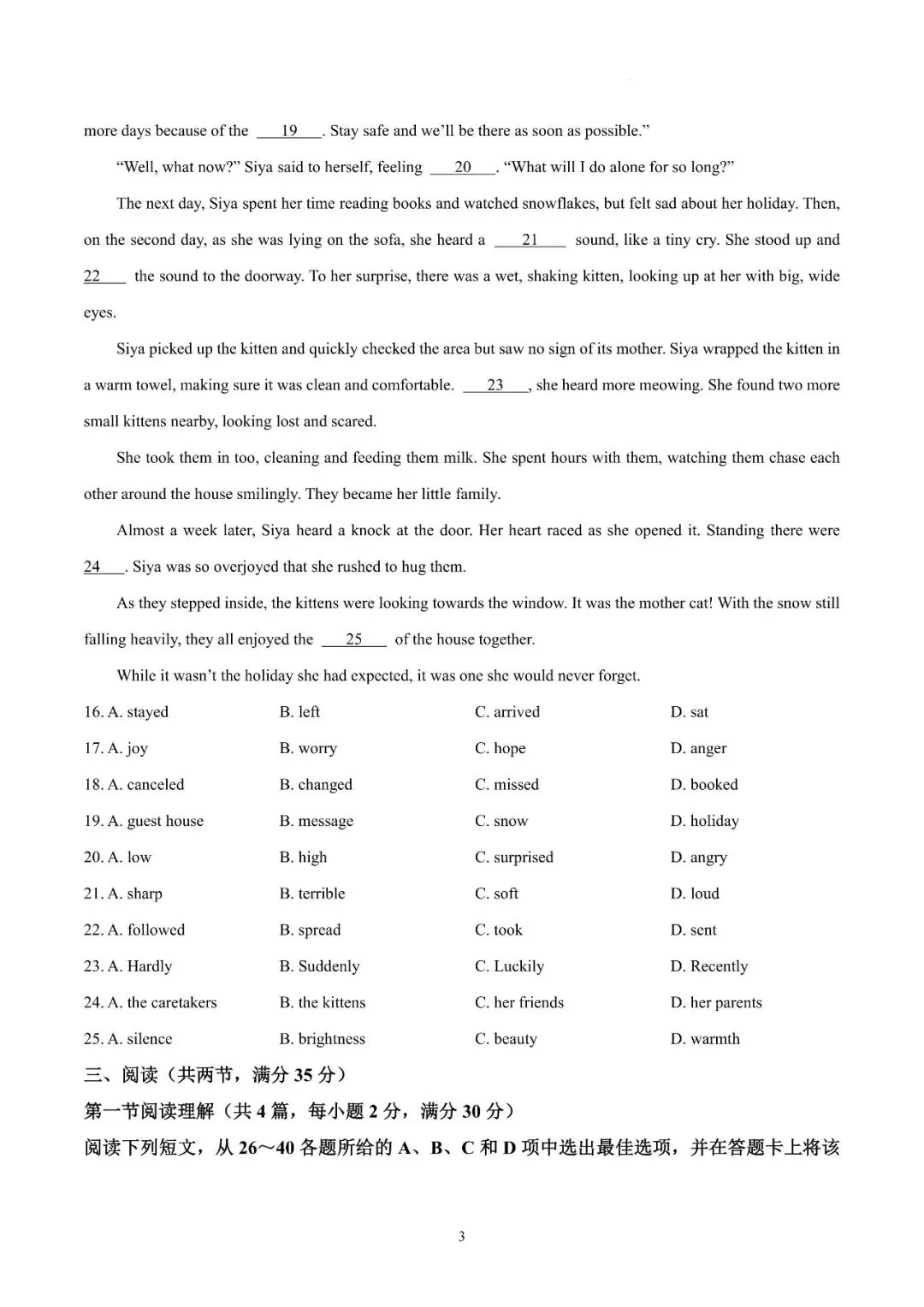
Siya was excited about her holiday in Banff. Her parents from Toronto would join her soon. She settled into the guest house a day before her parents arrived. As she sat by the window, the caretaker arrived with worry. "Ma'am, there's been heavy snowfall in Banff. So, the flights to Banff have been canceled. It will be difficult to get through for the next few days," he said.
Siya's heart sank. She received a message from her mother. "Dear kiddo, we have to stay in Toronto for five more days because of the snow. Stay safe and we'll be there as soon as possible."
"Well, what now?" Siya said to herself, feeling low. "What will I do alone for so long?"
The next day, Siya spent her time reading books and watched snowflakes, but felt sad about her holiday. Then, on the second day, as she was lying on the sofa, she heard a soft sound, like a tiny cry. She stood up and followed the sound to the doorway. To her surprise, there was a wet, shaking kitten, looking up at her with big, wide eyes.
Siya picked up the kitten and quickly checked the area but saw no sign of its mother. Siya wrapped the kitten in a warm towel, making sure it was clean and comfortable. Suddenly, she heard more meowing. She found two more small kittens nearby, looking lost and scared.
She took them in too, cleaning and feeding them milk. She spent hours with them, watching them chase each other around the house smilingly. They became her little family.
Almost a week later, Siya heard a knock at the door. Her heart raced as she opened it. Standing there were her parents. Siya was so overjoyed that she rushed to hug them.
As they stepped inside, the kittens were looking towards the window. It was the mother cat! With the snow still falling heavily, they all enjoyed the warmth of the house together.
While it wasn't the holiday she had expected, it was one she would never forget.
中文翻译
Siya对在班夫的假期感到兴奋。她从多伦多的父母很快会来和她会合。她在父母到达的前一天住进了客房。当她坐在窗边时,管理员带着担忧来了。“女士,班夫下了大雪。所以,飞往班夫的航班被取消了。接下来几天很难通行,”他说。
Siya的心沉了下去。她收到了母亲的短信。“亲爱的孩子,因为大雪我们不得不在多伦多多待五天。注意安全,我们会尽快赶到。”
“那现在怎么办?”Siya自言自语,情绪低落。“我一个人这么长时间能做什么呢?”
第二天,Siya花时间读书、看雪花,但依然为假期感到难过。然后,第二天,当她躺在沙发上时,她听到一个轻柔的声音,像小小的哭声。她站起来,跟着声音走到门口。令她惊讶的是,那里有一只湿漉漉的、发抖的小猫,睁着大大的眼睛看着她。
Siya捡起小猫,迅速检查了周围,但没有看到猫妈妈的踪影。Siya用温暖的毛巾把小猫包起来,确保它干净舒适。突然,她听到更多的喵喵声。她在附近又发现了两只小猫,看起来又迷路又害怕。
她也把它们带进来,清洗并喂它们牛奶。她和它们一起度过了好几个小时,微笑着看它们在屋子里追逐嬉戏。它们成了她的小家庭。
差不多一周后,Siya听到敲门声。她打开门时心跳加速。站在门口的是她的父母。Siya高兴极了,冲过去拥抱他们。
当他们走进屋子时,小猫们正朝窗外看。那是猫妈妈!雪还在下得很猛,他们一起享受着房子的温暖。
虽然这不是她期待的假期,但这是一个她永远不会忘记的假期。
逐题解析
16. A. stayed B. left C. arrived D. sat
正确选项:C. arrived
解析:
句子:She settled into the guest house a day before her parents ____. 她在父母到达前一天入住。
A stayed:停留,父母停留一天?逻辑不通。
B left:离开,她入住时父母还没来。
C arrived:到达,正确。
D sat:坐,无意义。
17. A. joy B. worry C. hope D. anger
正确选项:B. worry
解析:
管理员带来了坏消息(航班取消),带着担忧。
A joy:快乐,不符。
C hope:希望,但消息是坏消息。
D anger:愤怒,无依据。
18. A. canceled B. changed C. missed D. booked
正确选项:A. canceled
解析:
大雪导致航班取消。
B changed:改变,不一定取消。
C missed:错过,主语是人。
D booked:预订,与语境相反。
19. A. guest house B. message C. snow D. holiday
正确选项:C. snow
解析:
因为大雪(the snow)不得不多待五天。
A guest house:客房,无关。
B message:信息,不是原因。
D holiday:假期,不是原因。
20. A. low B. high C. surprised D. angry
正确选项:A. low
解析:
feeling low 情绪低落。
B high:高涨,相反。
C surprised:惊讶,虽有但情绪低落更直接。
D angry:生气,文中无。
21. A. sharp B. terrible C. soft D. loud
正确选项:C. soft
解析:
小猫的叫声是“轻柔的”,像小小的哭声。
A sharp:尖锐。
B terrible:可怕。
D loud:大声。
22. A. followed B. spread C. took D. sent
正确选项:A. followed
解析:
她站起来,跟着声音走到门口。
B spread:传播。
C took:拿。
D sent:送。
23. A. Hardly B. Suddenly C. Luckily D. Recently
正确选项:B. Suddenly
解析:
她刚安顿好一只小猫,突然又听到更多喵喵声。
A Hardly:几乎不。
C Luckily:幸运地,文中无此意。
D Recently:最近,不恰当。
24. A. the caretakers B. the kittens C. her friends D. her parents
正确选项:D. her parents
解析:
上文说父母要过来,敲门后站着的是她父母。
A caretakers:管理员,不符。
B kittens:小猫,不能敲门。
C her friends:未提及。
25. A. silence B. brightness C. beauty D. warmth
正确选项:D. warmth
解析:
享受房子的温暖,与外面大雪对比。
A silence:安静,不突出。
B brightness:明亮。
C beauty:美丽。
第三部分:阅读理解
阅读理解A
英文原文
(已在上文语法选择后提供过,但此处独立给出)
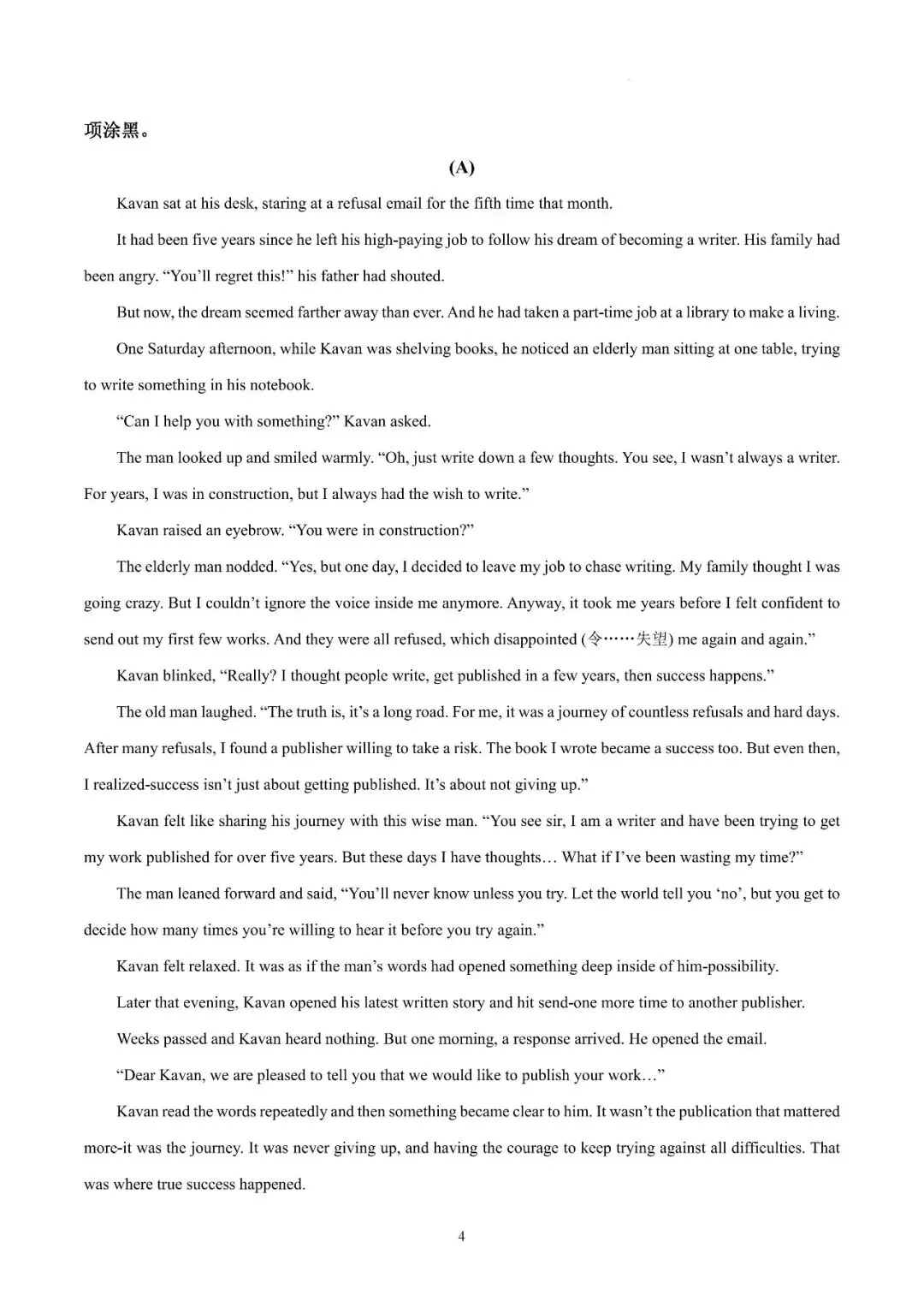
Kavan sat at his desk, staring at a refusal email for the fifth time that month.
It had been five years since he left his high-paying job to follow his dream of becoming a writer. His family had been angry. "You'll regret this!" his father had shouted.
But now, the dream seemed farther away than ever. And he had taken a part-time job at a library to make a living.
One Saturday afternoon, while Kavan was shelving books, he noticed an elderly man sitting at one table, trying to write something in his notebook.
"Can I help you with something?" Kavan asked.
The man looked up and smiled warmly. "Oh, just write down a few thoughts. You see, I wasn't always a writer. For years, I was in construction, but I always had the wish to write."
Kavan raised an eyebrow. "You were in construction?"
The elderly man nodded. "Yes, but one day, I decided to leave my job to chase writing. My family thought I was going crazy. But I couldn't ignore the voice inside me anymore. Anyway, it took me years before I felt confident to send out my first few works. And they were all refused, which disappointed me again and again."
Kavan blinked, "Really? I thought people write, get published in a few years, then success happens."
The old man laughed. "The truth is, it's a long road. For me, it was a journey of countless refusals and hard days. After many refusals, I found a publisher willing to take a risk. The book I wrote became a success too. But even then, I realized—success isn't just about getting published. It's about not giving up."
Kavan felt like sharing his journey with this wise man. "You see sir, I am a writer and have been trying to get my work published for over five years. But these days I have thoughts... What if I've been wasting my time?"
The man leaned forward and said, "You'll never know unless you try. Let the world tell you 'no', but you get to decide how many times you're willing to hear it before you try again."
Kavan felt relaxed. It was as if the man's words had opened something deep inside of him—possibility.
Later that evening, Kavan opened his latest written story and hit send—one more time to another publisher.
Weeks passed and Kavan heard nothing. But one morning, a response arrived. He opened the email.
"Dear Kavan, we are pleased to tell you that we would like to publish your work..."
Kavan read the words repeatedly and then something became clear to him. It wasn't the publication that mattered more—it was the journey. It was never giving up, and having the courage to keep trying against all difficulties. That was where true success happened.
中文翻译
(见上一轮,此处略,可参考之前内容)
第26题
Why did Kavan feel his dream was farther away?
A. He quit his high-paying job.
B. No one taught him writing skills.
C. He worked part-time in a library.
D. No publisher accepted his works.
正确选项:D
解析:
第一段:他盯着拒稿邮件 → 多次被拒。
第三段:the dream seemed farther away than ever → 梦想更遥远。
因果关系:拒稿导致梦想遥远。
A:辞职是五年前的事,不是当前原因。
B:文中未提无人教写作。
C:兼职是生存手段,不是梦想遥远的原因。
第27题
What did the old man tell Kavan about his writing journey?
A. He succeeded after many failures.
B. He gave up writing at an early age.
C. He succeeded soon after giving up his job.
D. He became famous with his family's support.
正确选项:A
解析:
老人说:“all refused... After many refusals, I found a publisher... became a success.” → 多次失败后成功。
B:放弃?他说他一直在写。
C:很快成功?他说花了很多年。
D:家人支持?家人认为他疯了。
第28题
How did Kavan's feeling change in the story?
A. doubtful→surprised→disappointed→joyful→encouraged
B. doubtful→surprised→joyful→disappointed→encouraged
C. disappointed→doubtful→surprised→joyful→encouraged
D. disappointed→surprised→doubtful→encouraged→joyful
正确选项:D
解析:
开始:被拒 → disappointed(失望)
遇到老人前:想是否浪费时间 → doubtful(怀疑)
听老人故事:surprised(惊讶)
老人鼓励后:encouraged(受鼓舞)
收到录用邮件:joyful(高兴)
顺序:disappointed → surprised → doubtful → encouraged → joyful(注意:原文中听到老人经历是先惊讶,然后产生怀疑(自己是否浪费时间),然后被鼓励,最后收到邮件快乐。选项D符合)
第29题
What can you learn from the passage?
A. Writing is a really hard career.
B. Success needs continuous efforts.
C. Wise men always change others' lives.
D. Dreams need others' help to come true.
正确选项:B
解析:
主旨句:It's about not giving up, courage to keep trying.
A:写作难,但不是核心寓意。
C:智者总是改变他人生活?绝对化。
D:梦想需要他人帮助?老人只是鼓励,关键是自己坚持。
阅读理解B
英文原文
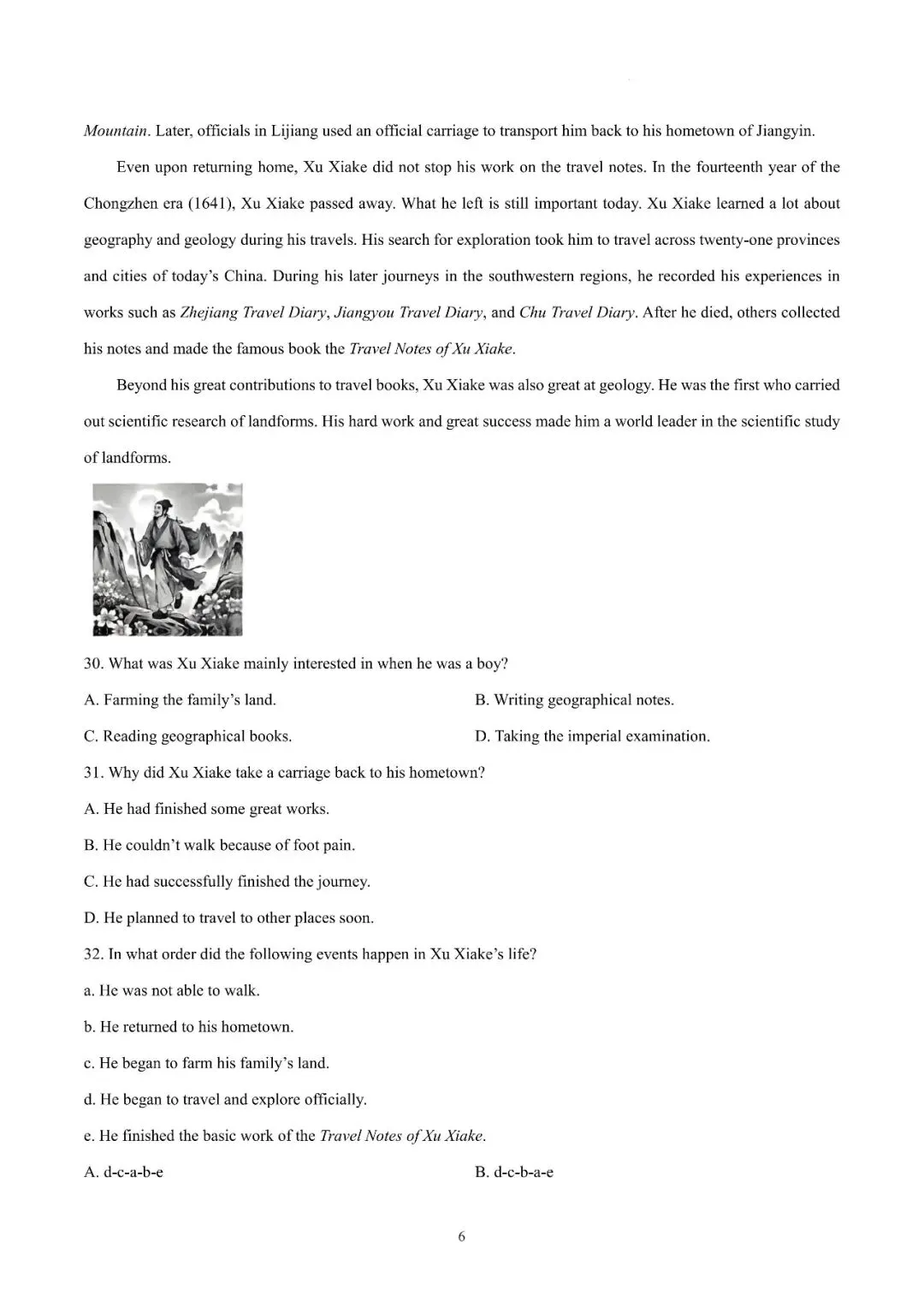
Xu Xiake (1587-1641), born in Jiangyin, Nan Zhili (present-day Jiangsu, exactly Jiangyin), was a famous person in the Ming Dynasty. He was well-known for his contributions as a geographer, traveler, explorer, and literary figure.
From an early age, Xu Xiake showed a strong love for learning, putting his heart into the study of poetry, literature, and, especially, geographical works. Although he faced difficulties, such as failing to pass the imperial examination (ke ju) at the age of fifteen, Xu Xiake didn't give up.
After his father died, Xu Xiake began to farm his family's land. It was not until the thirty-sixth year of the Wanli era (1608) that Xu Xiake started his official journey as a traveler and explorer. Throughout most of his life, he spent lots of time travelling and exploring. His long journeys, however, hurt his health, leading to serious foot problems that eventually left him unable to walk by the time he reached Yunnan.
In Yunnan, though he had serious foot problems, Xu Xiake kept on writing his travel notes, and finally finished the great basic work of the Travel Notes of Xu Xiake. He also spent time writing the Records of Chicken Foot Mountain. Later, officials in Lijiang used an official carriage to transport him back to his hometown of Jiangyin.
Even upon returning home, Xu Xiake did not stop his work on the travel notes. In the fourteenth year of the Chongzhen era (1641), Xu Xiake passed away. What he left is still important today. Xu Xiake learned a lot about geography and geology during his travels. His search for exploration took him to travel across twenty-one provinces and cities of today's China. During his later journeys in the southwestern regions, he recorded his experiences in works such as Zhejiang Travel Diary, Jiangyou Travel Diary, and Chu Travel Diary. After he died, others collected his notes and made the famous book the Travel Notes of Xu Xiake.
Beyond his great contributions to travel books, Xu Xiake was also great at geology. He was the first who carried out scientific research of landforms. His hard work and great success made him a world leader in the scientific study of landforms.
中文翻译
(见上一轮)
第30题
What was Xu Xiake mainly interested in when he was a boy?
A. Farming the family's land.
B. Writing geographical notes.
C. Reading geographical books.
D. Taking the imperial examination.
正确选项:C
解析:
第二段:putting his heart into the study of... geographical works → 热爱地理著作。
A:种地是父亲死后的事。
B:写地理笔记是后来。
D:科举他失败了,不是主要兴趣。
第31题
Why did Xu Xiake take a carriage back to his hometown?
A. He had finished some great works.
B. He couldn't walk because of foot pain.
C. He had successfully finished the journey.
D. He planned to travel to other places soon.
正确选项:B
解析:
第三段:serious foot problems that eventually left him unable to walk. 第四段:officials used an official carriage to transport him back.
A:完成作品是事实,但不是直接原因。
C:旅程结束,但原因仍是脚病。
D:计划旅行?相反。
第32题
In what order did the following events happen?
a. He was not able to walk.
b. He returned to his hometown.
c. He began to farm his family's land.
d. He began to travel and explore officially.
e. He finished the basic work of the Travel Notes of Xu Xiake.
A. d-c-a-b-e B. d-c-b-a-e C. c-e-d-a-b D. c-d-a-e-b
正确选项:D
解析:
时间线:父亲死后种地(c) → 1608开始游历(d) → 在云南脚不能走(a) → 写完游记基础(e) → 被送回故乡(b) → 顺序c-d-a-e-b
第33题
What was Xu Xiake's great achievement besides his travel books?
A. He wrote more literary books than other people.
B. He was a pioneer in the study of natural land shapes.
C. He discovered twenty-one provinces and cities in China.
D. He was the first to visit the southwestern regions in China.
正确选项:B
解析:
最后一段:first who carried out scientific research of landforms, world leader in the scientific study of landforms.
A:未提数量比较。
C:他游历了21个省市区,不是“发现”。
D:他去过西南,但不是第一个。
阅读理解C
英文原文
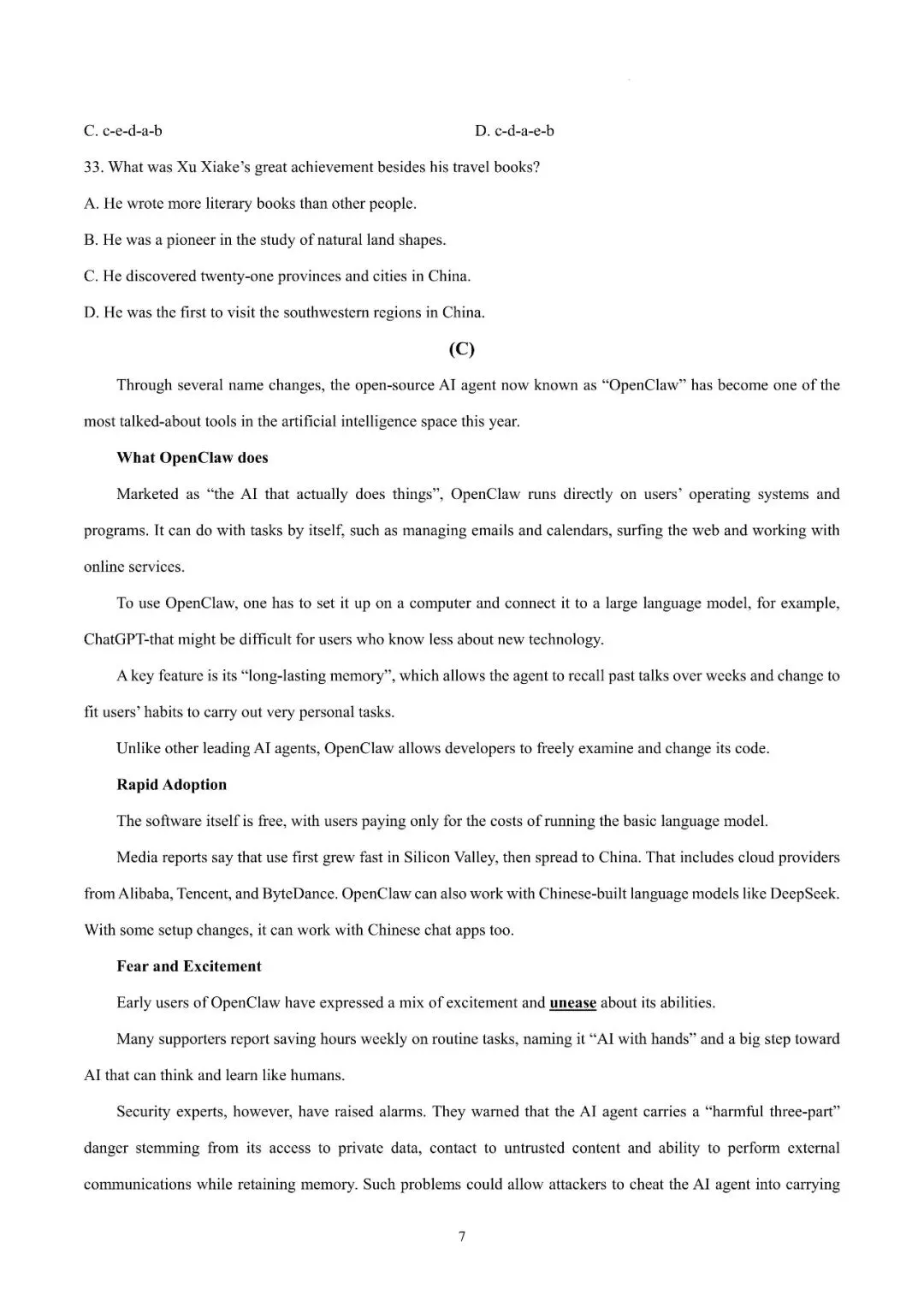
Through several name changes, the open-source AI agent now known as "OpenClaw" has become one of the most talked-about tools in the artificial intelligence space this year.
Marketed as "the AI that actually does things", OpenClaw runs directly on users' operating systems and programs. It can do with tasks by itself, such as managing emails and calendars, surfing the web and working with online services.
To use OpenClaw, one has to set it up on a computer and connect it to a large language model, for example, ChatGPT—that might be difficult for users who know less about new technology.
A key feature is its "long-lasting memory", which allows the agent to recall past talks over weeks and change to fit users' habits to carry out very personal tasks.
Unlike other leading AI agents, OpenClaw allows developers to freely examine and change its code.
The software itself is free, with users paying only for the costs of running the basic language model.
Media reports say that use first grew fast in Silicon Valley, then spread to China. That includes cloud providers from Alibaba, Tencent, and ByteDance. OpenClaw can also work with Chinese-built language models like DeepSeek. With some setup changes, it can work with Chinese chat apps too.
Early users of OpenClaw have expressed a mix of excitement and unease about its abilities.
Many supporters report saving hours weekly on routine tasks, naming it "AI with hands" and a big step toward AI that can think and learn like humans.
Security experts, however, have raised alarms. They warned that the AI agent carries a "harmful three-part" danger stemming from its access to private data, contact to untrusted content and ability to perform external communications while retaining memory. Such problems could allow attackers to cheat the AI agent into carrying out bad commands or letting out private information.
OpenClaw creator has admitted these risks and said that more work is needed on agent safety. "We are trying to improve it, but there are still some difficult parts now," he said in an email.
中文翻译
(见上一轮)
第34题
What can we know about OpenClaw according to the passage?
A. It can work without language models.
B. It can store memory for many months.
C. It is free to run the basic language model.
D. It's hard for people with poor computer knowledge to use.
正确选项:D
解析:
第三段:that might be difficult for users who know less about new technology.
A:需要连接语言模型。
B:记忆持续数周(weeks),不是数月。
C:软件免费,但运行语言模型需付费。
第35题
What does the underlined word "unease" in Paragraph 8 probably mean?
A. Worry.
B. Sadness.
C. Happiness.
D. Relaxation.
正确选项:A
解析:
上下文:mix of excitement and ___ → 与兴奋并列且转折,后文安全专家警告 → 负面情绪,忧虑。
B sadness:悲伤,程度过重。
C happiness:快乐,相反。
D relaxation:放松,不符。
第36题
Which one is the risk of using OpenClaw?
A. It can send messages to others by itself.
B. It may work with online services by itself.
C. It may give away users' personal information.
D. It can change to match users' habits to do personal tasks.
正确选项:C
解析:
第十段:letting out private information.
A、B、D都是功能或特性,不是风险。
第37题
What can we infer from the underlined sentence in the last paragraph?
A. It is easy to improve the OpenClaw.
B. OpenClaw should work with DeepSeek.
C. It needs hard work to solve the safety problems of OpenClaw.
D. OpenClaw is very wonderful and more changes will make it perfect.
正确选项:C
解析:
句子:We are trying to improve it, but there are still some difficult parts now. → 存在困难,需要努力。
A:说容易,错误。
B:未提与DeepSeek合作。
D:过于乐观,忽略困难。
阅读理解D
英文原文
BrainFest with Mind Institute
● Included in General Admission
● Special Events June 21, 10:00 a.m. – 4:00 p.m.
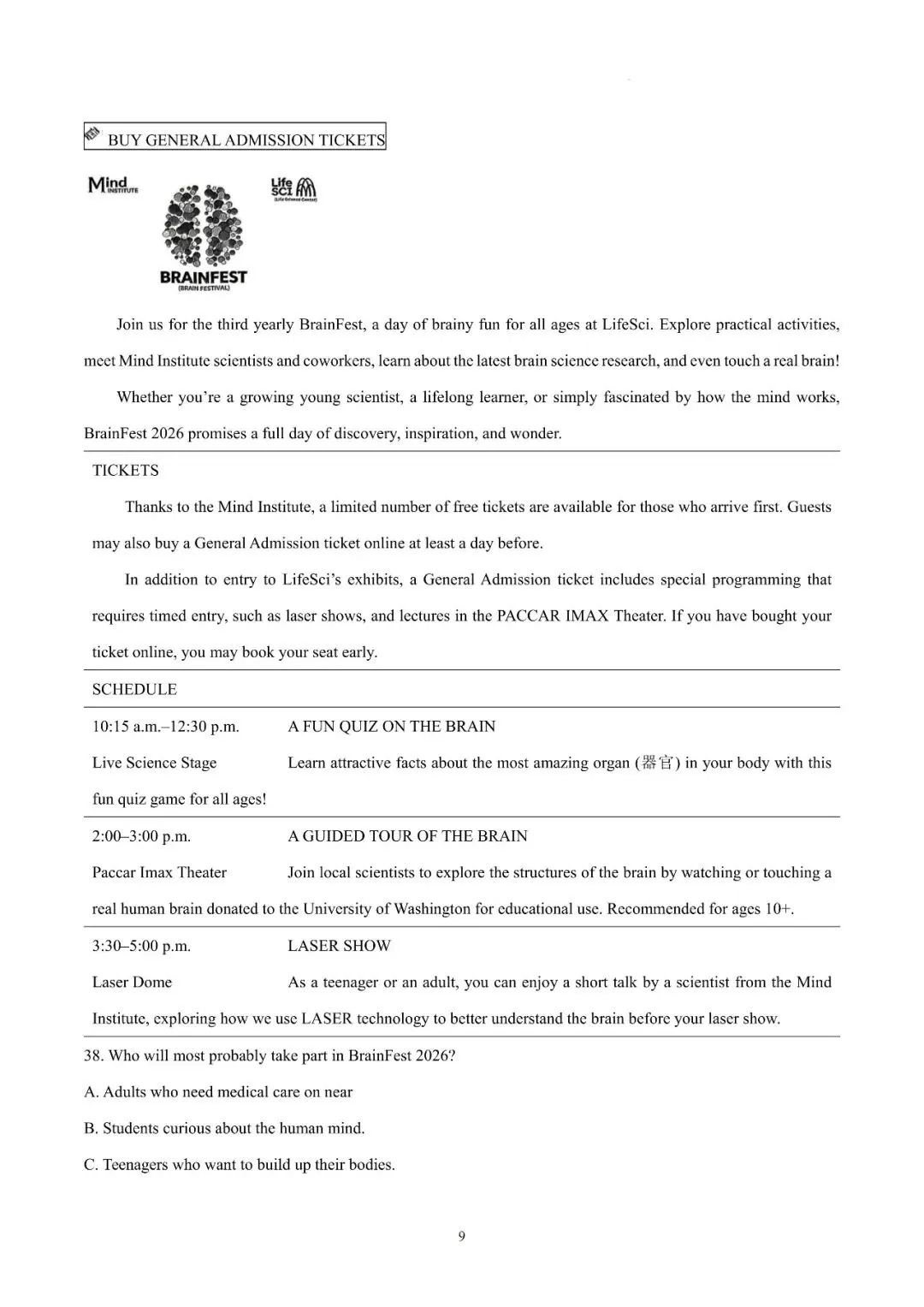
Join us for the third yearly BrainFest, a day of brainy fun for all ages at LifeSci. Explore practical activities, meet Mind Institute scientists and coworkers, learn about the latest brain science research, and even touch a real brain!
Whether you're a growing young scientist, a lifelong learner, or simply fascinated by how the mind works, BrainFest 2026 promises a full day of discovery, inspiration, and wonder.
TICKETS
Thanks to the Mind Institute, a limited number of free tickets are available for those who arrive first. Guests may also buy a General Admission ticket online at least a day before.
In addition to entry to LifeSci's exhibits, a General Admission ticket includes special programming that requires timed entry, such as laser shows, and lectures in the PACCAR IMAX Theater. If you have bought your ticket online, you may book your seat early.
SCHEDULE
10:15 a.m. – 12:30 p.m. A FUN QUIZ ON THE BRAIN
Live Science Stage Learn attractive facts about the most amazing organ in your body with this fun quiz game for all ages!
2:00 – 3:00 p.m. A GUIDED TOUR OF THE BRAIN
Paccar Imax Theater Join local scientists to explore the structures of the brain by watching or touching a real human brain donated to the University of Washington for educational use. Recommended for ages 10+.
3:30 – 5:00 p.m. LASER SHOW
Laser Dome As a teenager or an adult, you can enjoy a short talk by a scientist from the Mind Institute, exploring how we use LASER technology to better understand the brain before your laser show.
中文翻译
(见上一轮)
第38题
Who will most probably take part in BrainFest 2026?
A. Adults who need medical care on near
B. Students curious about the human mind.
C. Teenagers who want to build up their bodies.
D. Young scientists interested in laser technology.
正确选项:B
解析:
第二段:fascinated by how the mind works → 对心智着迷的学生。
A:需要医疗护理的成人,无关。
C:锻炼身体,无关。
D:对激光技术感兴趣的年轻科学家,激光只是部分活动。
第39题
What is special about the ticket to BrainFest 2026?
A. People don't need to pay for the tickets.
B. Free tickets are available for early arrivals.
C. Tickets must be booked online ahead of time.
D. People can book the seats early if they get free tickets.
正确选项:B
解析:
TICKETS部分:a limited number of free tickets are available for those who arrive first.
A:不是所有人都免费。
C:可以网上购买,但不是必须提前预订。
D:免费票不能提前选座,只有网上购票才能提前选座。
第40题
Which of the following activities fits an 8-year-old kid?
A. Listening to a short talk at Laser Dome.
B. Taking part in a quiz game at Live Science Stage.
C. Watching or touching a real brain at Paccar Imax Theater.
D. Exploring the structures of brain at Paccar Imax Theater.
正确选项:B
解析:
SCHEDULE中:10:15-12:30 A FUN QUIZ ON THE BRAIN → “for all ages” → 适合8岁。
C和D:2:00-3:00 Guided Tour → “Recommended for ages 10+” → 不适合。
A:3:30-5:00 Laser Show → “As a teenager or an adult” → 不适合儿童。
第四部分:阅读填空(41-45)
英文原文
After the rain, sometimes the sky paints a beautiful rainbow. Do you know how it forms? Rainbows are made by sunlight and water drops.
Light travels in waves of energy. Blue light has short waves while red light has longer ones. Sunlight is a crazy mix of many colors—including some we can't see. Our eyes see this mixture as white light. So all the colors of the rainbow are already hidden in sunlight.
When light travels through water or glass, its path bends a bit. Blue light bends more than red light. This makes the colors separate and spread out. A glass prism can clearly show this color separation.
Just like prisms, raindrops can also bend light and separate its colors. When sunlight shines through a round raindrop, the light is bent and reflected inside the drop. When the light comes out again, all the colors are separated. From where you stand, you'll see the red band from the highest drops, green from the middle, and just violet from the lowest drops. All these colored bands come together. They form the beautiful rainbow we see after rain.
中文翻译
雨后,天空有时会画出一道美丽的彩虹。你知道它是怎么形成的吗?彩虹是由阳光和水滴形成的。
光以能量波的形式传播。蓝光波长短,红光波长长。阳光是许多颜色的疯狂混合——包括一些我们看不见的颜色。我们的眼睛把这种混合看作白光。所以彩虹的所有颜色都已经隐藏在阳光中。
当光穿过水或玻璃时,它的路径会弯曲一点。蓝光比红光弯曲得更多。这使得颜色分离并散开。玻璃棱镜可以清楚地显示这种颜色分离。
就像棱镜一样,雨滴也能弯曲光线并分离其颜色。当阳光穿过圆形雨滴时,光线在雨滴内部被弯曲和反射。当光线再次出来时,所有颜色都被分离。从你站的位置,你会看到来自最高雨滴的红色带,中间的绿色带,以及最低雨滴的紫色带。所有这些彩色带汇聚在一起。它们形成了雨后我们看到的美丽彩虹。
逐空解析
41. 选项:A. Light travels in waves of energy.
正确选项:A
解析:
空白前问彩虹如何形成,空白后讲蓝光红光波长不同。需要先引入“光以波的形式传播”这一基本概念。
B讲颜色分离,应在后面。
C讲形成彩虹,应在最后。
D讲颜色隐藏在阳光中,应在介绍白光之后。
E讲雨滴像棱镜,应在介绍折射之后。
42. 选项:D. So all the colors of the rainbow are already hidden in sunlight.
正确选项:D
解析:
空白前说阳光是各种颜色的混合,我们看到白色。空白后说光穿过水或玻璃会弯曲。需要总结“白光中包含所有颜色”。D正好承接。
43. 选项:B. This makes the colors separate and spread out.
正确选项:B
解析:
空白前说蓝光比红光弯曲更多,空白后说棱镜能显示颜色分离。需要说明“这导致颜色分离散开”。B正确。
44. 选项:E. Just like prisms, raindrops can also bend light and separate its colors.
正确选项:E
解析:
空白后开始讲雨滴如何弯曲反射光线。需要先说明雨滴和棱镜一样能分光。E正确。
45. 选项:C. They form the beautiful rainbow we see after rain.
正确选项:C
解析:
空白前说所有彩色带汇聚在一起,空白后结束全文。需要说明它们形成彩虹。C正确。
第五部分:语篇填词(46-50)
英文原文(含首字母提示)
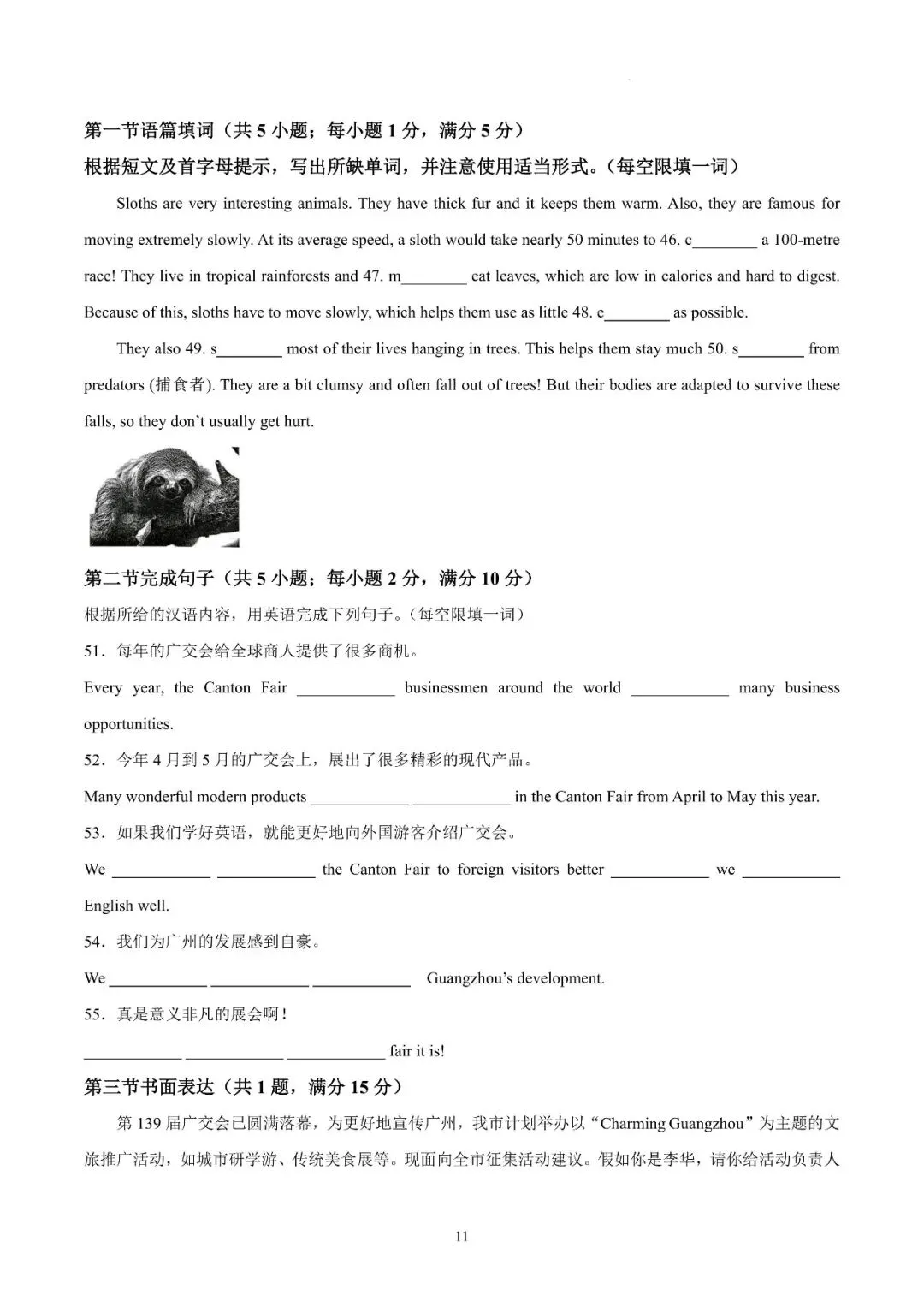
Sloths are very interesting animals. They have thick fur and it keeps them warm. Also, they are famous for moving extremely slowly. At its average speed, a sloth would take nearly 50 minutes to c46. c_______ a 100-metre race! They live in tropical rainforests and m47. m_______ eat leaves, which are low in calories and hard to digest. Because of this, sloths have to move slowly, which helps them use as little e48. e_______ as possible.
They also s49. s_______ most of their lives hanging in trees. This helps them stay much s50. s_______ from predators. They are a bit clumsy and often fall out of trees! But their bodies are adapted to survive these falls, so they don't usually get hurt.
中文翻译
树懒是非常有趣的动物。它们有厚厚的毛发,这能让它们保暖。此外,它们以行动极其缓慢而闻名。以它们的平均速度,树懒需要将近50分钟才能跑完100米!它们生活在热带雨林中,主要吃树叶,树叶热量低且难以消化。正因为如此,树懒必须缓慢移动,这帮助它们尽可能少用能量。
它们一生中的大部分时间都挂在树上。这帮助它们远离捕食者,安全得多。它们有点笨拙,经常从树上掉下来!但它们的身体适应了这些跌落,所以通常不会受伤。
逐空解析
cover(跑完,完成一段距离)
句意:跑完100米比赛。cover a race 或 cover a distance。
mainly(主要地)
句意:主要吃树叶。副词修饰eat。
energy(能量)
句意:尽可能少用能量。
spend(花费时间)
句意:它们一生中的大部分时间都挂在树上。spend time doing sth.
safer(更安全的)
句意:这帮助它们远离捕食者,安全得多。stay safer from... 比较级,与不挂树的动物相比。
第六部分:完成句子(51-55)答案
Every year, the Canton Fair provides businessmen around the world with many business opportunities.
Many wonderful modern products were shown / were on display in the Canton Fair from April to May this year.
We will introduce the Canton Fair to foreign visitors better if we learn English well.
We are proud of / take pride in Guangzhou's development.
What a meaningful fair it is!
八、书面表达
写作思路
活动一:城市研学游 (City Study Tour)
如何举办:组织学生参观广州塔、陈家祠、永庆坊,配专业讲解。
为什么要举办:让青少年深入了解广州的历史文化,增强归属感。
活动二:传统美食展 (Traditional Food Exhibition)
如何举办:邀请老字号现场制作,游客可试吃、学做点心。
为什么要举办:推广广府美食文化,吸引游客,促进旅游经济。
词汇与短语
| 词汇/短语 | 含义 |
|---|---|
| cultural tourism | 文化旅游 |
| study tour | 研学旅行 |
| food exhibition | 美食展 |
| dim sum | 点心 |
| historical sites | 历史遗迹 |
| hands-on experience | 亲身体验 |
| promote culture | 推广文化 |
| attract tourists | 吸引游客 |
连接词
| 连接词 | 用途 |
|---|---|
| First of all | 首先 |
| What’s more | 而且 |
| For example | 例如 |
| In addition | 此外 |
| As a result | 因此 |
| Therefore | 所以 |
三档次作文范文
第三档(基础,约60%分数)
Dear Mr. Wang,
I am glad to learn that "Charming Guangzhou" activities will be held soon. I’m writing to give some suggestions.
First, we can have a city study tour. Students can visit Guangzhou Tower and Chen Clan Academy. Second, we can have a food exhibition. People can try Guangzhou snacks.
These activities can help people know more about Guangzhou. I hope my ideas are helpful.
Yours sincerely,
Li Hua
第二档(良好,约80%分数)
Dear Mr. Wang,
I am glad to learn that "Charming Guangzhou" activities will be held soon. I’m writing to share two suggestions.
First, a city study tour can be organized. Students can visit historical places like Shamian Island and Yongqing Fang with guides. This helps them learn about Guangzhou’s past.
Second, a traditional food exhibition can be held. Famous restaurants can show how to make dim sum. Visitors can taste and learn. This will attract more tourists.
I hope my suggestions will be helpful.
Yours sincerely,
Li Hua
第一档(优秀,接近满分)
Dear Mr. Wang,
I am glad to learn that "Charming Guangzhou" activities will be held soon. I’m writing to offer two practical suggestions.
First, a city study tour could be arranged for students. They can visit landmarks like Canton Tower, Chen Clan Academy, and Yongqing Fang with professional guides. This hands-on experience will deepen their understanding of Guangzhou’s rich history and culture.
Second, a traditional food exhibition would be a great idea. Local time-honored brands can demonstrate how to cook classic dishes like shrimp dumplings and roast goose. Visitors can not only watch but also taste. This will surely promote Guangzhou’s food culture and attract more tourists.
I hope my suggestions will be taken into consideration. I look forward to the success of the event.
Yours sincerely,
Li Hua


