

第一部分 听力(共两节,满分30分)
做题时,先将答案标在试卷上,录音内容结束后,你将有两分钟的时间将试卷上的答案转涂到答题卡上。
第一节(共5小题;每小题1.5分,满分7.5分)
听下面5段对话。每段对话后有一个小题,从题中所给的A、B、C三个选项中选出最佳选项。听完每段对话后,你都有10秒钟的时间来回答有关小题和阅读下一小题。每段录音播放两遍。
1. What does the man advise the woman to do?
A. Use an app.
B. Watch some videos.
C. Read news online.
2. What are the speakers dissatisfied with about the party?
A. The activities.
B. The food.
C. The people.
3. Why did Helen skip the gym?
A. She was sick.
B. She was moving house.
C. She was busy packing.
4. What are the speakers mainly discussing?
A. Daily dressing tips.
B. Old clothes recycling.
C. Current fashion trends.
5. Where are the speakers?
A. In a classroom.
B. In a store.
C. In a computer lab.
第二节(共15小题;每小题1.5分,满分22.5分)
听下面5段对话或独白。每段对话或独白后有几个小题,从题中所给的A、B、C三个选项中选出最佳选项。听每段对话或独白前,你将有时间阅读各个小题,每小题5秒钟;听完后,各小题将给出5秒钟的作答时间。每段录音播放两遍。
听第6段录音,回答第6、7题
6. What could the woman most probably be?
A. A hotel receptionist.
B. A travel agent.
C. A tour guide.
7. What will the woman do?
A. Report the complaint.
B. Make an investigation.
C. Recommend another package.
听第7段录音,回答第8至10题
8. Why did the woman stop eating meat?
A. For better health.
B. For a good figure.
C. For environmental concerns.
9. What was the woman concerned about as a vegetarian?
A. Limited food choices.
B. Lack of some vitamins.
C. Difficulty in sticking to the diet.
10. How did the man change his diet?
A. By taking gradual steps.
B. By trying various dishes.
C. By following a strict meal plan.
听第8段录音,回答第11至13题
11. When will the speakers leave for the airport?
A. At 5 a. m.
B. At 6 a. m.
C. At 8 a. m.
12. What will the speakers do on Tuesday morning?
A. Explore the city.
B. Visit a factory.
C. Have business talks.
13. What is Mark’s opinion on the schedule?
A. It is acceptable.
B. It is very flexible.
C. It is too busy to follow.
听第9段录音,回答第14至16题
14. What does Rob say about the ticket giveaway activity at first?
A. It will interest people.
B. It should be rescheduled.
C. It needs more promotion.
15. What will the speakers announce first?
A. The morning headlines.
B. The ticket giveaway.
C. The weather update.
16. Where do the speakers probably work?
A. At a radio studio.
B. At a TV station.
C. At a concert hall.
听第10段录音,回答第17至20题
17. Which work has brought Jenny fame?
A. Three Bridges.
B. Blackfield Road.
C. King Lear.
18. What were senior students required to do in Jenny’s school?
A. Write a screenplay.
B. Make some costumes.
C. Get work experience.
19. What did Jenny do after graduation?
A. She starred in a film.
B. She acted in a TV commercial.
C. She played a Shakespeare character.
20. What does Jenny value most about performing in a theater play?
A. Participating in a classic.
B. Improving her acting skills.
C. Acting before a real audience.
第二部分 阅读理解(共两节,满分50分)
第一节(共15小题;每小题2.5分,满分37.5分)
阅读下列短文,从每题所给的A、B、C和D四个选项中,选出最佳选项。
A
As we move out of the depths of winter, and tip gently into spring, our moods and tastes can transition too; some days we still miss the comfort of winter foods, while, on others, we may feel ready to welcome the lighter, fresher flavors of the new season.
This vibrant vegetable and chicken one-pot, finished with lemon and fresh herbs, has you covered, whatever your mood. It, rich in nutrients that help nourish your mind as well as your body, offers warmth and familiarity, alongside freshness and vitality — perfect for those in-between days, gently supporting your mood during this time of transition.
SPRING CHICKEN & VEGETABLE ONE-POT (serves 4)
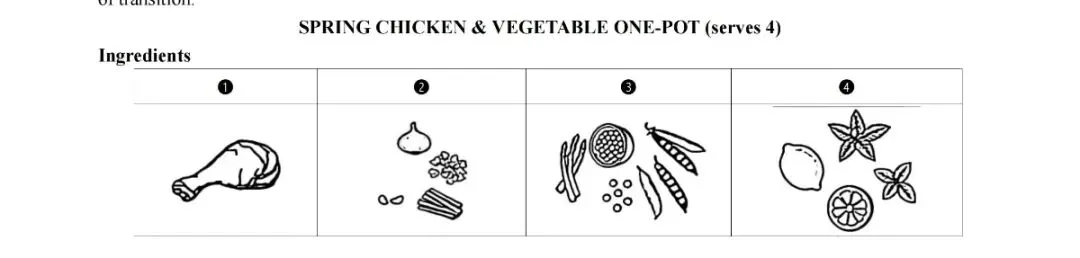
Ingredients
① ② ③ ④
500g skinless chicken legs Moderate Olive oil 150g onions 2 cloves of garlic 2 celery stalks 500 ml chicken soup 150g garden peas 200 g sugar snap peas 100 g asparagus tips 100 g natural yogurt 1 lemon, juiced 10 g finely chopped mint 10 g finely chopped basil
Method
- Season the skinless chicken.
- Heat moderate olive oil in a pan, fry the chicken until brown on both sides, and then set aside on a separate plate.
- Now add the onion, garlic, and celery to the pan and stir-fry for a few minutes until soft.
- Return the chicken to the pan, add the chicken soup, and cook gently for around 20 minutes, until the chicken is done.
- Then add the peas, sugar snaps, and asparagus. Cook for 5 minutes until the vegetables are just tender. Stir in the yogurt.
- Just before serving, add the lemon juice, mint, and basil. Adding the lemon too early may discolour the vegetables.
Tip for leftovers
Add a little cornflour to thicken the sauce, and then serve on top of pasta, or alongside rice.
21. Which can best describe the dish?
A. Mind blowing.
B. Eye-catching.
C. Memory enhancing.
D. Mood boosting.
22. Which ingredient is used the most in this recipe?
A. Peas.
B. Yogurt.
C. Chicken.
D. Onion.
23. Why is lemon juice added just before serving?
A. To lock in the vegetables’ color.
B. To ensure the chicken’s freshness.
C. To help the soup take in the flavor.
D. To prevent the yogurt from separating.
B
Till last year, I couldn’t remember the last time I’d done a jigsaw puzzle. It must have been at least 20 years ago. As far as I was concerned, puzzles were for kids. There were always other more exciting, interesting and productive things to do — or so I thought.
While at home on a rainy autumn afternoon, however, I chanced on a jigsaw puzzle that had been lying untouched since my husband and I were given it a few years ago. I’m not sure what came over me — perhaps it was because my husband was watching a film that didn’t particularly interest me — but I decided to give it a go.
The 1,000-piece puzzle took me a couple of weeks to complete. I would spend from five minutes to two hours on it at a time, depending on how busy I was. Strangely, there’s something so satisfying about finding the right piece for a space, joining up sections, getting closer to finishing a picture. Every time I successfully place a piece, I get a little rush and feel a sense of achievement. It’s a dopamine hit, but not one I usually get from just scrolling stream media. I soon became addicted to it.
Meanwhile, I’ve found an unexpected bonus: the slightly physical aspect of it, leaning over the pieces and picking different ones up, means I can’t be on my phone at the same time. I especially love that doing a puzzle doesn’t involve a screen in any capacity since so many aspects of my life almost can’t go without my computer, my phone or the television — even following a workout app in the gym or listening to a podcast on a walk.
And I’ve come to realize puzzling is not just for kids after all. Perhaps it was the very piece that I had failed to notice in my life all along.
24. What did the author use to view jigsaw puzzling as?
A. A popular time killer.
B. A childish recreation.
C. A refreshing comfort.
D. A handy stress reliever.
25. What does the underlined part “a dopamine hit” in paragraph 3 probably mean?
A. A sudden wave of regret.
B. A brief sense of relief.
C. A quick feeling of pleasure.
D. A deep state of anticipation.
26. Which aspect of puzzling does the author favor most?
A. It is calming.
B. It is screen-free.
C. It is educational.
D. It is user-friendly.
27. What is the best title for the passage?
A. The Missing Piece of My Life
B. The Journey of Going Puzzle-free
C. A Piece of Childhood Memory
D. An Unforgettable Rainy Afternoon
C
Tiny House Shadow, a 365-square-foot sustainable tiny house, stands in Lohja as a response to modern day climate and population challenges. Designed by Matti Kuittinen, an architect professor at Aalto University, it is an exercise in what future buildings might look like.
“We need to reduce emissions from the building sector by 80-90%, and build almost 2 billion new homes by the end of the century,” warns Kuittinen. These two goals are contradictory, “which is why we need to consider totally different housing and construction solutions.” After years of research into these issues, Kuittinen has collaborated with construction companies to build his idealized sustainable structure.
Tiny House Shadow is entirely mobile and can be taken apart. It is the first of its kind to feature a specialized decarbonated steel in its exterior. Sustainable materials define the interior as well, with the floors made from recycled plastic, the ceilings from old tires and the windows from old buildings. In fact, the house uses 56% recycled materials across its entire build, this alone reducing its footprint by 53%.
Just by living in a home that is smaller — and less energy-consuming in both design and day-to-day consumption — people will live a more sustainable life. In the case of Tiny House Shadow which considers everyday functions and needs versus wants, each resident reduces his or her carbon footprint greatly compared to life in a conventional house. Through the architecture and the lifestyle it promotes, Tiny House Shadow re-images what our residential space could be without the unnecessary waste we’re used to.
But that being said, spending time in Kuittinen’s design doesn’t mean roughing it. “Living in a tiny house doesn’t necessarily mean giving up comfort,” Kuittinen said. Inside, it can be transformed according to use, thanks to movable partitions and space-saving rooms separated by sliding doors and other mechanisms.
Regularly exhibited as a sample at construction fairs, Tiny House Shadow has made a remarkable entrance on the market. Kuittinen hopes it can be a demonstration of low-emission, resource-efficient single-family housing for the modern age.
28. What is the core reason for Kuittinen’s design?
A. To trade space for sustainability.
B. To stay true to his longtime ideals.
C. To balance emission cut and housing.
D. To create a cheaper alternative to flats.
29. What does paragraph 3 mainly talk about concerning Shadow?
A. Its building process.
B. Its spacious layout.
C. Its commercial value.
D. Its sustainable design.
30. What living philosophy is embodied in Tiny House Shadow?
A. Idealism.
B. Minimalism.
C. Materialism.
D. Optimism.
31. What is Kuittinen’s expectation of Tiny House Shadow?
A. Serving as a building model.
B. Entering the market quickly.
C. Attracting sufficient funding.
D. Winning prizes at building fairs.
D
“Humans have around 20,000 protein-coding genes, but little is known about how those protein molecules organize and interact.” says Trey Ideker, a professor of medicine at the University of California San Diego. Without that knowledge, trying to study and treat disease is “like trying to understand how to fix your car without the repair guide”.
In an April 2025 study in Nature, Ideker and his team presented their latest attempt to fill this information gap: a map of a human cell, showing the locations of more than 5,000 proteins organized into 275 smaller and smaller structures. The map goes far beyond the simplified diagrams you may recall from high school biology class.
The team achieved this level of detail by taking a “multimodal” approach. First, to figure out which proteins interact inside our cells, the researchers lined a tube with a particular protein, called the “bait protein”. Then, they poured a blended mixture of other proteins through the tube to see which ones would stick together, showing an interaction. Next, to locate these proteins precisely, they lit up individual molecules inside a cell using glowing antibodies. These antibodies stick to specific substances. Once the antibodies found their target, the lighted protein was visualized under a microscope and placed on the map.
There are many human cell types, and the one Ideker’s team chose to map is called the U2OS cell. It is commonly associated with childhood bone cancer. Indeed, the researchers identified more than 100 new mutated proteins that are linked to childhood cancer, helping reveal how the disease develops. Better yet, they located those proteins within the cell. Typically, cancer research is focused on individual mutations, but by placing them in context, the map provides a look at the larger structures that individual mutations affect.
“The U2OS cell took more than three years to chart, but technology and methodological improvements could speed up the mapping of other cells in the future,” Ideker adds. “Our goal is ‘to really scale it up’ and reveal the subcellular architecture beneath all sorts of diseases.”
32. What is stressed by using the metaphor in paragraph 1?
A. The diversity of genes.
B. The severity of disease.
C. The necessity of car maintenance.
D. The significance of cell mapping.
33. What is the function of the glowing antibodies in the study?
A. Making the tube easily visible.
B. Breaking down unwanted proteins.
C. Identifying the location of the proteins.
D. Speeding up the interaction of the proteins.
34. What sets Ideker’s research apart from traditional cancer research?
A. It names a new cell U2OS.
B. It prioritizes new mutated proteins.
C. It centers on individual cells.
D. It contextualizes mutations within cells.
35. What is Ideker’s attitude towards the future research?
A. Cautious.
B. Optimistic.
C. Unconcerned.
D. Doubtful.
第二节(共5小题;每小题2.5分,满分12.5分)
阅读下面短文,从短文后的选项中选出能填入空白处的最佳选项。选项中有两项为多余选项。
When I sat in the sun one afternoon, it was noisy outside. The industrious buzz of bees in cherry flowers was annoying, accompanied by “back off” warning chirps from blackbirds nesting in the tree. 36 A mini-digger was tearing apart the neighboring garden, sending out a deep, continuous roar.
They started with the hedge — I thought that was all they were going to do, because it happened around here a lot. 37 The first was proudly pointed out to me by the owner; the second I only saw in the aftermath. But this time they had bigger plans. When the hedge was out, they kept clearing away bushes, plants and trees. 38
Aren’t we supposed to be a nation of garden lovers? It doesn’t feel like it. 39 Paved driveways have covered what were plots of wild vegetation. And it’s happening almost everywhere. People have their reasons and it’s none of my bleeding-heart business, but I just can’t stop feeling worried.
I know people are busy and gardening may feel burdensome. But for anyone who has a corner of outside space, if they can’t do something, at least they can do nothing. Nothing might be the best thing of all, actually, as long as they don’t destroy it. 40 Wild grass and flowers feed insects and birds; insects lay eggs in plants; birds line nests in trees… Over time, the negative space where people don’t garden can be precisely where the ordinary magic of life happens.
A. Gardens can evolve in their own way.
B. There was another noise too, though.
C. Gardens are almost as diverse as a rainforest.
D. I couldn’t remember exactly the similar happenings.
E. It was the third case I had spotted in a matter of weeks.
F. By evening, what had once been a garden was no more.
G. Every year, a handful of front gardens get concreted over here.
第三部分 语言知识运用(共两节,满分30分)
第一节(共15小题;每小题1分,满分15分)
阅读下面短文,从短文后各题所给的A、B、C和D四个选项中,选出可以填入空白处的最佳选项。
It seems a common occurrence. When a player on the opposing team makes a 41 on a big play, the reaction for many sports fans is joy. But not every sports fan.
With a minute and a half left in an NFL playoff game last season, the Baltimore Ravens had 42 a touchdown to close their deficit to the Buffalo Bills, bringing the game to 25-27. A 2-point try would 43 the game.
The Ravens quarterback, Lamar Jackson, 44 the ball to tight end Mark Andrews, who was at the goal line. He caught it… but he dropped it. To be 45, he seemed to slip as the ball reached him on the snowy field. The whole season essentially 46 this play. And now Andrews blew it and their season was 47.
But two Bills fans felt 48, even amid their victory.
Andrews has T1D and pricked his finger several times a game to 49 his blood sugar. The two Bills fans decided to start a charitable 50 on their Instagram page to raise money for Breakthrough T1D, an organization Andrews has supported. “In sports, there’s something 51 than the game,” says one of them.
Their effort has raised more than $146,000. 52, donations were mostly from Bills fans, but as 53 spread, fans of the Ravens and other NFL teams joined in. “I’ve been feeling 54 for letting my team, coach and fans down. What they do really 55 the softest part of my heart,” says Andrews.
41. A. change
B. comment
C. breakthrough
D. mistake
42. A. scored
B. avoided
C. expected
D. witnessed
43. A. miss
B. ruin
C. tie
D. win
44. A. blocked
B. threw
C. fetched
D. followed
45. A. formal
B. brief
C. sure
D. fair
46. A. made up for
B. gave way to
C. came down to
D. put up with
47. A. over
B. near
C. tight
D. special
48. A. relief
B. shame
C. fear
D. sympathy
49. A. control
B. check
C. cure
D. identify
50. A. survey
B. show
C. drive
D. training
51. A. smarter
B. easier
C. newer
D. bigger
52. A. Initially
B. Naturally
C. Generally
D. Luckily
53. A. hope
B. word
C. fire
D. virus
54. A. puzzled
B. tired
C. awful
D. sick
55. A. touches
B. protects
C. breaks
D. exposes
第二节(共10小题;每小题1.5分,满分15分)
阅读下面短文,在空白处填入1个适当的单词或括号内单词的正确形式。
“Becoming Chinese”, a viral trend, has taken hold on social media platforms. 56 past crazes for foreign symbols, this phenomenon centers on adopting lifestyle habits 57 (root) in traditional Chinese wisdom, reflecting a deeper, more participatory engagement with Chinese culture. Started by a Chinese-American TikToker Sherry Xliruli, 58 video attracted 1.4 million views, the trend sees netizens worldwide playfully embracing routines like wearing house slippers, drinking hot water, practicing Ba Duan Jin exercises, and prioritizing wellness.
At its core, this transformation in cultural recognition signifies that, in a 59 (rapid) changing world, the Chinese way of life offers a 60 (solve) characterized by order, inclusiveness, and inner stability. The wisdom contained within it, such as harmony between heaven and humanity and the balance of yin and yang, 61 (provide) a buffer for today’s “burnout society”.
Inarguably, digital technology has become 62 booster for cultural exchange, with short-video platforms breaking down the geographical barriers of cultural transmission and 63 (allow) the daily habits of Chinese life to be presented vividly.
The “Becoming Chinese” trend marks a shift in China’s international cultural influence from “going out” to “going deep in”. When every ordinary day 64 (see) and recognized, the attraction of “Chineseness” goes beyond simple 65 (symbol) copying or identity labels, evolving into a more inclusive global cultural phenomenon.
第四部分 写作(共两节,满分40分)
第一节(满分15分)
假定你是李华,最近你校举办了“地方戏剧进校园”主题活动,请给校英文报投稿,内容包括:
(1) 活动介绍;
(2) 个人感悟。
注意:
(1) 写作词数应为80左右;
(2) 请按如下格式在答题纸的相应位置作答。
When Local Opera Meets the Young
第二节(满分25分)
阅读下面材料,根据其内容和所给段落开头语续写两段,使之构成一篇完整的短文。
The early morning sun streamed through the high windows of the gymnasium. Mum’s medals and trophies from years past lined the walls. I remembered how she used to let me wear them when I was little, telling me stories about her journey to the glory.
As usual, I watched Mum coach her gymnastics class. So gracefully did she move around the gymnasium that it was not hard to believe she had once been an outstanding gymnast. But something seemed different. “One more time, girls!” she called out, demonstrating a simple cartwheel. As she landed, she stumbled slightly and forced a smile. I saw how she was attempting to put less weight on her right ankle. The students did not notice it, but I did. It was the same ankle that had carried her through countless routines, but now seemed to be failing her.
My mind wandered back to when I was six, afraid to even do a forward roll. The gymnasium had seemed enormous then. Mum would spot me, her hands ready to catch me if I fell. When I had crashed during my first competition on the balance beam, she had been at the edge of the mat, encouraging me to continue. The memory was still vivid — the hushed audience, and my trembling legs as I stood up again. Pride in her eyes, she whispered then, “Every great gymnast falls, but only the best ones get back up.”
Now, watching her massage her ankle between demonstrations, I understood why she had been doing more coaching and less demonstrating lately. Her body was not responding the way it used to.
“Coach Chen,” one of the younger students called out, her ponytail bouncing with excitement, “Can you show us the cartwheel again?” A flash of pain crossed her face, so brief that only someone who knew her well would notice. She hesitated, and in that moment, I knew — she couldn’t do it.
注意:
(1) 续写词数应为150左右;
(2) 请按如下格式在答题卡的相应位置作答。
Paragraph 1: “Let me show you how,” I offered, moving to the center.
Paragraph 2: After class, I took Mum to the nearby clinic.
英语参考答案
第一部分 听力
1. A
2. B
3. C
4. C
5. B
6. B
7. A
8. C
9. B
10. A
11. A
12. C
13. A
14. A
15. C
16. A
17. B
18. C
19. B
20. C
第二部分 阅读
第一节
21-23 DCA
24-27 BCBA
28-31 CDBA
32-35 DCDB
第二节
36-40 BEFGA
第三部分 语言运用
第一节
41-45 DACBD
46-50 CADBC
51-55 DABCA
第二节
56. Unlike
57. rooted
58. whose
59. rapidly
60. solution
61. provides
62. a
63. allowing
64. is seen
65. symbolic
详细解析
第二部分 阅读理解
第一节(A-D篇)
A篇(春季鸡肉蔬菜一锅炖食谱)
21. 答案:D
核心解析:定位原文第二段“gently supporting your mood during this time of transition”,明确指出这道菜能调节情绪,对应“mood boosting(改善情绪)”,考点为细节理解题。
错误选项排除:A项“令人震撼的”原文无相关表述;B项“吸睛的”仅描述外观,未体现核心卖点;C项“增强记忆的”原文未提及对记忆力的作用。
22. 答案:C
核心解析:定位原文配料表,去皮鸡腿500g;豌豆类合计350g(150g青豆+200g甜脆豌豆);酸奶100g;洋葱150g。鸡肉用量最多,考点为数字信息比对。
错误选项排除:A项豌豆总用量350g<500g;B项酸奶100g用量最少;D项洋葱150g远少于鸡肉。
23. 答案:A
核心解析:定位原文做法最后一句“Adding the lemon too early may discolour the vegetables”,提前加柠檬汁会让蔬菜变色,因此临上桌加是为了锁住蔬菜的颜色,考点为因果细节题。
错误选项排除:B项“保证鸡肉新鲜”,鸡肉已提前煮熟,与柠檬汁无关;C项“帮助汤入味”原文未提及;D项“防止酸奶分层”无相关依据。
B篇(拼图:生活中缺失的那一块)
24. 答案:B
核心解析:定位原文第一段“As far as I was concerned, puzzles were for kids”,作者过去认为拼图是小孩子的娱乐,对应“childish recreation(幼稚的消遣)”,考点为观点态度题。
错误选项排除:A项“流行的消磨时间方式”是后来的认知,不是过去的看法;C项“清爽的慰藉”、D项“方便的减压工具”均为作者体验后发现的好处。
25. 答案:C
核心解析:定位原文第三段“Every time I successfully place a piece, I get a little rush and feel a sense of achievement”,“多巴胺冲击”指完成拼图碎片时短暂的愉悦感和成就感,考点为词义猜测题。
错误选项排除:A项“突然的后悔”与语境完全相反;B项“短暂的解脱”无“解脱”含义;D项“深度的期待”是完成前的情绪,不是完成后的感受。
26. 答案:B
核心解析:定位原文第四段“I especially love that doing a puzzle doesn’t involve a screen in any capacity”,作者最看重拼图“不涉及任何屏幕”的特点,考点为细节理解题。
错误选项排除:A项“让人平静”原文未明确提及;C项“有教育意义”无相关表述;D项“用户友好”不是作者强调的核心优势。
27. 答案:A
核心解析:定位原文最后一段“Perhaps it was the very piece that I had failed to notice in my life all along”,全文以拼图为线索,揭示它是作者忙碌生活中缺失的精神寄托,标题一语双关,考点为主旨大意题。
错误选项排除:B项“摆脱拼图的旅程”与原文“爱上拼图”的主旨相反;C项“童年记忆的碎片”文章并非回忆童年;D项“难忘的雨天下午”只是故事的引子,不是核心。
C篇(Tiny House Shadow:可持续微型住宅)
28. 答案:C
核心解析:定位原文第二段Kuittinen指出“既要减少建筑行业80-90%的排放,又要在本世纪末新建近20亿套住房”,两个目标矛盾,因此设计的核心是平衡减排与住房需求,考点为推理判断题。
错误选项排除:A项“用空间换可持续性”是设计手段,不是核心原因;B项“坚持长期理想”无依据;D项“创造更便宜的公寓替代”原文未提及价格优势。
29. 答案:D
核心解析:定位原文第三段,详细介绍了住宅的可移动可拆卸结构、脱碳钢外墙、回收材料内饰(塑料地板、轮胎天花板、旧窗户),以及53%的碳足迹减少量,全部围绕“可持续设计”展开,考点为段落主旨题。
错误选项排除:A项“建造过程”未提及;B项“宽敞布局”与“365平方英尺微型住宅”矛盾;C项“商业价值”本段未涉及。
30. 答案:B
核心解析:住宅仅保留日常必需功能,摒弃不必要的浪费,以小空间实现舒适生活,体现了极简主义(Minimalism)的生活哲学,考点为推理判断题。
错误选项排除:A项“理想主义”强调理念而非生活方式;C项“唯物主义”与“减少浪费”相悖;D项“乐观主义”是设计师的态度,不是住宅体现的哲学。
31. 答案:A
核心解析:定位原文最后一段“Kuittinen hopes it can be a demonstration of low-emission, resource-efficient single-family housing for the modern age”,“demonstration”即“典范、模型”,考点为细节理解题。
错误选项排除:B项“快速进入市场”,原文“has made a remarkable entrance on the market”说明已进入,不是期望;C项“吸引资金”、D项“建筑展获奖”均无相关表述。
D篇(人类细胞图谱:疾病研究的新突破)
32. 答案:D
核心解析:定位原文第一段,用“修车没有维修手册”比喻“不了解蛋白质相互作用就无法研究和治疗疾病”,强调细胞图谱研究的重要性,考点为写作手法题。
错误选项排除:A项“基因多样性”不是比喻的核心;B项“疾病严重性”未提及;C项“汽车保养的必要性”只是比喻的本体,不是写作目的。
33. 答案:C
核心解析:定位原文第三段“Next, to locate these proteins precisely, they lit up individual molecules inside a cell using glowing antibodies”,发光抗体的作用是精确定位蛋白质的位置,考点为细节理解题。
错误选项排除:A项“让管子可见”无依据;B项“分解无用蛋白质”原文未提及;D项“加速蛋白质相互作用”是“诱饵蛋白”的作用,不是抗体的作用。
34. 答案:D
核心解析:定位原文第四段“Typically, cancer research is focused on individual mutations, but by placing them in context, the map provides a look at the larger structures that individual mutations affect”,该研究的创新点是将基因突变放在细胞整体结构中研究,考点为对比细节题。
错误选项排除:A项“命名新细胞U2OS”,U2OS细胞早已存在;B项“优先研究新突变蛋白”无依据;C项“聚焦单个细胞”,研究的是细胞内的结构,不是单个细胞本身。
35. 答案:B
核心解析:定位原文最后一段“technology and methodological improvements could speed up the mapping of other cells in the future”,以及“我们的目标是扩大规模,揭示所有疾病下的亚细胞结构”,说明作者对未来研究持乐观态度,考点为观点态度题。
错误选项排除:A项“谨慎的”无犹豫或保留的表述;C项“不关心的”、D项“怀疑的”与原文积极的语气完全相反。
第二节(七选五:保护野生花园)
答案:36-B 37-E 38-F 39-G 40-A
36. 答案:B
逻辑衔接解析:前文提到蜜蜂和黑鸟的噪音,后文转折引出挖掘机的轰鸣声,B项“不过还有另一种噪音”完美承上启下,衔接两种不同的噪音,无其他选项能承接“噪音”这一核心话题。
37. 答案:E
逻辑衔接解析:后文明确提到“第一个…第二个…”,E项“这是我几周内发现的第三起”与之形成数字呼应,说明破坏花园的现象频繁发生。干扰项D项“我不记得具体类似的事情”与后文“第一、第二”的明确表述矛盾。
38. 答案:F
逻辑衔接解析:前文描述工人清理树篱、灌木、树木的过程,F项“到了晚上,曾经的花园不复存在”是这一过程的最终结果,逻辑连贯。
39. 答案:G
逻辑衔接解析:前文质疑“我们不是热爱花园的民族吗”,后文提到“铺砌的车道覆盖了野生植被”,G项“每年这里都有不少前花园被混凝土覆盖”是对这一现象的具体说明。干扰项C项“花园像雨林一样多样”与“破坏花园”的语境无关。
40. 答案:A
逻辑衔接解析:前文提出“什么都不做可能是最好的选择”,后文解释“野草和花能滋养昆虫和鸟类”,A项“花园可以按照自己的方式进化”衔接两者,说明自然生长的价值。
第三部分 语言知识运用
第一节(完形填空:体育中的善意)
答案:41-D 42-A 43-C 44-B 45-D 46-C 47-A 48-D 49-B 50-C 51-D 52-A 53-B 54-C 55-A
41. 答案:D
语境与考点解析:语境为对方球员失误,球迷会开心,考点为名词辨析。mistake(错误)符合语境;breakthrough(突破)会让对方球迷难过,不符合。
42. 答案:A
语境与考点解析:语境为乌鸦队得分达阵,缩小分差,考点为固定搭配。score a touchdown(达阵得分)是橄榄球专业术语。
43. 答案:C
语境与考点解析:语境为比分25-27,2分附加分成功则比分变为27-27,打平比赛,考点为动词辨析。tie(打平)符合比分逻辑。
44. 答案:B
语境与考点解析:语境为四分卫把球扔给近端锋,考点为动词辨析。throw(扔)是橄榄球传球的标准动作。
45. 答案:D
语境与考点解析:语境为说句公道话,他是因为滑倒才掉球的,考点为固定短语。to be fair(公平地说)符合语境。
46. 答案:C
语境与考点解析:语境为整个赛季归根结底就看这一次进攻,考点为动词短语辨析。come down to(归根结底)符合语境。
47. 答案:A
语境与考点解析:语境为他失误了,他们的赛季结束了,考点为形容词辨析。over(结束的)符合语境。
48. 答案:D
语境与考点解析:语境为但两个比尔队球迷即使赢了也感到同情,因为对方球员有糖尿病,考点为名词辨析。sympathy(同情)符合下文慈善募捐的情节。
49. 答案:B
语境与考点解析:语境为糖尿病患者扎手指是为了检查血糖,考点为动词辨析。check(检查)符合医疗常识;control(控制)是后续行为,不是扎手指的直接目的。
50. 答案:C
语境与考点解析:语境为他们在Instagram上发起慈善募捐活动,考点为固定搭配。charitable drive(慈善募捐活动)是常用表达。
51. 答案:D
语境与考点解析:语境为体育中有比比赛本身更重要的东西,考点为形容词辨析。bigger(更重要的)符合语境。
52. 答案:A
语境与考点解析:语境为最初捐款主要来自比尔队球迷,后来其他队也加入了,考点为副词辨析。initially(最初)体现时间顺序。
53. 答案:B
语境与考点解析:语境为消息传开后,其他队的球迷也参与进来,考点为固定搭配。word spread(消息传开)是常用表达。
54. 答案:C
语境与考点解析:语境为他因为让球队失望而感觉很糟糕,考点为形容词辨析。awful(糟糕的)符合愧疚的心情。
55. 答案:A
语境与考点解析:语境为他们的做法触动了我内心最柔软的地方,考点为动词辨析。touch(触动)符合情感语境。
第二节(语法填空:“成为中国人”文化热潮)
56. 答案:Unlike
考点:介词。表示“与…不同”,对比过去的外国符号热潮和现在的中国文化热潮,句首首字母需大写。
57. 答案:rooted
考点:非谓语动词。be rooted in(植根于)是固定搭配,habits与root是被动关系,用过去分词作后置定语。
58. 答案:whose
考点:定语从句。先行词是Sherry Xliruli,在从句中作定语修饰video,用关系代词whose。
59. 答案:rapidly
考点:副词。修饰形容词changing,需用rapid的副词形式rapidly。
60. 答案:solution
考点:名词。前面有不定冠词a,需用solve的名词形式solution,表示“一种解决方案”。
61. 答案:provides
考点:谓语动词。主语是不可数名词The wisdom,全文用一般现在时,谓语用第三人称单数形式provides。
62. 答案:a
考点:冠词。booster是可数名词单数,表示泛指“一个助推器”,用不定冠词a。
63. 答案:allowing
考点:非谓语动词。与前面的breaking down是并列结构,作介词with的宾语,用动名词形式allowing。
64. 答案:is seen
考点:被动语态。主语every ordinary day与see是被动关系,全文用一般现在时,用一般现在时的被动语态is seen。
65. 答案:symbolic
考点:形容词。修饰名词copying,需用symbol的形容词形式symbolic,表示“象征性的复制”。


