不知道你是不是也有这样的感受:面对一篇阅读理解,明明单词都认识,句子似乎也能懂,可题目就是做不对。那感觉,就像隔着一层雾看风景——明明很近,却又模糊不清。
问题出在哪里?很可能,是没摸透它的“逻辑”与“温度”。
今天,我们就借一篇关于90岁跑者的短文,来做一次透彻的“阅读精析”。我会带你一步步看清:好文章是如何编织信息的,命题人又常在何处设下“路标”与“陷阱”。
(阅读理解来自快捷英语中考模拟题)
主题:人物介绍
语篇类型:记叙文
词数:155
难度:☆☆☆
建议用时:7分钟
Italy has many old people . One in four Italians is over 65. Yet some of them are very active , like Emma Maria Mazzenga . She ' s over 90, but she can run really fast !
Mazzenga was born in 1933. She set a new world record (纪录) for 90-year -olds in May ,2024. She ran 200 meters in 51.47 seconds . That ' s amazing !
Mazzenga holds many records . She holds 5 world records,9 European records and 28 Italian national bests (全国最佳).Although she has no rivals (对手) in her age group , she still trains hard . She also has some special habits . She never wears socks when she runs . And she never wears the same shoes for training . After a race , she likes to drink beer .
Mazzenga started running when she was young . Later she had to stop to take care of her family ._△_Now , she looks forward to more races . Her story shows that age doesn ' t matter if you have a dream !
1. ( )What is the main idea of Paragraph 2?
A.Why Mazzenga started running again .
B.What Mazzenga's new world record is .
C.Why Mazzenga likes running very much .
D.What Mazzenga's family think of her running .
2.( )How many records does Mazzenga have ?
A . Five .
B . Nine .
C . Twenty - eight .
D . Forty - two .
3. ( )What ' s Mazzenga ' s special habits ?
① She likes to drink beer after a race .
② She never wears the same shoes for training .
③She always eats a lot of candies before a race .
④ She never wears socks when she runs .
A .①②③
B .①②④
C .①③④
D .②③④
4. ( )Why did she stop running before ?
A.Because she wanted to have a rest .
B.Because she was busy with her new job .
C.Because she had to take care of her family .
D.Because she had some other new hobbies .
5.( )Which can be put in "_△_" in Paragraph 4?
A.But she came back to running at 53.
B.But she had a cooking class with her friends .
C.So she spent all her time playing with her pet dog .
D.So she went on a very long trip with her family .
Ⅰ·中考高频词
1、高频动词(Verbs)
achieve v.实现,达到
achieve a goal / success
She worked hard to achieve her dream.
encourage v. 鼓励
encourage sb. to do sth.
Parents should encourage children to read.
improve v.改善,提高
improve skills / English
Practice can improve your speaking.
provide v.提供
provide sb. with sth.
Schools provide students with books.
realize v. 意识到
realize one’s mistake / dream
He realized he was late.
suggest v.建议
suggest doing sth. / that…
I suggest going there by bus.
2、核心名词(Nouns)
choice n.选择
make a choice
It’s your choice to decide.
environment n.环境
protect the environment
We should protect the environment.
experience n.经历;经验
have experience in…
She has experience in teaching.
knowledge n.知识
gain knowledge
Reading helps you gain knowledge.
safety n.安全
safety rules / for safety
Remember the safety rules in the lab.
progress n. 进步
make progress He made progress in math.
3、常用形容词(Adjectives)
confident adj.自信的
be confident in…
She is confident in speaking English.
convenient adj.方便的
It is convenient to…
It’s convenient to shop online.
responsible adj.负责的
be responsible for…
Everyone should be responsible for the earth.
similar adj.相似的
be similar to…
Your dress is similar to mine.
valuable adj.宝贵的
valuable time/advice
Thank you for your valuable advice.
4、高频副词(Adverbs)
actually adv.实际上 用于纠正或强调 Actually, I don’t like coffee.
especially adv. 尤其 强调某一部分
I love fruits, especially apples.
gradually adv.逐渐地 表示过程
The weather gradually became warmer.
probably adv.可能 表示可能性
It will probably rain tomorrow.
suddenly adv.突然地 表示突发动作
The phone rang suddenly.
5、常考短语与固定搭配(Phrases)
be good at 擅长
She is good at drawing.
depend on 依靠,取决于
Success depends on hard work.
get along with 与……相处
Do you get along with your classmates?
in order to 为了
He studies hard in order to pass the exam.
take part in 参加
I will take part in the sports meeting.
used to 过去常常
I used to play piano every day.
6、写作高频过渡词(Linking Words)
however 然而,表转折
She is young; however, she is very wise.
therefore 因此,表结果
It rained; therefore, the match was canceled.
meanwhile 与此同时
He was cooking; meanwhile, she was setting the table.
besides 此外,表补充
I love reading. Besides, I enjoy writing.
in conclusion 总之,用于总结
In conclusion, we should protect nature.
Ⅱ.重点句型和长难句解析
1. 并列句与转折关系
She’s over 90, but she can run really fast!
· 结构:
主语 + be动词 + 表语, but + 主语 + 谓语 + 状语
· 解析:
· 这是一个由并列连词but连接的并列句。
· 前半句表示年龄状态(超过90岁),后半句表示运动能力(跑得很快),两者形成鲜明对比,突出人物特点。
· 中文对照:她已年过九旬,但却跑得很快!
2. “in + 时间”表示完成某事所用的时间
She ran 200 meters in 51.47 seconds.
· 结构:主语 + 谓语 + 宾语 + in + 时间段
· 解析:
· in 51.47 seconds 表示“在51.47秒内完成”,说明跑步速度。
· 这种结构常用于表示完成某个动作所花费的时间。
· 中文对照:她以51.47秒跑完了200米。
3. 让步状语从句 (Although…)
Although she has no rivals in her age group, she still trains hard.
· 结构:Although + 从句, + 主句
· 解析:
· Although 引导让步状语从句,表示“尽管……”。
· 主句中的 still 强调“仍然”,突出她坚持训练的态度。
· 中文对照:尽管在她这个年龄组没有对手,她仍然努力训练。
4. “特殊习惯”列举句式
She also has some special habits. She never wears socks when she runs. And she never wears the same shoes for training. After a race, she likes to drink beer.
· 结构:总起句 + 并列细节句(含时间状语从句、并列连词、介词短语作时间状语)
· 解析:
· 第一句总述“有特殊习惯”,后三句具体列举。
· when she runs 是时间状语从句。
· After a race 是介词短语作时间状语。
· 使用 never 和 likes to 形成习惯的对比(不做的 vs 喜欢做的)。
· 中文对照:她还有一些特殊习惯。跑步时不穿袜子,训练时不穿同一双鞋。比赛后喜欢喝啤酒。
5. 条件状语从句与宾语从句嵌套
Her story shows that age doesn’t matter if you have a dream!
· 结构:主语 + 谓语 + that引导的宾语从句(内含if引导的条件状语从句)
· 解析:
· that age doesn’t matter 是 shows 的宾语从句。
· if you have a dream 是宾语从句内部的条件状语从句,表示“如果你有梦想”。
· 整句话传达“只要有梦想,年龄不是问题”的励志主题。
· 中文对照:她的故事表明,只要有梦想,年龄就不重要!
✅ 总结句式特点:
1. 并列句:通过 but 连接对比内容。
2. 时间状语:in + 时间、when从句、After短语。
3. 让步状语从句:Although 引导,表达转折逻辑。
4. 宾语从句 + 条件从句嵌套:that + 句子 + if 从句,表达观点与条件。
Ⅲ.答案及解析
第一题:
What is the main idea of Paragraph 2?
题目类型:段落主旨题
解题思路:问第二段的主要内容,需要概括该段的核心信息。
原文定位:第二段提到:
· Mazzenga 出生于 1933 年;
· 2024 年 5 月她创下了 90 岁年龄组的 200 米世界纪录;
· 成绩是 51.47 秒。
选项分析:
· A. Why Mazzenga started running again. (她为何重新开始跑步)→ 未提及
· B. What Mazzenga’s new world record is. (她的新世界纪录是什么)→ ✅ 符合段落内容
· C. Why Mazzenga likes running very much. (她为何非常喜欢跑步)→ 未提及
· D. What Mazzenga’s family think of her running. (她家人对她跑步的看法)→ 未提及
正确答案:B
第二题:
How many records does Mazzenga have?
题目类型:细节理解题
解题思路:问 Mazzenga 总共拥有多少项纪录,需要将文中提到的三类纪录数量相加。
原文定位:第三段:
· 5 项世界纪录
· 9 项欧洲纪录
· 28 项意大利全国最佳
计算:5 + 9 + 28 = 42
选项分析:
· A. Five → 只是世界纪录数量
· B. Nine → 只是欧洲纪录数量
· C. Twenty-eight → 只是意大利全国最佳数量
· D. Forty-two → ✅ 总数
正确答案:D
第三题:
What’s Mazzenga’s special habits?
题目类型:细节筛选题
解题思路:问她的特殊习惯,需从选项中选出文中明确提到的内容。
原文定位:第三段最后两句:
· 她跑步时不穿袜子;
· 训练时不穿同一双鞋;
· 比赛后喜欢喝啤酒。
选项分析:
· ① 比赛后喝啤酒 → ✅ 提到
· ② 训练时不穿同一双鞋 → ✅ 提到
· ③ 比赛前吃很多糖果 → ❌ 未提及
· ④ 跑步时不穿袜子 → ✅ 提到
正确组合:①②④ → 选项 B
正确答案:B
第四题:
Why did she stop running before?
题目类型:细节理解题
解题思路:问她之前为何停止跑步。
原文定位:第四段第二句:
Later she had to stop to take care of her family.
选项分析:
· A. 因为她想休息 → 未提及
· B. 因为她忙于新工作 → 未提及
· C. 因为她要照顾家庭 → ✅ 原文对应
· D. 因为她有其他新爱好 → 未提及
正确答案:C
第五题:
Which can be put in “△” in Paragraph 4?
题目类型:上下文逻辑衔接题
解题思路:问第四段中“△”处应填入哪个句子,需结合前后文逻辑。
原文定位:第四段内容:
· 她年轻时开始跑步;
· 后来因照顾家庭而停止;
· △
· 现在她期待更多比赛。
逻辑推断:
空格前是“停止跑步”,空格后是“现在继续参赛”,因此空格处应表示“她重新开始跑步”或“她回归跑步”。
选项分析:
· A. But she came back to running at 53. → ✅ 符合“中断—回归—继续”的逻辑
· B. But she had a cooking class with her friends. → 与跑步无关
· C. So she spent all her time playing with her pet dog. → 与跑步无关
· D. So she went on a very long trip with her family. → 与跑步无关
正确答案:A
✅ 总结答案:
1. B2. D3. B4. C5. A
Ⅳ.选择型阅读理解解题思路
一、核心答题原则
1. 顺序原则:题目顺序通常与文章段落顺序一致。
2. 证据原则:每个答案都应在文章中找到直接或间接依据。
3. 客观原则:忠于原文,避免主观臆断。
二、四步解题流程(建议用此法训练)
第一步:快速浏览,抓主旨
· 用 30秒 速读文章标题、首段、尾段及各段首句。
· 目标:明确文章主题(topic)、体裁(type)和基本脉络。
· 不要:纠结生词或细节。
第二步:审读题干,划关键词
· 仔细阅读每个问题,划出:
· 疑问词(What/Why/How/Where...)
· 主语/宾语(人名、地名、概念)
· 定位词(数字、年代、大写专有名词、独特表述)
· 目标:带着问题去读,有的放矢。
第三步:定位精读,比对选项
· 根据题干关键词,迅速定位到原文相关句或段。
· 精读定位句及其前后句,理解语境。
· 将选项与原文进行 逐词比对,注意:
· 同义替换(正确选项常换说法表达同一意思)
· 细节一致(时间、数字、因果等必须完全吻合)
· 逻辑吻合(选项结论必须由原文信息合理推出)
第四步:排除干扰,确定答案
· 分析错误选项的常见陷阱:
· ❌ 无中生有:原文未提及。
· ❌ 偷换概念:混搭信息或曲解对象。
· ❌ 以偏概全:将个别说成全部。
· ❌ 过度推断:推理超出原文范围。
· ❌ 反向干扰:与原文意思相反。
· 排除明显错误项,在剩余选项中择优。
三、五大题型专项策略
细节理解题
What/When/Who/Where/How many... 精准定位
原文找答案 答案常是原文的同义改写,注意数字、时间、因果等细节。
主旨大意题
What’s the main idea? / The passage is mainly about...
关注首尾段、各段首句、重复出现的概念 避免选择太具体(某细节)或太笼统(超出范围)的选项。
推理判断题
We can infer/guess that.../What will happen next?
依据原文信息进行合理逻辑推演 答案不是原文直接表述,但必须有原文依据。切忌“想太多”。
词义猜测题
The word “…” probably means…
通过上下文逻辑(并列、转折、举例、定义)推测 代入原文验证是否通顺。
观点态度题
How does the writer feel about…? / What’s the author’s attitude? 注意形容词、副词、情感动词及议论性句子 区分作者态度和文中人物态度。
四、时间分配与应试策略
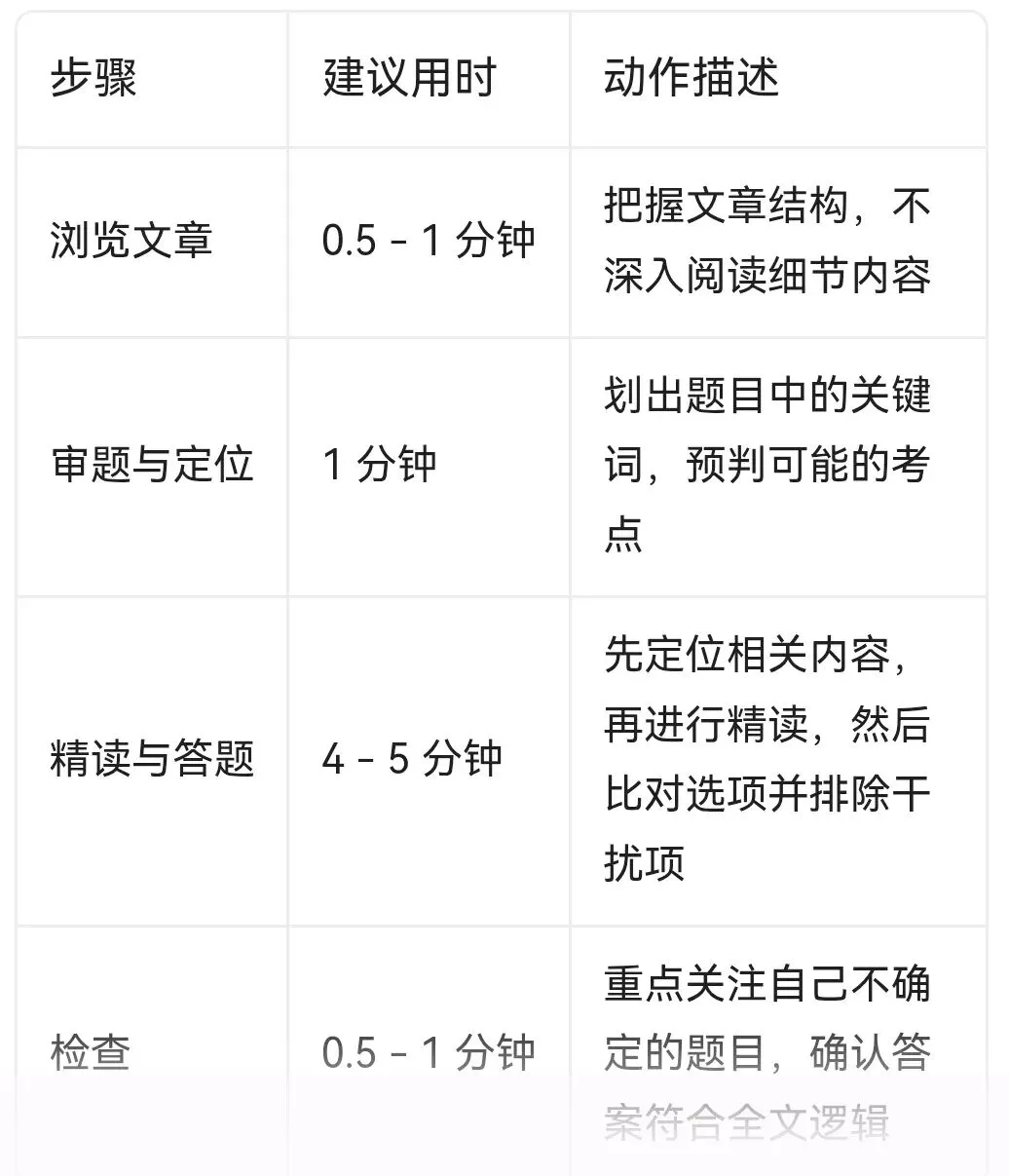
黄金法则:
先题后文,定位为王;
同义替换,排除为上。
五、临场加分要诀
1. 遇到生词别慌:多数生词不影响答题,可通过上下文猜,或直接忽略。
2. 长难句抓主干:找到“主谓宾”,理清“谁做了什么”。
3. 绝对词谨慎选:含 always, never, all, none 的选项往往有问题。
4. 答案分布规律:通常ABCD选项分布较均匀,可作为最后检查的参考(勿过度依赖)。
5. 相信第一感觉:除非有充分依据,否则不要轻易改动答案。
附:快速自检清单(做题时心里默问)
· 我是否找到了原文依据?
· 选项是否犯了“无中生有”或“偷换概念”的错误?
· 主旨题是否概括了全文,而非某一段?
· 推理题是否推得太远?
· 词义题代入原文是否通顺?
好了,读到这里的你,已经完成了一次从“理解文字”到“拆解逻辑”的深度训练。
记住,每一篇摆在你面前的阅读,都不仅仅是“考题”,更是一个微缩的世界、一套思维的模型。当你学会主动捕捉结构、推断意图、品咂细节时,你收获的将不只是分数,更是一种清晰理解世界的能力。
阅读的路很长,不必急于一时。愿你带着方法,也带着好奇,踏实走好每一步。