

6月25日,我们一起回来核对命中率。
进入五月下旬,距离中考只剩三十多天。前六套押题卷已覆盖阅读图表题、五选五还原题、跨学科融合题等2026年核心考法。今天我们继续推出第七套高精度押题卷,本卷在话题选择上进一步创新:从嵩阳书院的千年文脉到人工智能时代的英语学习,从洛阳牡丹的花语人生到环境保护的青年行动,全面覆盖2026年命题热点。
河南省2026年初中学业水平考试英语押题试卷(七)
(笔试部分 满分100分)
一、阅读理解(20小题,每小题2分,共40分)
A
Songyang Academy
— Where Ancient Scholars Dreamed Big
Welcome to Songyang Academy (嵩阳书院)
Nestled at the foot of Mount Song in Dengfeng, Henan, Songyang Academy is one of China's four great ancient academies. Built over 1,500 years ago, it was once the "Harvard of ancient China," where the brightest minds gathered to study, debate, and shape the future of the nation.
What Makes It Special?
📚 The Library of 5,000 Years
The academy houses a collection of over 10,000 ancient books. The most precious are carved stone tablets from the Tang and Song dynasties, recording classic works of Chinese philosophy.
🌳 The 4,500-Year-Old Cypress
Stand in awe before two ancient cypress trees, believed to be over 4,500 years old. Legend says Emperor Wu of the Han Dynasty named them "Great General" and "Second General." They have survived wars, storms, and centuries — silent witnesses to history.
🎓 Be a Scholar for a Day
· Wear traditional scholar robes and attend a "class" in the main lecture hall
· Try calligraphy with brush and ink on rice paper
· Recite classic poems in the courtyard where ancient scholars once stood
Visitor Information
· Opening Hours: 8:00 a.m. — 6:00 p.m.
· Tickets: Adults ¥80, Students ¥40
· Location: Dengfeng City, about 1.5 hours' drive from Zhengzhou
"Standing where great scholars once taught, I felt the weight of knowledge and the power of dreams." — A visitor from Zhengzhou
1. What is the text type of this passage?
A. A personal letter.
B. A travel guide.
C. A historical novel.
D. A news interview.
2. How old is Songyang Academy?
A. Over 500 years.
B. Over 1,000 years.
C. Over 1,500 years.
D. Over 4,500 years.
3. What can visitors do at the academy?
A. Take a class with modern teachers.
B. Plant a cypress tree.
C. Try calligraphy and recite poems.
D. Borrow ancient books to take home.
4. How much does a student ticket cost?
A. ¥20.
B. ¥40.
C. ¥80.
D. ¥120.
5. The visitor's comment expresses a feeling of ________.
A. sadness about the past
B. connection to history and learning
C. disappointment with the exhibits
D. confusion about ancient philosophy
B
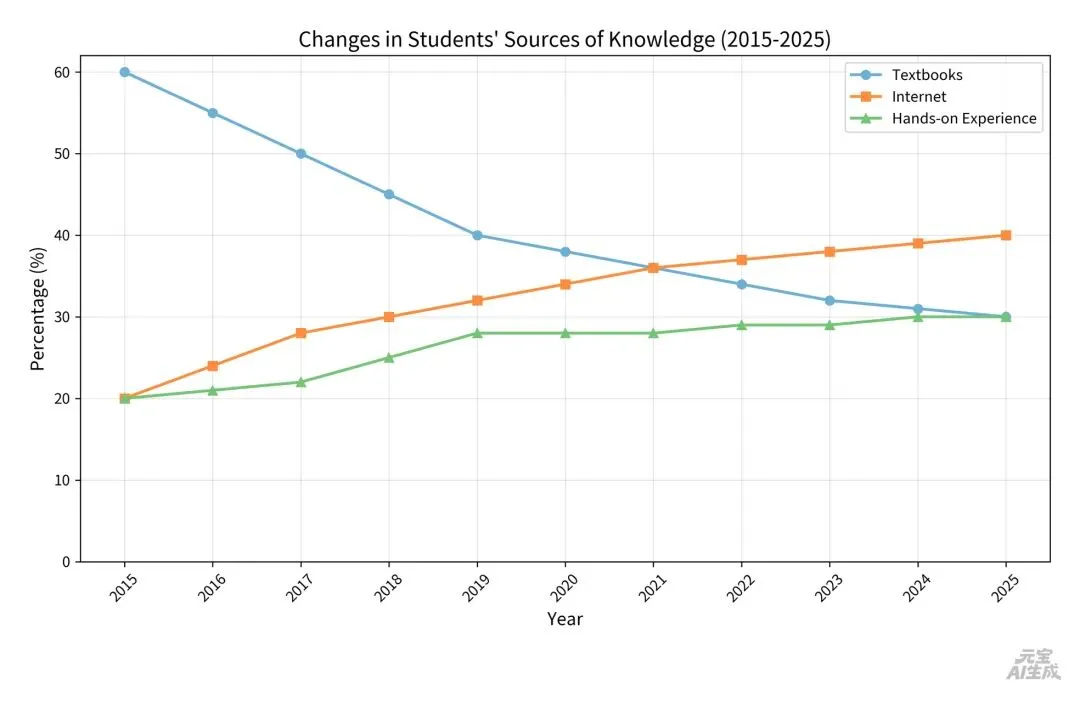
Where does knowledge come from?
How do students get their knowledge? A survey tracking changes in students’ sources of knowledge from 2015 to 2025 reveals some interesting shifts.
Textbooks, once the dominant source at 60% in 2015, have seen a sharp decline to 30% in 2025. This does not mean textbooks are becoming unimportant — rather, they are now being supplemented by other sources. The Internet has seen the most dramatic rise, jumping from 20% to 40% over the decade. With the rise of educational apps, online courses, and AI tools, students now have access to knowledge at their fingertips.
Hands-on experience has also gained ground, rising from 20% to 30%. More schools are incorporating project-based learning, science experiments, and field trips into their curriculum. "The best learning happens when students combine all three sources," said Ms. Li, a teacher from Zhengzhou. "Textbooks provide the foundation, the Internet offers endless resources, and hands-on experience turns knowledge into real ability."
6. What is the passage mainly about?
A. The history of textbooks.
B. Changes in how students get knowledge.
C. The dangers of the Internet.
D. How to do science experiments.
7. What percentage of knowledge came from the Internet in 2025?
A. 20%.
B. 30%.
C. 40%.
D. 60%.
8. What does the underlined word “supplemented” in Paragraph 2 probably mean?
A. 取代
B. 补充
C. 遗忘
D. 比较
9. According to Ms. Li, what is the best way to learn?
A. Using only textbooks.
B. Learning only from the Internet.
C. Combining textbooks, the Internet, and hands-on experience.
D. Only doing experiments.
10. This passage combines English reading with the skill of ________.
A. reading a line chart
B. writing a letter
C. drawing a picture
D. giving a speech
C
Peonies are known as the "King of Flowers" in Chinese culture. In Luoyang, Henan, the peony is not just a flower — it is a symbol of the city's spirit. Every April, the Luoyang Peony Festival attracts millions of visitors. But beyond their beauty, peonies hold deep lessons about life.
The first lesson is patience. Peonies are slow-growing plants. A peony farmer once said, "If you want to grow a beautiful peony, you must wait at least three years for the first bloom." In our world of instant gratification, peonies remind us that truly valuable things take time.
The second lesson is resilience . Peonies survive cold winters underground. When spring comes, they push through the frozen soil toward the sun. The harsher the winter, the more splendid the bloom. This is why Luoyang people often say, "The peony does not fear the cold of winter; it only thinks of the warmth of spring."
The third lesson is generosity. When peonies bloom, they do so fully and openly. They don't hide their beauty — they share it with the world. A single peony flower can have over a hundred petals, each one offering its color and fragrance freely.
Perhaps this is why peonies have inspired poets and artists for centuries. As one Song Dynasty poet wrote, "Only the peony is the true national beauty; when it blooms, the capital is moved."
11. What is the main topic of this passage?
A. How to plant peonies at home.
B. The history of the Luoyang Peony Festival.
C. Life lessons we can learn from peonies.
D. Different types of flowers in China.
12. How many life lessons are introduced in the passage?
A. One.
B. Two.
C. Three.
D. Four.
13. What does the underlined word “resilience” in Paragraph 3 probably mean?
A. 美丽
B. 芬芳
C. 耐心
D. 韧性
14. What can we learn from the peony farmer's words in Paragraph 2?
A. Growing peonies is very easy.
B. Beautiful things are worth waiting for.
C. Peonies only bloom once.
D. Everyone should grow peonies.
15. Which paragraph introduces the lesson about sharing beauty with others?
A. Paragraph 1.
B. Paragraph 2.
C. Paragraph 3.
D. Paragraph 4.
D
Have you ever wondered why some people seem to sail through difficult times while others fall apart? 16. ________ It's not about luck or natural ability — it's about a quality called "emotional resilience."
Emotional resilience is the ability to recover from setbacks and keep going. 17. ________ Life is full of exams we fail, games we lose, and friends who let us down. What matters is not what happens to us, but how we respond.
So how can teenagers build emotional resilience? Psychologists suggest four key strategies.
First, build strong relationships. 18. ________ When you're struggling, a supportive friend or family member can make all the difference. They don't need to solve your problems — they just need to listen.
Second, practice self-compassion. When you fail, don't call yourself a failure. 19. ________ Talk to yourself the way you would talk to a good friend who is going through a hard time.
Third, focus on what you can control. You can't control the weather on exam day or what questions will be on the test. 20. ________ Shifting your focus from things outside your control to things within it reduces anxiety and builds confidence.
根据材料内容,从下面五个选项中选出能填入文中空缺处的最佳选项,使文章意思通顺、内容完整。
A. Having people you can trust is like having a safety net.
B. But you can control how much you prepare and how you manage your time.
C. The answer lies in a skill that can be learned and strengthened.
D. Think of it as a muscle — the more you exercise it, the stronger it becomes.
E. Instead, treat yourself with kindness and understanding.
二、完形填空(15小题,每小题1分,共15分)
先通读短文,掌握其大意,然后从A、B、C、D四个选项中选出一个可以填入相应空白处的最佳答案。
My grandpa never throws anything away. His house is full of old newspapers, broken clocks, and jars of mysterious objects he swears he "might need someday." When I was younger, I used to think his 21 was just a sign of his age. It annoyed me.
This spring, my school organized a community repair event called "Fix It, Don't Ditch It." We invited residents to bring broken items, and volunteers would help 22 them. I told Grandpa about it, expecting him to be 23. Instead, his eyes lit up.
On the day of the event, Grandpa arrived early, pushing a cart full of his "junk." He set up a small station with his tools and a handwritten 24 that said, "70 years of experience — I can fix anything with a soul." At first, I felt 25. What would my classmates think?
But then magic happened. A young mother brought a music box that had 26 to her grandmother. Grandpa opened it gently, studied the tiny parts, and within twenty minutes, the music box was 27 a soft melody again. The mother's eyes filled with tears.
Throughout the day, Grandpa fixed a radio, a pair of old glasses, and a pocket watch that 28 at least fifty years old. People gathered around his table, watching in 29 as his wrinkled hands brought dead objects back to life.
That evening, as we 30 his tools, I finally asked, "Why do you keep all those things, Grandpa?" He smiled and said, "In my time, we didn't throw things away. We fixed them. When you fix something, you don't just 31 it — you show respect for the person who made it and the person who used it."
I looked around his workshop — the jars, the clocks, the pieces of metal and wood. For the first time, I didn't see 32. I saw stories waiting to be continued. I saw a philosophy of life that I had been too quick to 33.
The next week, I asked Grandpa to teach me how to fix a watch. My hands were clumsy, and I 34 three times. But each time, Grandpa patiently handed me the tool and said, "Try again."
Now, I see things 35. A broken toy is not garbage — it's an invitation to learn. And my grandpa is not a hoarder — he's a keeper of stories.
21. A. collecting B. cleaning C. repairing D. borrowing
22. A. sell B. fix C. paint D. wash
23. A. excited B. worried C. puzzled D. grateful
24. A. letter B. sign C. note D. book
25. A. proud B. embarrassed C. relaxed D. disappointed
26. A. belonged B. referred C. turned D. listened
27. A. writing B. singing C. playing D. recording
28. A. saw B. looked C. seemed D. sounded
29. A. anger B. silence C. amusement D. wonder
30. A. took out B. put away C. gave up D. threw off
31. A. sell B. keep C. repair D. use
32. A. treasure B. junk C. art D. history
33. A. accept B. remember C. judge D. forget
34. A. succeeded B. failed C. finished D. started
35. A. differently B. carelessly C. happily D. quickly
三、语篇填空(15小题,每小题1分,共15分)
第一节 阅读短文,从方框中选择适当的词并用其正确形式填空,使短文通顺、意思完整。每空限填一词,每词限用一次。
amaze, discover, far, include, it, power, recent, science, send, wonder
The universe has always fascinated humans. From ancient astronomers to modern scientists, we have never stopped looking up at the stars. And in the past few years, some of the most exciting 36 in space exploration have come from China.
In 2024, the Chang'e-6 mission made history by 37 back the first-ever soil samples from the far side of the moon. This was a truly 38 achievement. The far side of the moon, which never faces Earth, had never been explored in this way before.
The samples brought back by Chang'e-6 are 39 important for scientists. They help us understand how the moon formed and what materials exist on 40 surface. According to researchers, the far side is quite different from the near side, and studying it may solve long-standing 41 about the moon's history.
China's space program has many more 42 plans. The Tiangong space station continues to grow, and there are plans to send astronauts to the moon by 2030. More 43, China has launched the Xuntian Space Telescope, which will scan the sky alongside the space station.
These achievements are not just about national pride. They represent humanity's shared curiosity and desire to explore the unknown. Every new discovery brings us one step 44 to answering the biggest question: Are we alone in the universe?
As a young student, these missions fill me with 45. They remind me that the sky is not the limit — it is just the beginning.
第二节 阅读短文,根据语篇要求填空,使短文通顺、意思完整。每空限填一词。
The Mid-Autumn Festival is one of the most beloved traditional festivals in China. It falls 46 the 15th day of the eighth lunar month. In Henan, families celebrate by eating mooncakes, admiring the full moon, and sharing stories about Chang'e.
The festival has a history of over 3,000 years. Originally, it was a harvest festival 47 people gave thanks for the year's crops. Over time, it became connected with the legend of Chang'e, the moon goddess.
This year, my family celebrated the Mid-Autumn Festival 48 a special way. Instead of staying at home, we went to the Yellow River scenic area. There, under the bright full moon, my grandmother told us stories about 49 she celebrated the festival as a child. Her stories made me realize that while traditions may change in form, their core spirit — family reunion and gratitude — never changes.
As we shared mooncakes by the river, I felt deeply connected 50 both my family and the long history of our culture.
四、补全对话(5小题,每小题2分,共10分)
根据下面的对话情景,在每个空白处填上一个适当的句子,使对话的意思连贯、完整。
A: Hi, Chen Yu! I heard your school won first prize in the Henan Youth Science Competition. 51. _____________________________________!
B: Thank you! Yes, we're really excited about it. Our team worked on the project for almost half a year.
A: That's amazing! 52. _____________________________________?
B: We designed a small robot that can help pick up litter in parks. It uses a camera to recognize different types of waste and sorts them into the right bins.
A: Wow, that's so creative! 53. _____________________________________?
B: The idea came from a field trip to the Yellow River Wetland Park. We saw a lot of trash there and wanted to do something about it.
A: So your robot can actually help protect the environment. 54. _____________________________________?
B: At the moment, it can only recognize four types of waste — plastic, paper, glass, and metal. We're still working on improving it.
A: I'd love to see it in action. 55. _____________________________________?
B: Sure! We're doing a demonstration at our school's science fair next Friday afternoon. You're welcome to come!
五、书面表达(20分)
科技日新月异,人工智能正在走进我们的生活。某英文网站正在举办以"AI in My Life"为主题的征文活动,请你根据以下提示写一篇短文投稿。
1. 描述人工智能在你生活中某个方面的应用(学习、出行、娱乐等);
2. 分享一次你使用人工智能的亲身经历;
3. 说说你对人工智能未来发展的看法或期待。
要求:
1. 文中须包含所有提示要点,可适当发挥;
2. 文中不得出现考生的真实姓名和学校名称;
3. 词数100左右。
---
(试卷结束)
参考答案
一、阅读理解
1-5 BCCBB 6-10 BCBCA 11-15 CCDBD 16-20 CDAEB
二、完形填空
21-25 ABABB 26-30 ACCDB 31-35 CBCBA
三、语篇填空
36. discoveries 37. sending 38. amazing 39. scientifically 40. its
41.wonders 42. powerful 43. recently 44. farther 45. amazement
46. on 47. when 48. in 49. how 50. to
四、补全对话
51. Congratulations!
52. What did you design? / What was your project about?
53. How did you come up with the idea? / Where did the idea come from?
54. How many types of waste can it recognize? / What can it recognize?
55. Can I see it? / Can I come and watch?
五、书面表达(参考范文)
AI in My Life
AI has become a part of my daily life, especially in my English learning. I often use an AI-powered language app to practice speaking. It listens to my pronunciation, points out my mistakes, and suggests better expressions.
Last month, I had to give a speech in English. I practiced with the app every evening. It helped me improve my pronunciation and even gave me feedback on my tone and pace. On the day of the speech, I felt much more confident. My teacher said my pronunciation had improved a lot.
I believe AI will play an even bigger role in education in the future. It can be like a personal teacher who is always available. However, I think real teachers will always be important, because learning is not just about knowledge — it is also about human connection.
命题亮点解析
河南本土文化深度渗透
· 阅读A篇:嵩阳书院——登封千年文脉(旅游指南体裁)
· 阅读C篇:洛阳牡丹——花语中的人生哲理
· 语篇填空第二节:中秋夜游黄河风景名胜区
· 补全对话:河南省青年科学竞赛获奖项目
跨学科融合
· 阅读B篇:折线图数据分析 × 数学统计思维
· 阅读C篇:牡丹生长习性 × 生物学常识
· 语篇填空第一节:嫦娥六号 × 天文科学知识
高阶思维考查
· 阅读B篇第10题:图文转换题(折线图趋势分析)
· 阅读C篇第15题:段落功能判断(推理判断)
· 阅读D篇:五选五还原短文(情绪韧性 × 心理学策略)
真实语境运用
· 补全对话:科技竞赛获奖交流——祝贺、提问、邀请
· 书面表达:人工智能与生活——先描述再叙述经历,拒绝模板化
语篇填空考点
· 第一节:名词复数(discoveries)、动名词(sending)、形容词(amazing)、副词(scientifically)、物主代词(its)、名词复数(wonders)、形容词(powerful)、副词(recently)、比较级(farther)、名词(amazement)
· 第二节:介词(on)、连词(when)、介词(in)、连接词(how)、介词(to)
难度梯度
· 基础题约60%(如1-4、6-8、11-13、21-25等)
· 中档题约30%(如5、9-10、14、26-30、36-43等)
· 拔高题约10%(如15、16-20、31-35、44-45等)
写在最后
第七套押题卷在话题选择上进一步拓宽——从嵩阳书院的千年文脉到洛阳牡丹的花语人生,从嫦娥六号的探月壮举到情绪韧性的心理建设,素材兼具文化厚度与时代精神。至此,七套试卷已形成系统完备的话题矩阵,建议与第一至六套配合使用,进行完整模拟训练。
6月25日,我会在这里等你们。
我们核对押题成功率。
---
点击「在看」或「收藏」,考后回来汇报你的命中喜讯。
关注本号,后续3套押题卷持续发布。


