

6月25日,我们一起回来核对命中率。
进入五月中旬,备考已进入最后冲刺阶段。前五套押题卷发布后,很多同学反馈已经能够熟练应对图表题、五选五还原题以及真实语境中的语法考查。今天我们继续推出第六套高精度押题卷,本卷在话题选择上进一步拓展:从殷墟甲骨文的历史传承到短视频对注意力的影响,从河南方言的文化魅力到科技与传统的融合创新,全面覆盖2026年命题热点。
---
河南省2026年初中学业水平考试英语押题试卷(六)
(笔试部分 满分100分)
一、阅读理解(20小题,每小题2分,共40分)
A
Anyang Yin Xu Museum
— Walk Through 3,000 Years of History
Welcome to Yin Xu
Located in Anyang, Henan, Yin Xu is the ancient capital of the Shang Dynasty and a UNESCO World Heritage site. It is famous as the birthplace of Chinese archaeology and the home of oracle bone inscriptions (甲骨文) — the earliest known form of Chinese writing.
Highlights of Your Visit
🔍 Oracle Bone Gallery
See real oracle bones that are over 3,000 years old! These turtle shells and animal bones were used by ancient kings to communicate with gods. The carvings on them are the ancestors of today's Chinese characters.
🏛️ Royal Tombs Area
Visit the underground tombs of Shang kings. The most famous is the Tomb of Fu Hao, China's first known female general. Over 1,600 artifacts were discovered here, including jade, bronze, and pottery.
✍️ Hands-on Activities
· Try writing your name in oracle bone script
· Make a rubbing (拓片) of ancient inscriptions
· Join a "little archaeologist" digging experience (for ages 8-15)
Visitor Information
· Opening Hours: 8:30 a.m. — 5:30 p.m. (closed on Mondays)
· Tickets: Adults ¥90, Students ¥45 (with student ID)
· How to get there: Take high-speed train to Anyang East Station, then bus No. 16
"Seeing oracle bones with my own eyes was like touching the soul of Chinese civilization." — A visitor from Zhengzhou
1. What is the text type of this passage?
A. A personal diary.
B. A travel guide.
C. A scientific report.
D. A news article.
2. What is Yin Xu most famous for?
A. The Terracotta Warriors.
B. Oracle bone inscriptions.
C. The Great Wall.
D. Buddhist carvings.
3. Who was Fu Hao according to the passage?
A. A Shang Dynasty king.
B. A famous archaeologist.
C. China's first known female general.
D. A museum tour guide.
4. How much should a student pay for a ticket with a student ID?
A. ¥45.
B. ¥50.
C. ¥90.
D. ¥160.
5. The visitor's comment expresses a feeling of ________.
A. disappointment
B. deep connection with history
C. confusion about the exhibits
D. boredom with ancient things
B
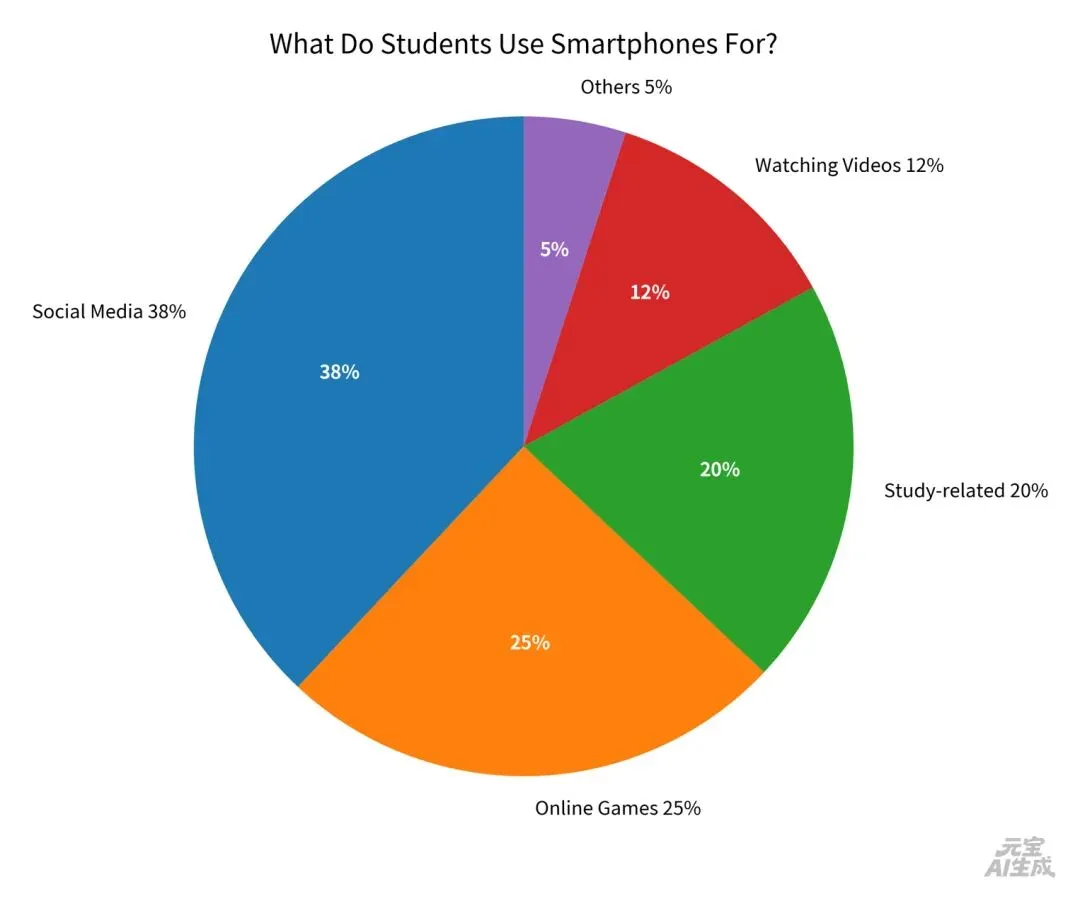
What do students use smartphones for?
A survey conducted among 1,500 middle school students in Henan reveals how teenagers are spending their time on smartphones. The pie chart above breaks down the results.
Social media takes the largest slice at 38%. Students use apps like WeChat and QQ to chat with friends and share moments of their daily lives. Online games come second at 25%, which has raised concerns among both parents and teachers.
However, there is also positive news. Study-related activities account for 20% of smartphone use. More students are using educational apps to look up English words, watch teaching videos, and even take online courses. Watching videos for entertainment makes up 12%, while other activities take up the remaining 5%.
"In the digital age, the question is not whether students should use smartphones, but how they use them," said Mr. Wang, a teacher from Zhengzhou. "We should guide students to see their phones as learning tools, not just toys for killing time."
6. What is the passage mainly about?
A. The history of smartphones.
B. How students use smartphones.
C. The dangers of social media.
D. How to buy a good smartphone.
7. What percentage of students use smartphones for online games?
A. 5%.
B. 12%.
C. 20%.
D. 25%.
8. What does the underlined phrase "killing time" in the last paragraph probably mean?
A. 节约时间
B. 浪费时间
C. 安排时间
D. 记录时间
9. According to Mr. Wang, how should students view smartphones?
A. As expensive toys.
B. As learning tools.
C. As dangerous devices.
D. As useless machines.
10. This passage combines English reading with the skill of ________.
A. analyzing a pie chart
B. drawing a map
C. writing a poem
D. giving a speech
C
In an age of short videos and endless social media scrolling, our attention has become a valuable resource — and one that is increasingly hard to protect. Scientists call this "attention fragmentation" (注意力碎片化), and it affects both students and adults.
Research from the University of California shows that the average human attention span (持续时间) has dropped from 12 seconds in the year 2000 to just 8 seconds today. To put that in perspective, a goldfish is believed to have an attention span of 9 seconds. We are now officially less focused than a goldfish.
Why is this happening? Every time your phone buzzes with a notification, your brain receives a small hit of dopamine (多巴胺) — the "feel-good" chemical. Over time, your brain becomes addicted to these tiny rewards. As a result, it gets harder to focus on things that require long periods of concentration, like reading a book or solving a complex math problem.
The good news is that focus is like a muscle — it can be strengthened. Dr. Sarah Chen suggests three habits to rebuild your attention span. First, practice "single-tasking." Put your phone in another room while studying and focus on just one task at a time. Second, try "digital fasting" — spend at least one hour every day without any screens, preferably before bedtime. Third, read physical books for at least 20 minutes daily. The linear (线性的) nature of books naturally trains your brain to follow a thought from beginning to end.
"In the future, the ability to focus deeply will be a superpower," Dr. Chen says. "Those who can control their attention will control their lives."
11. What is the main topic of this passage?
A. The history of goldfish.
B. How to use social media.
C. Attention fragmentation and how to fight it.
D. The benefits of smartphones.
12. What is the average human attention span today?
A. 12 seconds.
B. 9 seconds.
C. 8 seconds.
D. 20 seconds.
13. Why do notifications make it harder to focus?
A. They contain important information.
B. They give the brain small rewards that become addictive.
C. They remind us to take breaks.
D. They help us multitask more effectively.
14. What does the underlined word "single-tasking" in Paragraph 4 probably mean?
A. 多任务处理
B. 单任务处理
C. 快速切换
D. 同时进行
15. Which paragraph explains how to rebuild our attention span?
A. Paragraph 1.
B. Paragraph 2.
C. Paragraph 3.
D. Paragraph 4.
D
When we think of intangible cultural heritage, we often imagine ancient crafts that exist only in museums. But in Henan, a different story is unfolding — young people are breathing new life into old traditions. 16. ________
Li Xin, a 25-year-old artist from Kaifeng, is a perfect example. 17. ________ But Li found a way to attract new audiences: she incorporated elements of modern animation into the traditional designs. Her woodblock prints of cartoon-style characters dressed in Song Dynasty clothing went viral online.
Another young inheritor, 19-year-old Wang Tao from Luoyang, has been learning Tang tri-colored pottery (唐三彩) from his grandfather since he was ten. "Many people see it as something for tourists," he says. 18. ________ He opened a Douyin account and started livestreaming the entire process of making a Tang tri-colored horse, from shaping the clay to applying the colored glaze.
The results have been encouraging. 19. ________ Some viewers even signed up for offline workshops. "When I see comments like 'I didn't know China had such amazing art,' I feel so proud," Wang says.
These young inheritors are proving that tradition and innovation can go hand in hand. 20. ________ As Li Xin puts it, "Tradition is not the worship of ashes — it is the passing on of fire."
根据材料内容,从下面五个选项中选出能填入文中空缺处的最佳选项,使文章意思通顺、内容完整。
A. She specializes in Zhuxian Town woodblock prints, a traditional art with over 1,000 years of history.
B. His videos have received millions of views.
C. They are using social media, modern design, and new technology to make ancient arts relevant again.
D. "But I believe it can be something people truly appreciate in their daily lives."
E. By staying true to the spirit of their crafts while embracing change, they are ensuring these traditions survive for future generations.
二、完形填空(15小题,每小题1分,共15分)
先通读短文,掌握其大意,然后从A、B、C、D四个选项中选出一个可以填入相应空白处的最佳答案。
It was the last class before summer vacation. Our teacher, Ms. Zhao, walked in carrying a large bag of potatoes. We all looked at each other in 21. Were we going to cook?
"Before you leave for the summer," she said, "I want to teach you one 22 lesson. It's not about math or English. It's about forgiveness."
She gave each of us a potato and a marker. "Think of someone you're still 23 at. Write their name on the potato. If there are more people, write more names." I hesitated, then wrote the name of my former best friend who had 24 me to another group last year.
"Now put your potatoes in your schoolbag and keep them there for a whole week," Ms. Zhao 25. "Everywhere you go — to class, to the playground, to bed — your bag must stay with you."
The first day was funny. We laughed at the 26 of carrying potatoes. By the third day, though, the potatoes started to soften and smell. By the fifth day, the 27 was unbearable. My bag smelled terrible, and the potato was 28 and heavy.
On the last day, Ms. Zhao asked us to take out our potatoes. "That smell," she said, "is what 29 does to your heart. The longer you hold onto it, the heavier and more harmful it becomes. The only way to lighten your load is to let it 30."
We threw the rotten potatoes into a bin. The 31 in the classroom was mixed — relief from getting rid of the smelly potatoes, and 32 from realizing how much our grudges (怨恨) had been weighing us down.
I thought about my former friend. The potato with her name was now 33, but the lesson wasn't. That evening, I sent her a message: "I don't know if you still care, but I forgive you. I hope you're doing well."
She replied within minutes. We had a long 34 that night. Now, a year later, she's my friend again. All because a wise teacher used some 35 to teach us the power of letting go.
21. A. excitement B. confusion C. fear D. sadness
22. A. first B. easy C. final D. boring
23. A. surprised B. excited C. mad D. amazed
24. A. introduced B. invited C. followed D. left
25. A. joked B. complained C. explained D. instructed
26. A. joy B. silliness C. danger D. problem
27. A. taste B. smell C. sound D. sight
28. A. soft B. fresh C. light D. clean
29. A. unforgiveness B. friendship C. kindness D. happiness
30. A. stay B. grow C. go D. remain
31. A. silence B. noise C. feeling D. lesson
32. A. pride B. shame C. confidence D. fear
33. A. gone B. fresh C. rotten D. whole
34. A. argument B. fight C. conversation D. exam
35. A. books B. potatoes C. pens D. bags
三、语篇填空(15小题,每小题1分,共15分)
第一节 阅读短文,从方框中选择适当的词并用其正确形式填空,使短文通顺、意思完整。每空限填一词,每词限用一次。
it, perform, wide, create, year, become, stage, young, move, proud
Henan Opera, also known as Yuju, has been an important part of Henan's cultural identity for hundreds of years. It is one of China's five major opera forms and is loved for 36 expressive singing and lively storytelling.
In recent years, a new trend has appeared: 37 performers are bringing fresh energy to this ancient art. Among them is 16-year-old Chen Xiaotong from Zhoukou. She 38 on stage for the first time at the age of seven and has since won several national awards. "Some of my friends think opera is old-fashioned," she says. "But once they see a live 39, they completely change their minds."
To attract younger audiences, opera troupes across Henan have begun experimenting with new formats. Some have 40 short opera videos on Douyin that have gone viral. Others have introduced modern stage lighting and interactive elements, making performances more visually exciting.
These efforts are paying off. During this 41 Spring Festival, Yuju performances were held in over 200 villages across Henan, drawing larger crowds than ever before. "What excites me most is seeing young children in the audience, 42 to the music," says Master Liu, a veteran performer. "That's when I know the tradition will live on."
The success of Yuju shows that tradition and modernity can go hand in hand. By 43 the core spirit while embracing change, this ancient art is finding new life. It is a source of 44 for Henan people and a reminder that cultural heritage is not just about the past — it is also about the future. As one young fan put 45, "Yuju is not just my grandparent's music. It's mine too."
第二节 阅读短文,根据语篇要求填空,使短文通顺、意思完整。每空限填一词。
The Longmen Grottoes in Luoyang are one of the greatest treasures of Buddhist art in the world. Carved into the limestone cliffs along the Yi River, they contain tens of thousands of statues that date back 46 the Northern Wei Dynasty.
Walking among the grottoes is like walking through a history book carved in stone. The largest statue is over 17 meters tall, 47 the smallest is less than 2 centimeters. Each one tells a story of faith, art, and human creativity.
In recent years, modern technology 48 been used to protect and present the grottoes in new ways. Through 3D scanning and virtual reality, visitors from around the world can now explore the grottoes online. This not only helps preserve the fragile carvings but 49 makes them accessible to people who may never visit Luoyang in person.
The Longmen Grottoes remind us 50 the importance of protecting our shared cultural heritage. They are a gift from the past, and it is our responsibility to pass them on to future generations.
四、补全对话(5小题,每小题2分,共10分)
根据下面的对话情景,在每个空白处填上一个适当的句子,使对话的意思连贯、完整。
A: Hey, Liu Yang! Did you go anywhere interesting during the May Day holiday?
B: 51. ______________________________________. I spent three days there and it was amazing!
A: Kaifeng? That's a historic city! 52. _____________________________________?
B: I visited the Millennium City Park, the Dragon Pavilion, and the Kaifeng Museum. But what impressed me most was the food street at Gulou Night Market.
A: The night market? 53. _____________________________________?
B: I tried guantang baozi, the famous soup dumplings. You bite a small hole, sip the soup first, and then eat the rest. It was delicious!
A: My mouth is watering just listening to you! 54. _____________________________________?
B: Sure! Next weekend if you're free, we can go together. It's only an hour by train from Zhengzhou.
A: That would be great! 55. _____________________________________?
B: A one-day trip is enough to see the main attractions. But if you want to try all the food, maybe stay one night!
五、书面表达(20分)
科技正在改变我们的学习方式。有人喜欢传统的课堂学习,有人偏爱利用网络资源自学。某英文杂志正在举办以"My Favorite Way of Learning"为主题的征文活动,请你根据以下提示写一篇短文投稿。
1. 介绍你最喜欢的学习方式(课堂学习、在线学习、阅读书籍、动手实践等);
2. 分享一次与这种学习方式有关的经历;
3. 说明为什么这种方式对你最有效。
要求:
1. 文中须包含所有提示要点,可适当发挥;
2. 文中不得出现考生的真实姓名和学校名称;
3. 词数100左右。
---
(试卷结束)
参考答案
一、阅读理解
1-5 BBCAB 6-10 BDBBA 11-15 CCBBD 16-20 CADBE
二、完形填空
21-25 BCCDD 26-30 BBAAC 31-35 CBACB
三、语篇填空
36. its 37. young 38. performed 39. performance 40. created
41.year's 42. moving 43. keeping 44. pride 45. it
46. to 47. while 48. has 49. also 50. of
四、补全对话
51. Yes, I went to Kaifeng. / I went to Kaifeng.
52. What places did you visit? / What did you see there?
53. What food did you try? / What did you eat there?
54. Can we go together sometime? / Would you like to go with me?
55. How long does it take to visit Kaifeng? / Is one day enough?
五、书面表达(参考范文)
My Favorite Way of Learning
My favorite way of learning is through hands-on practice. While some people prefer reading books or watching videos, I find that I learn best when I can actually do things myself.
Last semester, our physics teacher taught us about electric circuits. Instead of just explaining the theory, he brought wires, batteries, and small light bulbs to class. We worked in groups to build circuits ourselves. I still remember the excitement when our light bulb finally lit up. That moment taught me more than any textbook could.
Hands-on learning works best for me because it turns abstract ideas into real experiences. When my hands are busy, my mind is more focused. Making mistakes and fixing them also helps me understand things more deeply. As the saying goes, "I hear and I forget. I see and I remember. I do and I understand."
命题亮点解析
河南本土文化深度渗透
· 阅读A篇:安阳殷墟——甲骨文发源地(旅游指南体裁)
· 语篇填空第一节:豫剧——河南非遗戏曲的年轻化传承
· 语篇填空第二节:龙门石窟——洛阳世界文化遗产
· 补全对话:开封鼓楼夜市——河南饮食文化
跨学科融合
· 阅读B篇:饼状图数据分析 × 数学统计思维
· 阅读C篇:注意力碎片化 × 神经科学常识
· 书面表达:学习方式 × 物理学电路实验
高阶思维考查
· 阅读B篇第10题:图文转换题(饼状图信息解读)
· 阅读C篇第15题:段落功能分析(推理判断)
· 阅读D篇:五选五还原短文(非遗传承 + 创新融合)
真实语境运用
· 补全对话:开封旅游经历——特殊疑问句 + 开放性回答
· 书面表达:最喜欢的学习方式——先介绍再举例,拒绝模板化
语篇填空考点
· 第一节:物主代词(its)、形容词(young)、动词过去式(performed)、名词(performance)、动词过去式(created)、名词所有格(year's)、现在分词(moving)、动名词(keeping)、名词(pride)、代词(it)
· 第二节:介词(to)、连词(while)、助动词(has)、副词(also)、介词(of)
难度梯度
· 基础题约60%(如1-4、6-8、11-13、21-25等)
· 中档题约30%(如5、9-10、14、26-30、36-43等)
· 拔高题约10%(如15、16-20、31-35、44-45等)
写在最后
第六套押题卷在文化主题上进一步深化——从殷墟甲骨文的三千年回响到豫剧的年轻化传承,从注意力经济的科学认知到土豆实验里的宽恕哲学,素材兼具文化厚度与人生智慧。至此,六套试卷已形成完整的话题矩阵,建议与第一至五套配合使用,进行系统性模拟训练。
6月25日,我会在这里等你们。
我们核对押题成功率。
---
点击「在看」或「收藏」,考后回来汇报你的命中喜讯。
关注本号,后续4套押题卷持续发布。


