


中考模拟
2026绵阳涪城区中考二模英语卷
一、阅读理解
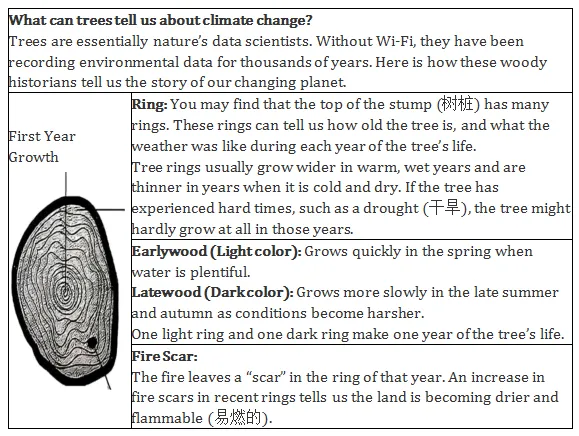
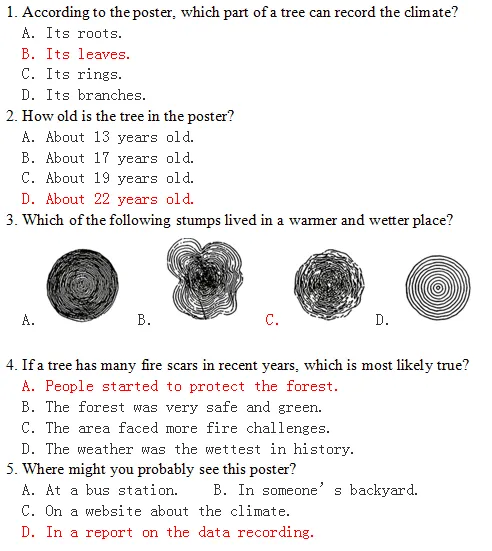
文章大意:本文介绍了树木年轮如何记录气候变化,包括年轮的宽窄与天气的关系、早材与晚材的区别以及火疤的指示意义。
文章大意:本文是一篇记叙文,主要介绍清代女科学家王贞仪的生平、自学经历与在天文学、数学、诗歌等领域的成就,展现她克服时代局限、坚持学习并为女性权益发声的故事。
Wang Zhenyi (王贞仪, 1768-1797) was not only a famous scientist but also a woman well known for her contributions in astronomy (天文学) , mathematics, and poetry in the Qing dynasty. At that time, girls were prevented from getting a formal education. However, her father and grandfather, encouraged her to read the books in their own libraries and educate her. As a child, Wang Zhenyi was very smart and had a great passion for reading.
At the age of sixteen, Wang Zhenyi traveled south of the Yangtze river with her father. It broadened her horizons and enriched her life experiences. When she was eighteen, she made friends through her poetry and began focusing on her studies in astronomy and mathematics, most of which were self-taught. At age twenty-five she married Zhan Mei from Anhui. After her marriage, she became better known for her poetry and knowledge in mathematics and astronomy that she once taught some male students.
Although she only lived to be twenty-nine, Wang Zhenyi was very good in astronomy. Not only did she study the research of other astronomers, but she was able to find her own research. In the field of mathematics, Wang Zhenyi wrote an article called “The Explanation of the Pythagorean Theorem and Trigonometry,” 《勾股定理与三角法的解释》. With her poetry, published in a collection, she often addressed inequalities (不平等) in society and championed the rights of women.
Her studies were difficult and she once said, “There were times that I had to put down my pen and sigh. But I love the subject, I do not give up.”
6. What can you learn about Wang Zhenyi’s childhood?
A.She had a large collection of books in her own library.
B.She was very interested in reading and was very smart.
C.She always traveled in different places with her family.
D.She studied astronomy, mathematics and poetry at school.
7. How did Wang Zhenyi receive her education according to the text?
A.She was taught by many famous poets.
B.Most of her knowledge in medicine was self-taught.
C.She studied mathematics with her favorite teachers.
D.She taught herself astronomy mostly as she grew up.
8. What does the underlined word “championed” mean in Para. 3?
A.complained about
B.depended on
C.fought for
D.gave up
9. What can we know about Wang Zhenyi in Para.3?
A.Her achievements.
B.Her wishes for study.
C.Her travelling experiences.
D.Her male students.
10. What can you infer from Wang Zhenyi’s words in the last paragraph?
A.Math problems are not as hard as they seem to be.
B.It was necessary to use a pen when she was studying.
C.Math is so interesting that we had better love the subject.
D.We should never give up studying when facing difficulties.
文章大意:本文主要介绍了科学家发现悉尼的葵花凤头鹦鹉会自己打开公共喷泉式饮水器喝水。它们用脚压住把手,但成功率只有约41%。这种行为可能是为了喝到更干净的水、更安全,或单纯喜欢挑战。
Scientists who have been studying a group of sulphur-crested cockatoos (葵花凤头鹦鹉) in Sydney have recently made an amazing discovery: the birds know how to use public drinking fountains (喷泉式饮水器) to get water.
In 2018, Dr. Barbara Klump noticed a cockatoo drinking from a public drinking fountain in Sydney. She thought someone had forgotten to turn off the water. But after looking at a video, she realized that the bird was turning on the fountain by itself. Dr. Klump’s team then decided to study the cockatoos closely. They set up two cameras near a drinking fountain that the birds used often. Over 44 days, the cameras recorded the birds using the fountain 525 times.
The scientists found that each bird did it a little differently, but they all used at least one foot to hold down the handle (把手) on the fountain and turn it on. And some put their foot on the water outlet. Once the water was running, they tried to drink from the fountain.
Cockatoos are actually very intelligent birds. However they didn’t always succeed. The birds got water in only about 41% of their efforts to use the fountain. The birds had an especially hard time when they were in a hurry or when other cockatoos were trying to use the fountain at the same time.
The scientists aren’t exactly sure why the cockatoos started using the drinking fountains. They say one possible reason is that the clean water tastes better to them than water from small pools. Another possibility is greater safety. There, the birds can watch out for dangerous birds while drinking. Dr. Klump says it’s also possible that the cockatoos just like the challenge of making the fountain work.
11. What made Dr. Klump start the study on cockatoos?
A.Cockatoos were the most intelligent birds.
B.Cockatoos drank from public water fountains.
C.A cockatoo forgot to turn off a public fountain.
D.A cockatoo turned on the water fountain by itself.
12. According to the passage, how do the cockatoos turn on the fountain?
A.By using at least one foot.
B.By waiting for humans’ help.
C.By standing on the water outlet.
D.By working together with other birds.
13. In which situation would a cockatoo likely fail to get water?
A.When drinking from the small pools.
B.When using its foot to press the handle.
C.When several cockatoos used one fountain.
D.When the cameras recorded the birds’ behaviors.
14. What is mainly talked about in the last paragraph?
A.The public fountains might be polluted by birds.
B.The possible reasons behind this unusual bird behavior.
C.The ways cockatoos turned on fountains when drinking.
D.The different types of dangerous birds living in Sydney.
15. Which would be the best title for this passage?
A.A Famous Bird Protector
B.The Best Invention for Sydney Birds
C.How Cockatoos Used a Human Tool
D.Why Birds Should Watch Out While Drinking
文章大意:本文探讨了文化的定义、文化从家庭到社会的扩展、文化冲突的原因以及学习沟通对理解文化差异的重要性。
Our culture is the system we use to build our identity (身份). All living creatures are part of a culture. Even animals have a culture!
So what is culture? It’s the way we behave in a group. It begins with each individual family. Within our families we do things to build relationships with each other. This can include routines for doing things. It also includes traditions. Traditions are activities that are repeated on a regular basis.
Culture is not limited to individual family groups. The real strength of culture is in larger community groups. These larger groups are called societies. Every society makes rules for itself. It decides how people should act in different situations. Some of these rules are written down. Some are just things that are automatically expected of all members of that society. Often, cultures can be identified by what the people believe. Cultures are also known by what they choose to include in their art. Sometimes a society forms around people who speak the same language. Cultures may also be known for their customs, including the foods they make and the things they do.
Our cultures help us understand who we are and what we believe. There are very strong emotions connecting us to our own society. Two different cultures may disagree on something, especially if they both feel strongly about it. When that happens, war is a common result.
People are learning better ways to communicate. The more we learn, the more we understand the differences in cultures.
16. Why does the author say “Even animals have a culture!”?
A.To start an opinion.
B.To give an example.
C.To set up a mystery.
D.To make a comparison.
17. According to the passage, where does culture begin?
A.The family.
B.The society.
C.The animal.
D.The war.
18. What is the main purpose of Para. 3?
A.To explain how to write rules for a new society.
B.To show that food is an important part of customs.
C.To encourage people to join larger community groups.
D.To explain what culture is and how it is expressed in societies.
19. Why do wars sometimes begin between cultures?
A.Because of the unwritten rules.
B.Because of the strong disagreement.
C.Because of the poor communication.
D.Because of the unexpected emotion.
20. What can we get from the passage?
A.It is impossible for different cultures to agree.
B.Animals and humans have the same kind of culture.
C.Learning more helps us understand cultural differences.
D.Communication is the only way to build a new identity.
二、完形填空
文章大意:本文讲述了性格内向、习惯独处的Leo,在老师的鼓励下鼓起勇气参加学校音乐会,克服表演恐惧并获得成功的故事,传递了 “创造美好事物需要勇气” 的主题。
Leo usually sat in the corner of the library with a book, while his classmates were shouting and playing basketball on the playground. He didn’t mind being 21 , but sometimes he felt like a “ghost” that nobody noticed.
Actually, he had a secret: he loved playing the piano. One day, his teacher suggested he join a school concert. 22 Leo was afraid of making a mistake, he made the decision to try. During the performance, he overcame his fear by 23 the music rather than the crowd. 24 , he received thunderous applause (掌声). This experience influenced him deeply. He learned that 25 is required to create something beautiful. And even the silent person can make the most beautiful sound.
21.A.popular B.noisy C.alone D.busy
22.A.If B.Although C.As D.Until
23.A.fighting on B.depending on C.focusing on D.turning on
24.A.To his surprise B.After all C.In return D.As expected
25.A.secret B.hobby C.mistake D.courage
文章大意:本文讲述了作者参加卡塔尔航空公司面试的经历,因交通堵塞迟到,初选名单遗漏但最终补录,最后成功获得工作的故事。
The interview was scheduled at 9 a.m. Though I woke up at 5 a.m., 26 the heavy traffic, we arrived at the venue late by 15 minutes.
I got 27 after realizing every other applicant (申请人) already went inside the hall. I left my dad outside and went inside. I took an empty seat in a crowded room. Almost after 30 minutes, we were given a question paper. After 45 minutes we finished our papers.
After a break, the 28 was announced for the next round of interview. Only 5 of the applicants out of 150 29 it to the finals. I sank into the feeling of deep 30 as my name was not announced. All other applicants 31 the hall including me. Dad saw me and immediately knew that I didn’t pass. He said, “It’s OK. There’s 32 the next time.”
On our way home, I got a call and heard a(n) voice, “ 33 is Nancy from Qatar Airways. Sorry, we 34 to announce your name. You have the chance to the finals, and come back for your next round of interview.”
We went back and finished my final round.
Two weeks later, just when I lost 35 , I received a mail saying “Congratulations. You have been offered a job with Qatar Airways.”
26.
A.thanks to B.because of
C.as for D.instead of
27.
A.anxious B.relaxed
B.C.confused D.amazed
28.
A.rule B.location
C.result D.prize
29.
A.fixed B.requested
C.connected D.made
30.
A.pride B.embarrassment
C.disappointment D.thanks
31.
A.left B.decorated
B.C.placed D.built
32.
A.seldom B.sometimes
C.always D.ever
33.
A.That B.This
C.She D.One
34.
A.planned B.tried
C.forgot D.decided
35.
A.trust B.calm
C.faith D.hope
三、短文填空
文章大意:本文是一篇说明文,主要介绍中国社区食堂的服务对象、优势、运营及政府支持,受各年龄段欢迎。
阅读下面短文,在空白处填入1个恰当的词或括号内单词的正确形式(不超过三个单词),并将答案写在答题卡的相应位置。
For only 12 yuan, Ms. Fang could buy her lunch at a community canteen (社区食堂) in Mianyang. She had a meat dish, a vegetable dish and a bowl of rice—all very 36 (health). “The dishes have a home-cooked taste,” said Ms. Fang.
Community canteens have become more and more popular in China recently. They were set up for 37 old at first. It can be difficult for some old people to cook on 38 (they) own, so the canteens offer help. They can have lunch and dinner within a 10-minute walk, or community 39 (work) bring the dishes to them. The meals are cooked 40 (special) for these people. The food is softer and has 41 (little) oil.
Now, the community canteens are bringing in more young people! If they don’t want to order takeout meals or eat at restaurants, the canteens provide them 42 healthier and cheaper dishes.
This also encourages community canteens to think of some 43 (create) ways to provide food and make things easier for people. A canteen in Beijing’s Lugu Community brings out buffet-style (自助模式) dishes. They 44 (sell) at 2.48 yuan per 100 grams. The price is lower than that of restaurants close by.
The rise of community canteens couldn’t have happened without the work of local governments. They provide subsidies (补贴) for 45 (build) the canteens and the dining expenses (花费) of old people. There are more than 6,700 community canteens in China.
四、任务型阅读
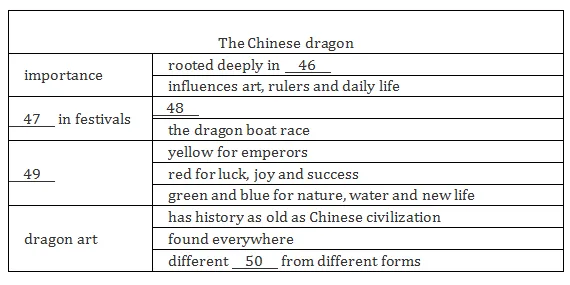
文章大意:本文是一篇说明文,介绍中国龙的文化地位、节日体现、颜色寓意及艺术形象,展现龙是中国文化核心象征。
阅读下面短文,然后在文后思维导图内完成内容摘要,每空不超过三个词,并将答案写在答题卡的相应位置。
The Chinese dragon is a powerful symbol rooted deeply in Chinese culture. For thousands of years, it has influenced art, rulers, and daily life. In fact, many Chinese people proudly call themselves “descendants of the dragon (龙的传人)”. But what makes this creature so special?
You can see the dragon most clearly during festivals. The dragon dance is a highlight of every Chinese New Year. It takes a team of talented people to make the long dragon costume move smoothly, as if it were alive. Another famous celebration is during the Dragon Boat Festival, held on the fifth day of the fifth lunar month. This festival remembers the great poet Qu Yuan. The dragon boat racing is a popular sport across China’s waterways, showing the spirit of teamwork and bravery.
In Chinese culture, different colors of dragons represent different meanings. Yellow was often used by emperors. Red represents luck, joy, and success. Green and blue represent nature, water, and new life.
Dragon art is as old as Chinese civilization (文明) itself. You can find dragons everywhere — in paintings, on ancient buildings, and as beautiful sculptures. Depending on how it is drawn, a dragon can mean many things. For example, a rising dragon often represents energy and strength.
From ancient myths to modern festivals, the dragon remains the heart of Chinese identity. By understanding the dragon, we understand the spirit of China.
五、书面表达
51. 假如你是李华,请阅读你的外国网友Mary的邮件,并用英语回复,给她至少3条建议并说明理由。
To: Li Hua |
From: Mary |
Dear Li Hua, I’m a middle school student. Recently I argued with my parents about using mobile phones. I prefer to do homework with the help of mobile phones. But my parents think I depend too much on them. So they don’t allow me to use mobile phones when I do my homework. It makes me crazy. What should I do? Can you give me some advice?I’m looking forward to your reply.Sad Mary |
要求:
1.内容须包含所有信息,可以适当发挥,以使行文连贯。
2.词数100词左右。开头和结尾已给出,不计入总词数。
3.文中不得出现真实姓名与学校名称。
____________________________________________________________________________________________________________________________________________________________________________________________________________________________________________________________________________________________________________________________________________________________________________________________________________________________________________________________________________________________________________________________________________________________________________________________________________________________________________________________________________________________________________________________________________________________________________________________________________________________________________________________________________________________________________________
初中数学精品资料
七年级数学资料
八年级数学资料
九年级数学资料
2026中考模拟
2025中考数学压轴题解析
更新中.........
2025中考真题
更新中.........
中考数学最值微课
更新中.........
中考数学知识拓展
更新中.......


