

四级作文题合集 | |
 |  |
四级写作真题下载
链接:https://pan.quark.cn/s/aeeaad379c0c
复制以上链接打开「夸克」APP,即可下载

 |  |
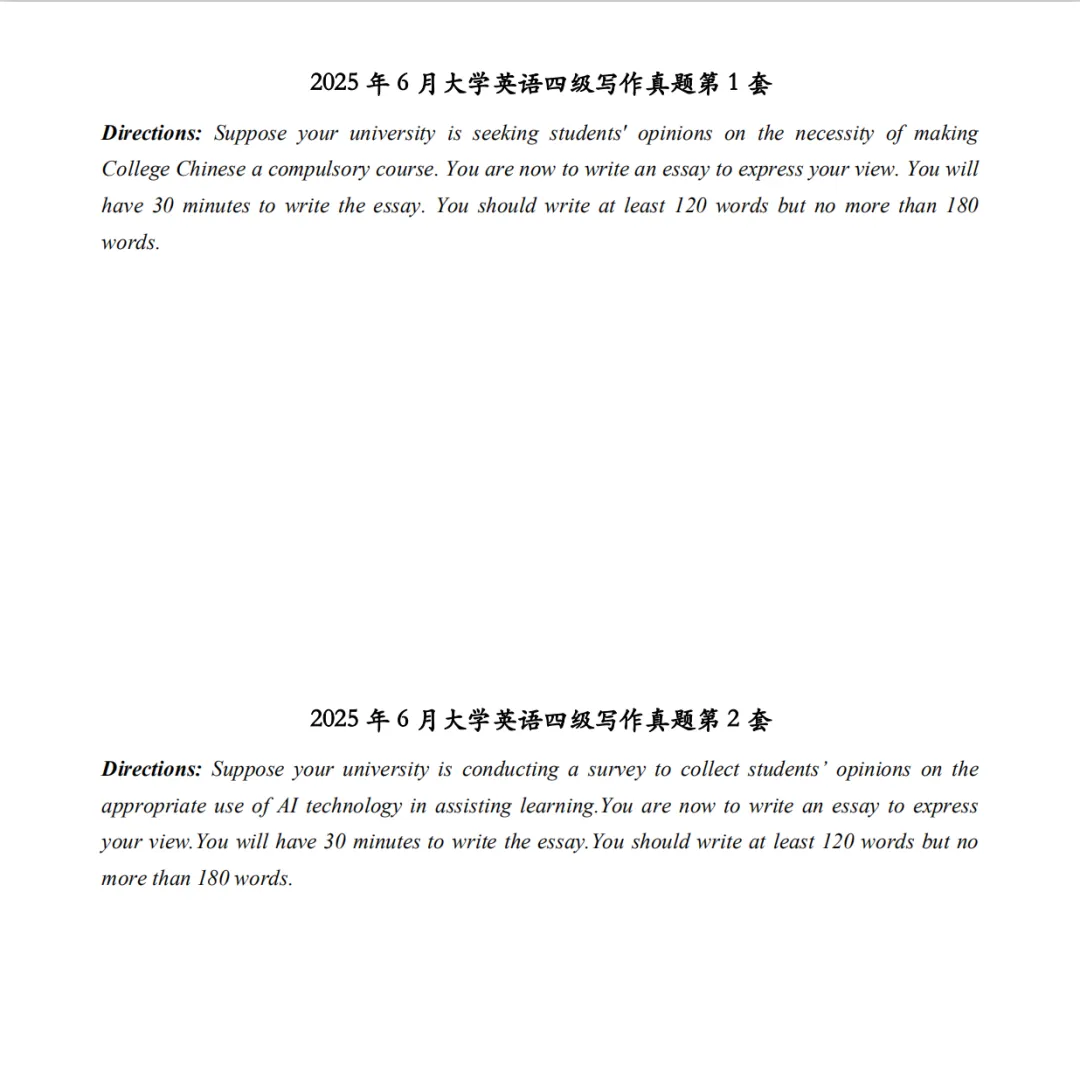
【题目】Suppose your university is seeking students' opinions on the necessity of making College Chinese a compulsory course. You are now to write an essay to express your view. You will have 30 minutes to write the essay. You should write at least 120 words but no more than 180 words.
【参考范文】
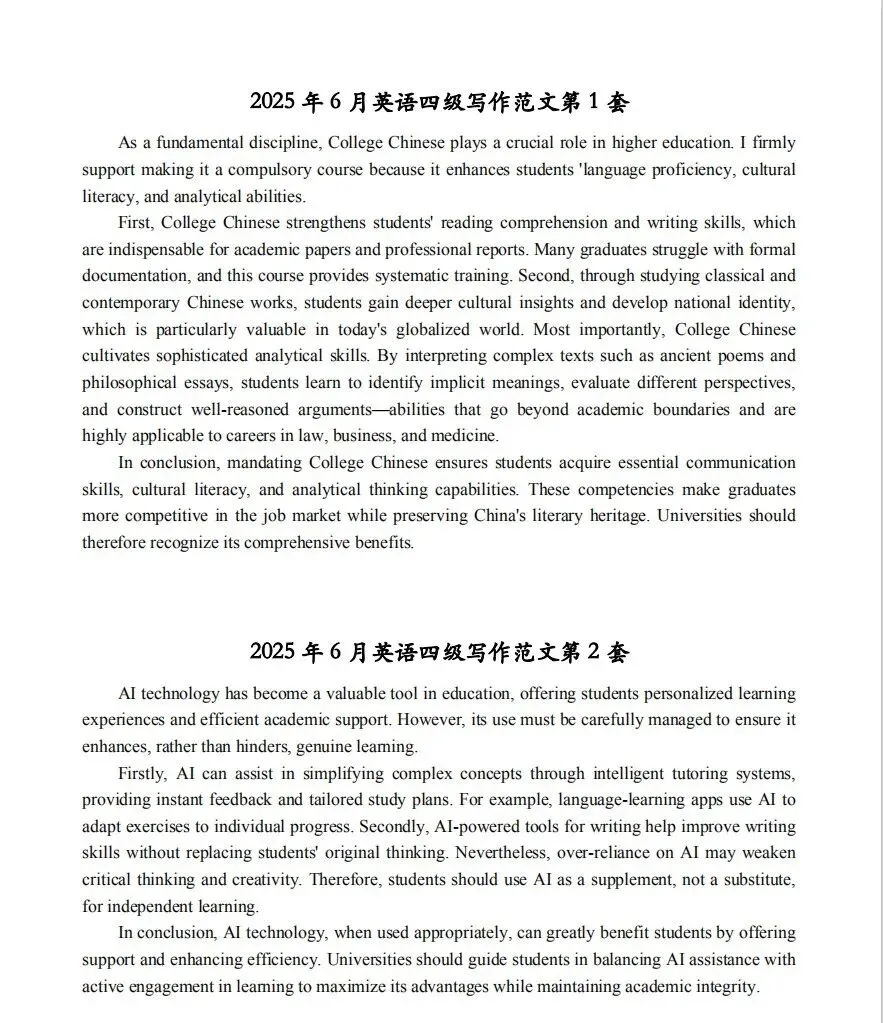
As a fundamental discipline, College Chinese plays a crucial role in higher education. I firmly support making it a compulsory course because it enhances students' language proficiency, cultural literacy, and analytical abilities.
First, College Chinese strengthens students' reading comprehension and writing skills, which are indispensable for academic papers and professional reports. Many graduates struggle with formal documentation, and this course provides systematic training. Second, through studying classical and contemporary Chinese works, students gain deeper cultural insights and develop national identity, which is particularly valuable in today's globalized world. Most importantly, College Chinese cultivates sophisticated analytical skills. By interpreting complex texts such as ancient poems and philosophical essays, students learn to identify implicit meanings, evaluate different perspectives, and construct well-reasoned arguments—abilities that go beyond academic boundaries and are highly applicable to careers in law, business, and medicine.
In conclusion, mandating College Chinese ensures students acquire essential communication skills, cultural literacy, and analytical thinking capabilities. These competencies make graduates more competitive in the job market while preserving China's literary heritage. Universities should therefore recognize its comprehensive benefits.
【题目】Suppose your university is conducting a survey to collect students’ opinions on the appropriate use of AI technology in assisting learning.
【参考范文】
AI technology has become a valuable tool in education, offering students personalized learning experiences and efficient academic support. However, its use must be carefully managed to ensure it enhances, rather than hinders, genuine learning.
Firstly, AI can assist in simplifying complex concepts through intelligent tutoring systems, providing instant feedback and tailored study plans. For example, language-learning apps use AI to adapt exercises to individual progress. Secondly, AI-powered tools for writing help improve writing skills without replacing students' original thinking. Nevertheless, over-reliance on AI may weaken critical thinking and creativity. Therefore, students should use AI as a supplement, not a substitute, for independent learning.
In conclusion, AI technology, when used appropriately, can greatly benefit students by offering support and enhancing efficiency. Universities should guide students in balancing AI assistance with active engagement in learning to maximize its advantages while maintaining academic integrity.
【题目】Suppose your university is organizing a forum on the development of students’ cross-cultural communication abilities.
【参考范文】
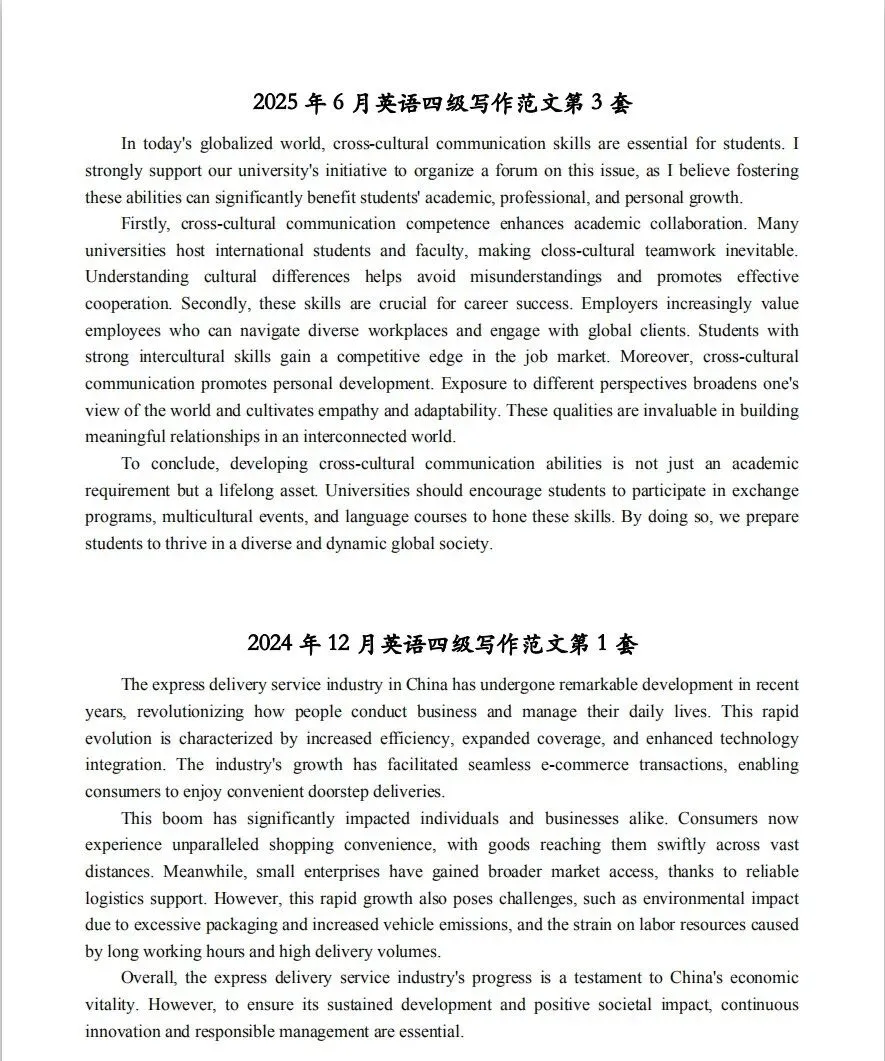
In today's globalized world, cross-cultural communication skills are essential for students. I strongly support our university's initiative to organize a forum on this issue, as I believe fostering these abilities can significantly benefit students' academic, professional, and personal growth.
Firstly, cross-cultural communication competence enhances academic collaboration. Many universities host international students and faculty, making cross-cultural teamwork inevitable. Understanding cultural differences helps avoid misunderstandings and promotes effective cooperation. Secondly, these skills are crucial for career success. Employers increasingly value employees who can navigate diverse workplaces and engage with global clients. Students with strong intercultural skills gain a competitive edge in the job market. Moreover, cross-cultural communication promotes personal development. Exposure to different perspectives broadens one's view of the world and cultivates empathy and adaptability. These qualities are invaluable in building meaningful relationships in an interconnected world.
To conclude, developing cross-cultural communication abilities is not just an academic requirement but a lifelong asset. Universities should encourage students to participate in exchange programs, multicultural events, and language courses to hone these skills. By doing so, we prepare students to thrive in a diverse and dynamic global society.


