

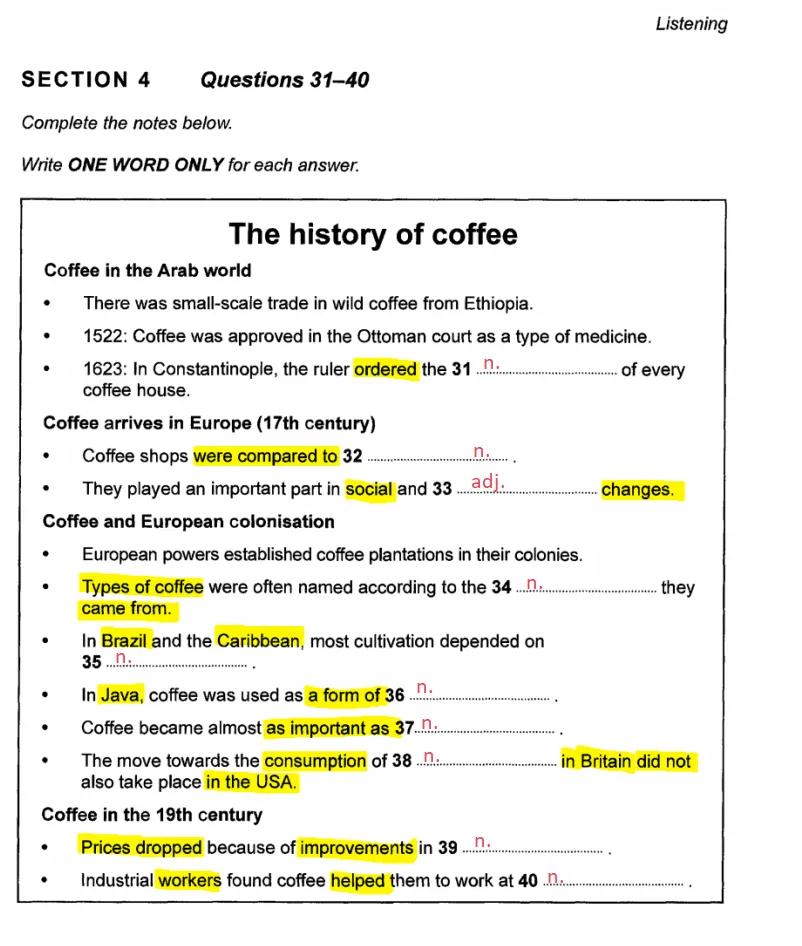
答案:
31.destruction
32.universities
33.political
34.port
35.slaves
36.taxation
37.sugar
38.tea
39.transportation
40.night
听力原文:
In my presentation, I'm going to talk about coffee, and its importance both in economic and social terms.
We think it was first drunk in the Arab world, but there's hardly any documentary evidence of it before the 1500s, although of course that doesn't mean that people didn't know about it before then.
However, there is evidence that coffee was originally gathered from bushes growing wild in Ethiopia, in the northeast of Africa.
In the early sixteenth century, it was being bought by traders, and gradually its use as a drink spread throughout the Middle East.
It's also known that in 1522, in the Turkish city of Constantinople, which was the centre of the Ottoman Empire, the court physician approved its use as a medicine.
By the mid-1500s, coffee bushes were being cultivated in the Yemen and for the next hundred years this region produced most of the coffee drunk in Africa and the Arab world.
What's particularly interesting about coffee is its effect on social life.
It was rarely drunk at home, but instead people went to coffee houses to drink it.
These people, usually men, would meet to drink coffee and chat about issues of the day.
Q31. But at the time, this chance to share ideas and opinions was seen as something that was potentially dangerous, and in 1623 the ruler of Constantinople demanded thedestruction of all the coffee houses in the city, although after his death many new ones opened, and coffee consumption continued.
Q32. In the seventeenth century, coffee drinking spread to Europe, and here too coffee shops became places where ordinary people.Nearly always men, could meet to exchange ideas.Because of this, some people said that these places performed a similar function to universities.
Q33. The opportunity they provided for people to meet together outside their own homes and to discuss the topics of the day had an enormous impact on social life, and many social movements and political developments had their origins in coffee house discussions
In the late 1600s, the Yemeni monopoly on coffee production broke down and coffee production started to spread around the world, helped by European colonisation.
Europeans setup coffee plantations in Indonesia and the Caribbean and production of coffee in the colonies skyrocketed.
Q34. Different types of coffee were produced in different areas, and it's interestingthatthe names given to these different types, like Mocha or Java coffee, were often taken from the port they were shipped to Europe from.
But if you look at the labour system in the different colonies, there were some significant differences.
Q35. In Brazil and the various Caribbean colonies, coffee was grown in huge plantations and the workers there were almost all slaves.
Q36. But this wasn't the same in all colonies;for example in Java, which had been colonised by the Dutch.The peasants grew coffee and passed a proportion of this on to the Dutch.So it was used as a means oftaxation.
But whatever system was used, under the European powers of the eighteenth century, coffee production was very closely linked to colonisation.
Q37. Coffee was grown in ever-increasing quantities to satisfy the growing demand from Europe, and it became nearly as important as sugarproduction, which was grown under very similar conditions.
However, coffee prices were not yet low enough for people to drink it regularly at home, so most coffee consumption still took place in public coffee houses and it still remained something of a luxury item.
In Britain, however, a new drink was introduced from China, and started to become popular, gradually taking over from coffee, although at first it was so expensive that only the upper classes could afford it.
Q38. This was tea,and by the late 1700s it was being widely drunk . However, when the USA gained independence from Britain in 1776. They identified this drink with Britain, and coffee remained the preferred drink in the USA, as it still is today.
So, by the early nineteenth century, coffee was already being widely produced and consumed.But during this century, production boomed and coffee prices started to fall.
Q39. This was partly because new types of transportation had been developed which were cheaper and more efficient.
So now, working people could afford to buy coffee - it wasn't just a drink for the middle classes. And this was at a time when large parts of Europe were starting to work in industries.
Q40. And sometimes this meant their work didn't stop when it got dark; they might have to continue throughout thenight.
So, the use of coffee as a stimulant became important-it wasn't just a drink people drank in the morning, for breakfast.
There were also changes in cultivation...
答案解析:
31. 答案:destruction
原文:But at the time, this chance to share ideas and opinions was seen as something that was potentially dangerous, and in 1623 the ruler of Constantinople demanded the destruction of all the coffee houses in the city, although after his death many new ones opened, and coffee consumption continued.
翻译:但在当时,这种分享想法和观点的机会被视为具有潜在危险性,1623 年,君士坦丁堡的统治者下令摧毁城中所有的咖啡馆,尽管在他去世后,许多新的咖啡馆开业了,咖啡消费也继续进行。
解析:关键词定位 —— 题干核心词为 “1623”“ruler of Constantinople”“demanded”,听到这组信号词聚焦后续名词;同义替换 —— 题干考查 “统治者要求的动作”,原文 “demanded the destruction of” 对应题干空处,答案为名词 destruction。
32. 答案:universities
原文:In the seventeenth century, coffee drinking spread to Europe, and here too coffee shops became places where ordinary people, nearly always men, could meet to exchange ideas. Because of this, some people said that these places performed a similar function to universities.
翻译:17 世纪,喝咖啡的习惯传播到了欧洲,在那里,咖啡馆也成为了普通人(几乎都是男性)可以见面交流想法的地方。正因为如此,有些人说这些地方起到了和大学类似的作用。
解析:关键词定位 —— 题干核心词 “seventeenth century”“Europe”“similar function to”,听到后直接预判后续名词;同义替换 ——“these places” 指代 “coffee shops”,题干 “咖啡馆的功能” 对应原文 “performed a similar function to universities”,答案为复universities,对应 “these places” 的复数含义。
33. 答案:political
原文:The opportunity they provided for people to meet together outside their own homes and to discuss the topics of the day had an enormous impact on social life, and many social movements and political developments had their origins in coffee house discussions.
翻译:它们(咖啡馆)为人们提供了走出家门、聚在一起讨论当下话题的机会,这对社会生活产生了巨大影响,许多社会运动和政治发展都起源于咖啡馆的讨论。
解析:关键词定位 —— 题干核心词 “social movements”“developments”,听到并列连词 “and” 后聚焦后续修饰词;同义替换 —— 题干空处需填 “developments” 的修饰词,原文 “political” 直接对应,答案词性为形容词。
34. 答案:port
原文:Different types of coffee were produced in different areas, and it's interesting that the names given to these different types, like Mocha or Java coffee, were often taken from the port they were shipped to Europe from.
翻译:不同地区生产不同种类的咖啡,有趣的是,这些不同种类咖啡的名称(如摩卡咖啡或爪哇咖啡),通常取自它们运往欧洲时的港口名称。解析:同义替换定位 —— 题干中 “were often taken from” 与原文一致,“shipped to Europe from” 与原文同义,结合 “names” 核心词,锁定 “taken from” 后名词port,即为答案。
35. 答案:slaves
原文:In Brazil and the various Caribbean colonies, coffee was grown in huge plantations and the workers there were almost all slaves.
翻译:在巴西和各个加勒比殖民地,咖啡种植在大型种植园里,那里的工人几乎都是奴隶。解析:关键词定位 —题干核心词 “Brazil”“Caribbean colonies”“workers”,听到 “workers there were almost all” 后紧跟的名词即为答案; 题干 “工人的身份” 对应原文 “workers... were almost all slaves”,答案为复数 slaves。
36. 答案:taxation
原文:But this wasn't the same in all colonies; for example in Java, which had been colonised by the Dutch. The peasants grew coffee and passed a proportion of this on to the Dutch. So it was used as a means of taxation.
翻译:但并非所有殖民地都是如此;例如,被荷兰殖民的爪哇岛。农民们种植咖啡,并将一部分咖啡交给荷兰人。因此,咖啡被用作一种税收手段。
解析:关键词定位 —题干核心词 “Java”“Dutch”“a means of”,听到 “means of” 后接的名词即为答案;对应原文 “used as a means of taxation”,答案为 taxation。
37. 答案:sugar
原文:Coffee was grown in ever-increasing quantities to satisfy the growing demand from Europe, and it became nearly as important as sugar production, which was grown under very similar conditions.
翻译:为了满足欧洲日益增长的需求,咖啡的种植量不断增加,它变得几乎和甘蔗种植一样重要,而甘蔗种植的条件与咖啡非常相似。
解析:关键词定位—题干核心词“nearly as important as”,听到比较结构后紧跟的名词即为答案;题干“与咖啡种植同等重要的作物”对应原文“as important as sugar production”,答案为 sugar。
38. 答案:tea
原文:In Britain, however, a new drink was introduced from China... .This was tea, and by the late 1700s it was being widely drunk. However, when the USA gained independence from Britain in 1776, they identified this drink with Britain, and coffee remained the preferred drink in the USA, as it still is today.
翻译:然而,在英国,一种从中国传入的新饮品开始流行起来...... 这种饮品就是茶,到18 世纪末,茶已经被广泛饮用。然而,当美国在1776 年从英国独立后,他们将这种饮品与英国联系起来,而咖啡仍然是美国人心目中的首选饮品,直到今天依然如此。
解析:先明确答案为 tea;题干背景为“英国一种从中国传入、取代咖啡且 18 世纪末广泛饮用的新饮品”,原文中 “a new drink was introduced from China, gradually taking over from coffee” 对应题干背景,“This was” 直接指代答案 tea,“by the late 1700s it was being widely drunk” 进一步印证,同义替换中 “took over from” 与原文 “taking over from” 一致,锁定答案。
39. 答案:transportation
原文:So, by the early nineteenth century, coffee was already being widely produced and consumed. But during this century, production boomed and coffee prices started to fall. This was partly because new types of transportation had been developed which were cheaper and more efficient.
翻译:因此,到 19 世纪初,咖啡已经被广泛生产和消费。但在这个世纪里,咖啡产量激增,价格开始下降。部分原因是新型交通工具的出现,它们更便宜、更高效。
解析:关键词定位—题干核心词 “coffee prices started to fall”“because”,听到“because” 后接的主语名词即为答案;“咖啡价格下降的原因” 对应原文 “because new types of transportation had been developed”,答案为 transportation。
40. 答案:night
原文:And this was at a time when large parts of Europe were starting to work in industries. And sometimes this meant their work didn't stop when it got dark; they might have to continue throughout the night. So, the use of coffee as a stimulant became important-it wasn't just a drink people drank in the morning, for breakfast.
翻译:而当时欧洲大部分地区正开始进入工业时代。有时这意味着他们的工作在天黑后不会停止;他们可能不得不整夜工作。因此,咖啡作为兴奋剂的用途变得重要起来 —— 它不再只是人们早上早餐时喝的饮品。
解析:关键词定位 —— 题干核心词 “work didn't stop when it got dark”“continue throughout the”,听到后聚焦后续时间名词;同义替换 —题干 “工作持续的时间” 对应原文 “continue throughout the night”,答案为 night。
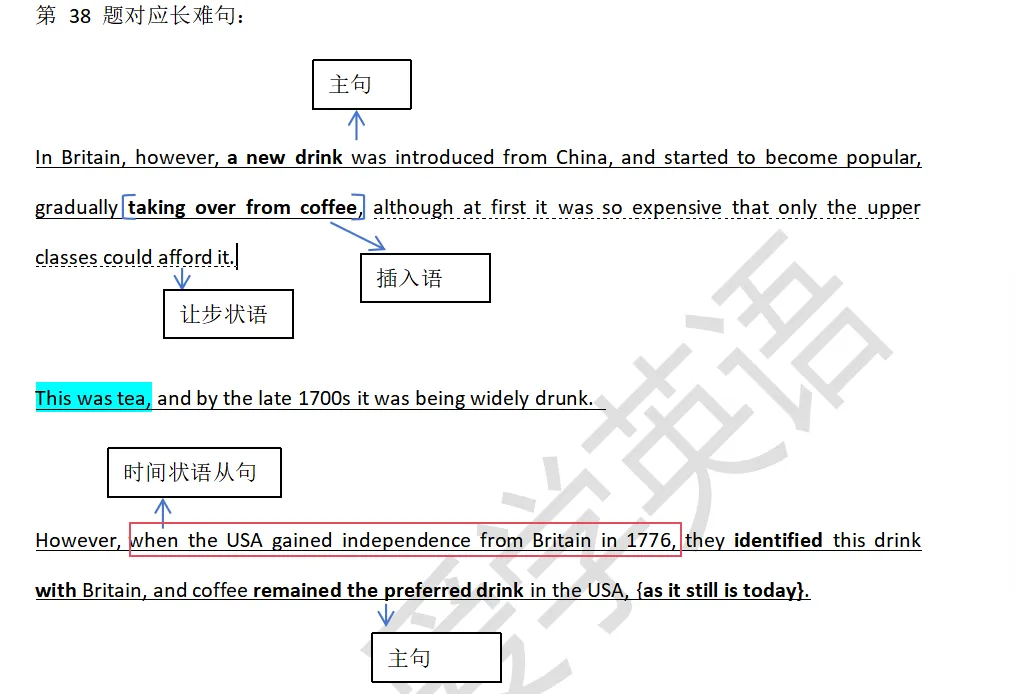
1.定位词 consumption / Britain / USA
2. 翻译:然而在英国,一种从中国传入的新饮品开始流行,并逐渐取代了咖啡。尽管一开始它价格昂贵,只有上层阶级才喝得起。这种饮品就是茶。到18 世纪末,茶已经被广泛饮用。然而,1776 年美国脱离英国独立后,美国人把这种饮品(茶)与英国联系在一起,因此咖啡依旧是美国人的首选饮品,直到今天依然如此。
3. 解析:这道题属于答案前置题型,答案其实在定位词Britain / USA 出现之前就已经给出:This was tea, and by the late 1700s it was being widely drunk。不过我们依然可以借助上文 “most coffee consumption… remain luxury item” 提前预判,答案大概率就在这一区间。再结合定位信息 in Britain, however, a new drink was introduced from China… this was tea,一步步锁定答案是 tea。这道题整体难度偏高,但只要耐心抓取上下文线索,就能稳稳推导出正确答案。
生词积累:
1.presentation /ˌpreznˈteɪʃn/ (n.) 演讲;展示
2.economic /ˌiːkəˈnɒmɪk/ (adj.) 经济的;经济上的
3.evidence /ˈevɪdəns/ (n.) 证据;证明
4.gather /ˈɡæðə(r)/ (v.) 收集;采集
5.bush /bʊʃ/ (n.) 灌木;灌木丛
6.Ethiopia /ˌiːθiˈəʊpiə/ (n.) 埃塞俄比亚
7.trader /ˈtreɪdə(r)/ (n.) 商人;贸易商
8.Constantinople /ˌkɒnstæntɪˈnəʊpl/ (n.) 君士坦丁堡
9.Ottoman /ˈɒtəmən/ (adj.) 奥斯曼帝国的;(n.) 奥斯曼人
10.physician /fɪˈzɪʃn/ (n.) 内科医生
11.cultivate /ˈkʌltɪveɪt/ (v.) 种植;栽培
12.Yemen /ˈjemən/ (n.) 也门
13.monopoly /məˈnɒpəli/ (n.) 垄断;专卖权
14.colonisation /ˌkɒlənaɪˈzeɪʃn/ (n.) 殖民化
15.plantation /plænˈteɪʃn/ (n.) 种植园
16.skyrocket /ˈskaɪrɒkɪt/ (v.) 激增;猛涨
17.peasant /ˈpeznt/ (n.) 农民;佃农
18.taxation /tækˈseɪʃn/ (n.) 税收;征税
19.consumption /kənˈsʌmpʃn/ (n.) 消费;消耗
20.stimulant /ˈstɪmjələnt/ (n.) 兴奋剂;刺激物
主题拓展词汇:
Ethiopia 埃塞俄比亚;
Arab /ˈærəb/ 阿拉伯;
Middle East 中东;
Constantinople 君士坦丁堡;
Yemen 也门;
Europe 欧洲;
Brazil 巴西;
Caribbean 加勒比海;
Indonesia 印度尼西亚;
Java 爪哇;
mocha /ˈmɒkə/摩卡

🌏趣味延伸:
17 世纪的欧洲咖啡馆,不是现在的网红打卡地,而是普通人聊时事、谈观点的 “公共论坛”;最早的咖啡馆起源于阿拉伯世界,起初还被用作药用场所,后来才逐渐成为社交的中心。如今,咖啡馆依旧是人们工作、会面、放松与交流的热门空间,一杯咖啡,串联起古今不变的人间烟火与思想碰撞。

今天的精听练习就到这里了,大家有没有发现,雅思听力 Section 4 的话题众多,其实也常从我们身边最熟悉的日常事物切入~今天我们借着这篇有关咖啡的起源和发展的经典真题,一边吃透实用的解题技巧,一边解锁背后超有意思的历史冷知识。让学习不止于做题,更能收获知识与乐趣!
如果你喜欢这份干货内容,欢迎点赞、收藏、转发~~✨


