

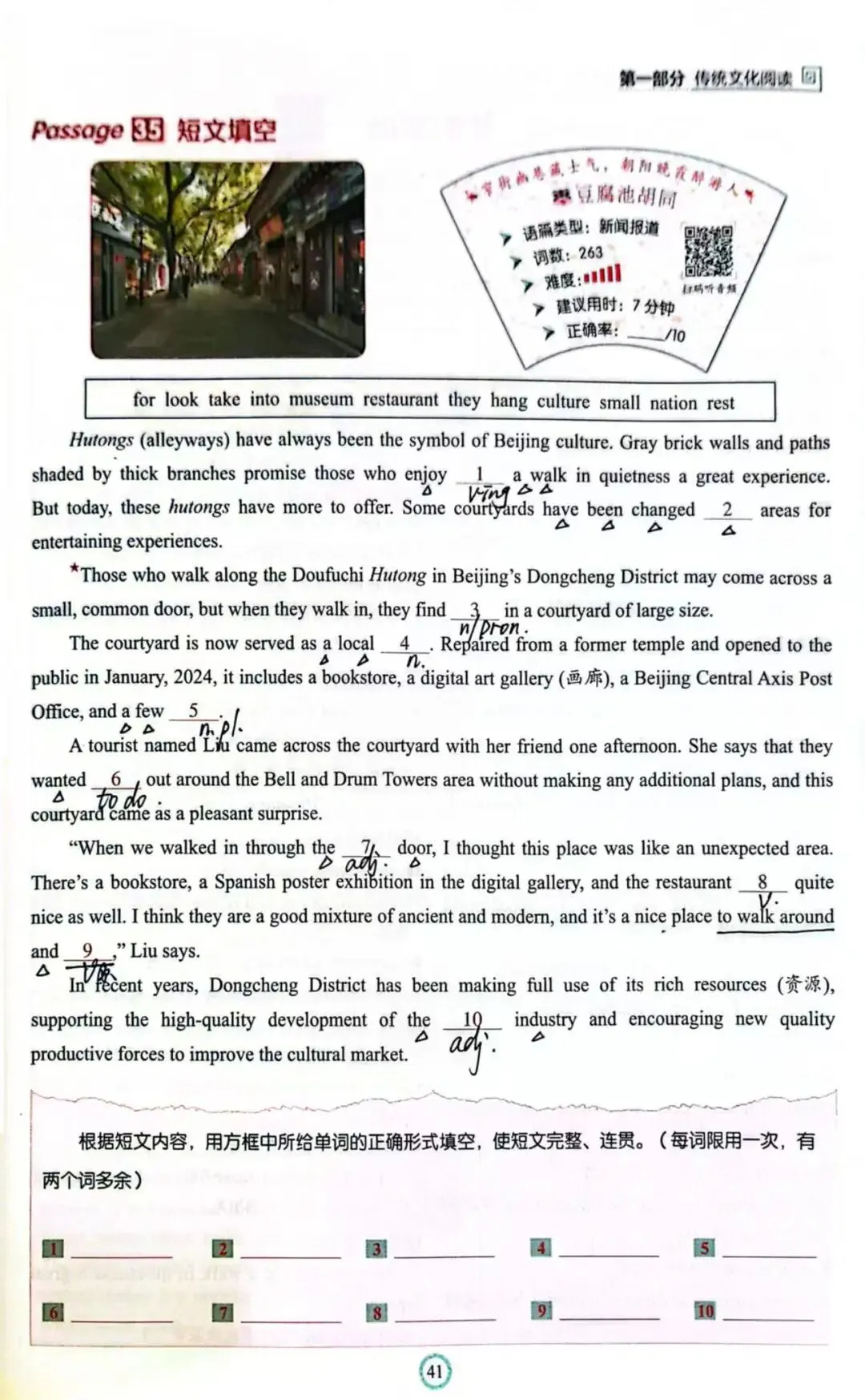
1. taking
解析: enjoy doing sth. 是固定搭配,表示“喜欢做某事”,而 take a walk 意为“散步”,因此将 take 变为动名词 taking 。
2. into
解析:固定搭配 change...into... 表示“把……转变成……”,符合文中“一些庭院被改造成娱乐体验区”的语境。
3. themselves
解析:此处用反身代词指代主语 they ,表达“他们发现自己置身于一个巨大的庭院里”,强调主语自身。
4. museum
解析:形容词修饰名词,根据后文提到的书店、数字艺术画廊等设施,结合所给单词,这个庭院被用作当地的博物馆。
5. restaurants
解析: a few 后接可数名词复数,后文也出现了 the restaurant ,因此将 restaurant 变为复数 restaurants 。
6. to hang
解析:固定搭配 want to do sth. 表示“想要做某事”, hang out 意为“闲逛”,因此用不定式 to hang 。
7. small
解析:对应前文 a small, common door ,直接使用形容词 small 描述“小门”。
8. looks
解析: look 在此处作系动词,后接形容词 nice ,表示“看起来不错”;主语 the restaurant 是第三人称单数,一般现在时用 looks 。
9. rest
解析:与前文 walk around 并列,指“这是一个适合闲逛和休息的好地方”,用动词原形 rest 。
10. cultural
解析:修饰名词 industry用形容词 ,需要将名词 culture 变为形容词 cultural ,表示“文化产业”。
二、词汇积累
- gray /ɡreɪ/ adj. 灰色的
- brick /brɪk/ n. 砖;砖块
- path /pɑːθ/ n. 小路;小径
- shade /ʃeɪd/ v./n. 遮蔽;阴凉处
- branch /brɑːntʃ/ n. 树枝;分支
- quietness /ˈkwaɪətnəs/ n. 宁静;安静
- countryard(正确拼写:courtyard)/ˈkɔːtjɑːd/ n. 庭院;院子
- entertain /ˌentəˈteɪn/ v. 娱乐;招待
- those who /ðəʊz huː/ pron.+conj. 那些……的人(引导定语从句)
- come across /kʌm əˈkrɒs/ v. 偶遇;无意中发现
- former /ˈfɔːmə(r)/ adj. 以前的;前者的
- temple /ˈtempl/ n. 庙宇;寺院
- open to the public /ˈəʊpən tuː ðə ˈpʌblɪk/ v. 对公众开放
- digital /ˈdɪdʒɪtl/ adj. 数字的;数码的
- additional /əˈdɪʃənl/ adj. 额外的;附加的
- plan /plæn/ n./v. 计划;打算
- pleasant /ˈpleznt/ adj. 令人愉快的;舒适的
- poster /ˈpəʊstə(r)/ n. 海报;招贴
- exhibition /ˌeksɪˈbɪʃn/ n. 展览;展示
- mixture /ˈmɪkstʃə(r)/ n. 混合;混合物
- make full use of /meɪk fʊl juːz ɒv/ v. 充分利用
- industry /ˈɪndəstri/ n. 产业;工业
- high-quality /haɪ ˈkwɒləti/ adj. 高质量的
- productive /prəˈdʌktɪv/ adj. 生产的;有成效的
- force /fɔːs/ n. 力量;武力
三、长难句拆解
句子1
原文:Those who walk along the Doufuchi Hutong in Beijing's Dongcheng District may come across a small, common door, but when they walk in, they find themselves in a courtyard of large size.
结构拆解:
这是由 but 连接的并列复合句。
- 前半句:主干为 Those may come across a small, common door ,其中 who walk along the Doufuchi Hutong in Beijing's Dongcheng District 是定语从句,修饰先行词 Those ,限定“走在豆腐池胡同的人”。
- 后半句:主干为 they find themselves in a courtyard of large size , when they walk in 是时间状语从句,说明“发现自己身处庭院”的时间节点。
翻译:走在北京东城区豆腐池胡同的人们,可能会偶遇一扇普通的小门,但当他们走进去时,会发现自己置身于一个巨大的庭院中。
句子2
原文:Repaired from a former temple and opened to the public in January, 2024, it includes a bookstore, a digital art gallery, a Beijing Central Axis Post Office, and a few restaurants.
结构拆解:
这是一个简单句,开头是过去分词短语作状语。
- 状语: Repaired from a former temple and opened to the public in January, 2024 交代庭院的背景——由古庙修缮而来,2024年1月对公众开放。
- 主干: it includes a bookstore, a digital art gallery, a Beijing Central Axis Post Office, and a few restaurants ,列举庭院内的多元文化设施。
翻译:这座庭院由一座古庙修缮而成,于2024年1月对公众开放,内部包含一家书店、一个数字艺术画廊、北京中轴线邮局和几家餐馆。
句子3
原文:In recent years, Dongcheng District has been making full use of its rich resources, supporting the high-quality development of the cultural industry and encouraging new quality productive forces to improve the cultural market.
结构拆解:
这是一个现在完成进行时的句子,后接两个并列的现在分词作伴随状语。
- 主干: Dongcheng District has been making full use of its rich resources ,强调“东城区持续充分利用资源”的动作。
- 伴随状语1: supporting the high-quality development of the cultural industry ,说明利用资源的核心目标之一。
- 伴随状语2: encouraging new quality productive forces to improve the cultural market ,与前一状语并列,补充另一发展方向。
翻译:近年来,东城区充分利用自身丰富资源,支持文化产业高质量发展,鼓励新质生产力完善文化市场


