资讯 / 正文
2026年6月天津高考英语真题(官方版)
点击蓝字 关注我们
Hello People! 我是托福口语写作满分,每年陪伴大家高考的Mike老师!
高中满分英语Mike
欢迎关注「每年高考麦克」!每年高考结束后,我会第一时间整理发布考场回忆版真题及参考答案,方便大家核对答案、提前估分,尽早决定是否参加二考,不焦虑、不浪费时间。
扫码添加Mike本人
第一时间获取最新考情
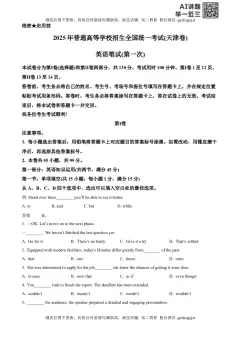
2026 年普通高等学校招生全国统一考试(天津卷)英语笔试(第二次)
第 Ⅰ 卷 注意事项:
每小题选出答案后,用铅笔将答题卡上对应题目的答案标号涂黑。如需改动,用橡皮擦干净后,再选涂其他答案标号。 本卷共 55 小题,共 95 分。
第一部分:英语知识运用(共两节,满分 45 分)
第一节:单项填空(共 15 小题;每小题 1 分,满分 15 分)
从 A、B、C、D 四个选项中,选出可以填入空白处的最佳选项。 例:Stand over there ____ you’ll be able to see it better. A. or B. and C. but D. while 答案是 B。
— How much time do you spend online every day? — ____. I’d say from half an hour to three hours. A. It depends B. Don’t mention it C. Never mind D. That’s really something It is open to debate ____ the method used in this study considers all factors. A. what B. why C. when D. whether The Winter Olympics ____ not have the large crowds and huge stars of the summer ones, but they share the same Olympic spirit. A. must B. may C. need D. shall A bottle of honey, combined with biscuits, ____ a perfect gift. A. makes B. make C. is made D. are made Philip Layton is an English painter who ____ in New York for the past ten years. A. was working B. will be working C. has been working D. had been working Scientists travel to remote areas ____ undiscovered species. A. in pursuit of B. in contrast to C. in case of D. in return for — Would you like to join the team for dinner? — No, they always eat steak, and ____. A. I’ll see to it B. leave me alone C. I can’t complain D. I’m fed up with it Written Chinese has become an important means ____ China’s present is connected with its past. A. for which B. by which C. with which D. from which Open ____ makes this academic research freely available, so anyone can read and build upon the research. A. access B. admission C. discussion D. inquiry Road travel, which ____ the largest share of cross‑regional movement, grew by 3.3% last year. A. counted on B. accounted for C. consisted of D. dealt with He ____ received a discount of £50 after complaining about the telephone charge. A. permanently B. intentionally C. generously D. subsequently Advanced AI could be helpful in solving the world’s problems, but there is a high level of risk ____. A. involving B. involved C. to involve D. being involved The student struggled to ____ his late submission due to a family emergency. A. demonstrate B. suspend C. tolerate D. justify Obviously, ____ a great variety of people and situations has contributed to his easy‑going nature. A. exposing to B. exposed to C. being exposed to D. having exposed to Getting a good night’s sleep can not only improve our mood, ____ we feel less tired and more light‑hearted, but also help prevent health issues. A. as B. if C. unless D. though 第二节:完形填空(共 20 小题;每小题 1.5 分,满分 30 分)
阅读下面短文,掌握其大意,然后从 16~35 各题所给的 A、B、C、D 四个选项中,选出最佳选项。
As a chemistry lecturer, I was never quite sure how much course material my students were truly absorbing, so I decided to conduct an experiment. Once I gave each student a card with the key topics I had 16 and asked them to mark each topic with green, yellow, or red. Green meant “I understand well,” yellow told me “I’m somewhat unsure,” and red 17 a tougher problem: “I’m confused or lost.” I wasn’t sure how the 18 would work. I waited 19 to collect and examine the cards, hoping for a(n) 20, real‑time picture of how much my students actually understood.
Years earlier, when I was a teaching assistant, I simply gave my lectures and didn’t 21 if my methods were effective. If nobody raised a hand, I took it as a 22 that the material was clear. But over time, I began to realize I shouldn’t make that 23. After exams, I would discover concepts students had misunderstood, and wonder how I could have 24 earlier.
I needed a way to estimate students’ understanding 25 it was too late. I could have given regular tests to assess 26 they were in their learning. But what I really wanted to test was my own teaching methods, and I was 27 a low‑pressure way to invite feedback. So, 28 I became lecturer, I started to experiment with the cards.
The 29 of colors was eye‑opening. Concepts that I thought were 30 showed an unexpected mix of yellow and red. For the first time, I had an assessment of understanding across the class, and it quickly 31 how I taught. I began to see lectures not as 32, but as an experiment to test, adjust, and learn 33 my students.
As I continued to use the cards, I found they didn’t just help me. They also helped the students 34 what they had been taught, becoming more aware of gaps in their understanding.
Developed for chemistry lectures, this strategy could be used anywhere feedback 35: lab meetings, professional workshops, even research sessions. The broader lesson is that science communication, like science, grows on evidence and awareness.
16. A. recalled B. dropped C. covered D. ignored
17. A. indicated B. introduced C. interpreted D. included
18. A. approach B. subject C. occasion D. process
19. A. calmly B. eagerly C. confidently D. cheerfully
20. A. attractive B. extensive C. relative D. comprehensive
21. A. understand B. decide C. announce D. question
22. A. truth B. case C. sign D. myth
23. A. decision B. assumption C. impression D. confirmation
24. A. interrupted B. intervened C. investigated D. integrated
25. A. before B. until C. unless D. as
26. A. who B. what C. where D. when
27. A. looking for B. looking into C. looking after D. looking through
28. A. only if B. even though C. soon after D. shortly before
29. A. definition B. distribution C. concentration D. constitution
30. A. appropriate B. complex C. essential D. straightforward
31. A. threatened B. predicted C. transformed D. acknowledged
32. A. experience B. performance C. entertainment D. procedure
33. A. alongside B. among C. without D. beyond
34. A. get across B. depend on C. reflect on D. come across
35. A. follows B. dominates C. stays D. matters
### 第二部分:阅读理解(共 20 小题;每小题 2.5 分,满分 50 分)
阅读下列短文,从每题所给的 A、B、C、D 四个选项中,选出最佳选项。
#### A
This report provides an outline of the results for a national high school student survey conducted during the 2024‑2025 school year, asking nearly 6,000 students representing all regions of the US about their participation in high school sports.
The following notable results provide critical information about the experience of high school students in sports.
**Most Popular High School Sports Across Genders**
· Basketball 24%
· Soccer 21%
· Track & Field 19%
· Volleyball 17%
· Football 16%
**Most Requested Sports Not Offered at Their School**
· Archery 13%
· Gymnastics 8%
· Lacrosse 7%
· Bowling 5%
**Why Students Engaged in Sports**
· Having fun 81%
· Doing workout 79%
· Acquiring and improving skills 66%
· Making and playing with friends 64%
· Competing 59%
· Winning games 53%
**Motivation for Playing Sports for Males and Females**
表格
| Male | Female |
| --- | --- | --- |
| Competing | 64% | 54% |
| Winning games | 60% | 48% |
| Mental health | 41% | 56% |
| A sense of belonging | 29% | 38% |
| College applications | 37% | 46% |
**Top Reasons Why Students Are Not Participating in High School Sports**
· Schoolwork 52%
· Not enjoying sports in general 32%
· Not having sports that are of interest 31%
· Unsure about their athletic abilities 25%
**Interest in Participating in Physical Activities for Males and Females**
表格
| | Male | Female |
| --- | --- | --- |
| Strength training | 44% | 29% |
| Cycling | 26% | 23% |
| Scaling | 20% | 9% |
| Skateboarding | 17% | 24% |
| Yoga | 7% | 33% |
| Dance | 4% | 32% |
36. Which sport is second most needed yet unavailable in the schools?
A. Gymnastics. B. Basketball. C. Archery. D. Soccer.
37. What percentage of males engage in sports for an academic reason?
A. 37%. B. 41%. C. 46%. D. 66%.
38. Which statement is supported by the survey results about why students don’t participate in sports?
A. A third of them have no passion for competitive sports.
B. A quarter of them lack interest in the sports available to them.
C. Less than one fifth of them lack confidence in their athletic abilities.
D. Over half of them can hardly spare time for sports owing to their assignment.
39. Which physical activity exhibits the widest gender gap in terms of interest?
A. Yoga. B. Dance. C. Cycling. D. Skateboarding.
#### B
I walked into the memory care center holding my flute (长笛) tightly, nervous energy making my hands sweat. As I began setting up in the common room, an elderly man looked up from his chair. His eyes were kind but distant, the way eyes get when the foggy mind wanders.
“I used to… play the flute… at Carnegie Hall,” he said slowly.
The words hung in the air. This man sitting before me, struggling to hold onto his own storyline, had once stood on one of the world’s most celebrated stages. His name was Don.
That afternoon, I played for the residents. The notes danced along in the air, and I watched faces change. Some closed their eyes; others swayed (摇摆) gently. And I noticed something deep. Music reaches places that words cannot.
The visit planted a seed. What if this wasn’t just a one‑time visit? Why not create something bigger? Hence the organization, Our Ode To You, where student musicians, dancers, and artists were gathered. Our method, unlike those of other such organizations, was simple but intentional: create with residents rather than just perform at them.
Then came the day we brought extra instruments to the center. I brought an old and unused violin. Don’s eyes landed on it. His weathered hands reached out. For a moment, nothing happened… until his fingers found their positions. Then, he began to play, perfectly and beautifully. His fingers remembered what his mind had forgotten. Tears streamed down his face as music reconnected him to his core identity as an artist, despite dementia (痴呆症). We all witnessed that the same person was still there, awaiting the right key to unlock his spirit.
The beauty of this work is its two‑way benefit. Our volunteers arrive thinking they’re helping, but they leave a reshaped version of themselves: they learn aging doesn’t lower in people’s worth; they discover that wisdom isn’t found only in textbooks but in the people’s experiences; they understand that everyone deserves respect regardless of cognitive (认知的) ability.
Don still plays sometimes. And when he does, we’re reminded why we do this work: everyone has the right to feel like themselves again, even if just for the length of one perfect tune.
40. What amazed the author after learning Don once played in Carnegie Hall?
A. The disagreement between his blank face and warm heart.
B. The gap between his communication attempt and expressive difficulty.
C. The striking contrast between his past attainment and present condition.
D. The apparent contradiction between his musical ambition and foggy mind.
41. What did the author take notice of concerning music, according to Paragraph 4?
A. It outperforms language in emotional connection.
B. It outweighs other media in regaining lost senses.
C. It is easier to remember than written expressions.
D. It appeals to a larger audience than spoken words.
42. What is special about Our Ode To You, compared with other such organizations?
A. It brings together young professional artists.
B. It pays regular visits to the memory care center.
C. It encourages the residents to get actively engaged.
D. It facilitates the residents’ restoration of their memory.
43. What did Don’s violin performance bring back to his mind?
A. His old and unused violin.
B. What he had always been.
C. Where his free spirit would rest.
D. His deep love for classical music.
44. What do volunteers learn in the memory care center?
A. Knowledge and skills to care for the elderly.
B. Philosophical significance of music and fine art.
C. Ways to strengthen the residents’ cognitive power.
D. Life lessons from what the residents went through.
45. What belief does the author probably hold on to in running Our Ode To You?
A. Everyone is entitled to live a dignified life.
B. Art connects people through shared joy and sorrow.
C. One can better themselves by lighting up others’ inner world.
D. Public spirit enriches the cultural life of the aging population.
#### C
Many dog owners will tell you that their dogs seem to anticipate dinnertime or regular walking time to within minutes. But time, measured in seconds, minutes, and hours, is a human invention. Do dogs actually have the idea of time in their memory like we do?
Researchers often break down long‑term memory into implicit memory and declarative memory. Implicit memory is a pure muscle memory we use to perform tasks we have learned and repeated many times in the past, while declarative memory is where we store the personal experiences and factual information that make up the story of our lives.
Pavlov taught us that dogs and other animals have implicit memories, which are used for trial‑and‑error learning or conditioned responses. But there’s still some uncertainty regarding whether they have declarative memory. Researchers are eager to figure out if animals have episodic memory (one form of declarative memory), or the ability to recall contextual information about past events, such as what was happening, or where and when it occurred. Prof. Stewart described such ability as a type of mental time travel.
The outline of tests on animals’ episodic memory is fairly simple. Let’s say you give a chimpanzee (大猩猩) two sealed (密封的) lightproof jars: one contains a frozen ball of juice that’s going to melt (融化); the other has a non‑melting grape. After five minutes, the chimpanzee is given the chance to open one jar. After an hour, it can open the other. Once the test has been repeated several times, most of them will break open the jar containing the disappearing treat first. They have demonstrated the three w’s: What: a tasty treat. Where: inside this jar. When: within five minutes or it won’t be around anymore.
While evidence suggests that dogs remember people and events, it’s still an open question whether their minds can re‑experience the past. That leads us again to the question: Can dogs actually tell time? Here is one educated guess made by researchers as to how dogs may do it if they can: dogs may use their advanced sense of smell to determine how long it has been since something happened. If you have a fairly regular schedule, it’s possible your dog has figured out that it needs to come charging up to greet you when the smell has decreased by a specific amount.
46. What is the author’s intention in writing the underlined sentence in Paragraph 1?
A. To address a misconception.
B. To introduce a challenge to a claim.
C. To present an opposing supposition.
D. To offer an explanation to the opening sentence.
47. What mainly involves declarative memory?
A. Playing the piano skillfully.
B. Adapting cooking recipes.
C. Using chopsticks.
D. Riding a bicycle.
48. Why did the researchers set the jar‑opening times 55 minutes apart?
A. To observe if chimpanzees could learn through trial and error.
B. To examine whether chimpanzees would show food preference.
C. To see if chimpanzees would base their choice on acquired experience.
D. To watch whether chimpanzees would hesitate over the two alternatives.
49. How can a dog probably know when its owner is returning home?
A. By tracking its owner’s dominating smell.
B. By bearing its owner’s unique smell in mind.
C. By sensing the changed amount of its owner’s smell.
D. By remembering its owner’s scheduled time for home.
50. What would the author most likely say yes to?
A. Time telling requires higher intelligence than remembering people and events.
B. Animals’ capability of mental time travel gives conditioned responses.
C. Advanced animals have to follow their biological clock to figure out time.
D. Actual time awareness requires the ability to think back in time.
#### D
Why can’t many people finish anything? That’s the question I ask myself whenever I sit down to write a book that is overdue. It’s perfectly fine for a bunch of projects to be incomplete, as it takes time to do pretty much anything of value. And a bunch of half‑done projects don’t have to be stressful — in a certain state of mind, they can even be an inspiring testament (证据) to your ambition and imagination. Eventually, though, once a line gets crossed, the not‑yet‑finished becomes simply the unfinished.
There are many reasons for things ending up unfinished. In one common pattern, the skills needed to wrap something up turn out to be quite different from the ones needed to do the main part of the work: you’ve done a lot, but simply don’t know how to do what’s left. In another, a self‑critical impulse (冲动) takes hold, and what seemed good at first is suddenly embarrassing. Your strength can be another issue: perhaps you just get tired or bored before pushing things through. And it’s also possible to be a victim of your own success: you have created something so good that you have no idea how to follow it up and get stuck.
One obvious way to complete things is to get pushed from outside. It’s true that my book is overdue — and yet, being overdue is actually a blessed state, thanks to the existing deadline. Because there stands an editor waiting for my final draft, the book is not‑yet‑finished, rather than unfinished.
We’ve all tried to set deadlines ourselves. It’s easy enough to write one next to an item on your to‑do list, or to enter one into whatever app you use to organize your life. Oddly, this is an almost philosophical act, given that it forces you to face the nature of reality. The difference between a real deadline and a self‑set one is like the difference between eating breakfast and seeing it online. A real deadline has real accountability. This is by no means impossible: a monthly book‑club meeting might be real enough to help you finish more books. But the more complex, ambitious your project is, the harder it can be to find a real reason to do it.
However, finishing things the hard way is often valuable precisely because it ends up in ways you can’t anticipate. Wrapping up any particular project can require learning things that are context‑bound, and acquiring skills for which you didn’t sign up. There might be a sense in which finishing, in general, is a skill you can build. But what you’re really developing is patience with the twists and turns (迂回曲折).
51. What does the author mean by “a line” in Paragraph 1?
A. A limit to keep within.
B. The reachable finish line.
C. A well‑set moral standard.
D. The bottom line to consider.
52. What is one possible reason for someone to leave a project halfway?
A. Lacking the skills to redesign their project.
B. Getting frustrated by a huge amount of work.
C. Growing dissatisfied with what they have done.
D. Being incredibly successful in the early stage of career.
53. What is the main idea of Paragraph 3?
A. One should be grateful for the existing deadline.
B. External pressure can practically serve as a positive drive.
C. What has not yet been finished will eventually be finished.
D. Completing things as scheduled may not necessarily be a blessing.
54. What’s the author’s purpose of citing the example of the monthly book‑club meetings?
A. To explain what accountability really means.
B. To demonstrate how to complete a project collectively.
C. To illustrate how to make a self‑set deadline truly work.
D. To suggest the possibility of getting things done without restrictions.
55. To wrap up a complex project, one has to ____.
A. expand the frontiers of technology with patience
B. master unexpected, domain‑specific skills that are new to them
C. develop a sense of confidence through dealing with ups and downs
D. complete a cycle of anticipating, analyzing, reasoning and concluding
---
# 第 Ⅱ 卷
注意事项:
1. 用黑色墨水的钢笔或签字笔将答案写在答题卡上。
2. 本卷共 6 小题,共 35 分。
### 第三部分:写作(共 35 分)
#### 第一节:阅读表达(共 5 小题;每小题 2 分,满分 10 分)
阅读短文,按照题目要求用英语回答问题。
“Mama, this basketball game after school is super important. I need you there.”
Like any proud mama, I promised I wouldn’t miss it. When I got to work, I told my colleagues at the university I’d be leaving early to make it.
But as the day unfolded, I got caught in last‑minute requests and quick questions, and before I knew it, I was running very late. By the time I was finally at the high school gym, the game was already in the fourth quarter.
After the buzzer (终场哨), my son came over to the stands and told me how glad he was that I made it. Then, with zero ill will, he asked me, “Have you ever been late for a meeting, a class, or even a flight?” I admitted to him — never, because those things are important.
He looked at me with sadness in his eyes and his voice, and asked, “But you can be late for me?”
That moment struck an emotional blow to me. He was right. The way I was showing up didn’t align with the values I claimed to hold most dear. If family was what I valued most, my actions suggested otherwise.
My son gave me a gift that day: he reminded me that change is possible and trusted I’d do better. From then on, I made it non‑negotiable to keep my word when it came to the things of highest importance.
The reality is that so many of us live such full lives that it can feel difficult to make room for what we deeply value.
Often, it takes a moment of deep reflection for people to realize how far they’ve drifted (偏离) from what they value most. However, it’s never too late to realign with our values. When we achieve it, our days feel richer. And the beautiful thing is, we give others permission to live within their values, too.
56. Why did the author fail to leave early as planned?(no more than 10 words)
57. Hearing her son’s words after the game, how did the author feel?(no more than 3 words)
58. What do the underlined words mean?(1 or 2 words)
59. According to the author, why do people often drift from what they deeply value?(no more than 15 words)
60. What do you value most in your life, and what do you do for it?(no more than 20 words)
第二节:书面表达(满分 25 分)
假设你是晨光中学的李津,你校英语学习俱乐部决定举办主题为 “My Dream Campus Day” 的英文征文活动,请从下列选题中选择一个进行投稿,内容包括:
(1)你期待设立的校园主题日;
(2)你希望安排的特色活动;
(3)设立这个主题日的意义。
征文选题:
・握手日 Handshake Day
・点赞日 Thumbs‑up Day
・角色互换日 Role‑switching Day
注意:
(1)词数不少于 100;
(2)可适当加入细节,使内容充实、行文连贯;
(3)题目已给出,不计入总词数。
天津高中英语各题型技巧、寒假10天集训请私信
寒假集训还有10来个名额,报名赠送真题核心词汇课和2027一考点睛直播课!
2027年寒假集训也会在寒假的第一天开启!年前一期,年后一期!限20人!
1月26~2月4日一期
2月9~2月18日二期
目前还有十几个名额。我也期待在线下通过十天时间,帮助大家系统覆盖天津高考英语的全部考点,为首考取得目标分做好充分准备!
具体课程和集训营介绍如下。
每年高考Mike寒假集训,贫困生0学费!限20人!
寒假10天线下集训两期:
1月26~2月4日一期
2月9~2月18日二期
每期限20人,高二高三基础100+且执行力强的来,贫困生0学费每期1名额💙
寒假集训每天7-8小时授课,为了最大化学习成果,提前一个月就布置相应任务,寒假离首考较近,会有进一步的针对性安排!座位按报名顺序安排。目前已有5人报名!
赠送2027年英语一考点睛直播课(2026年英语点睛700-800天津考生参与,成功覆盖单选语法以及写作)
寒假抢不到名额的同学可以考虑各题型技巧视频课:
最新升级2027天津高考英语各题型技巧课!
课程包含:
✅ 全程学习规划
✅ 每日打卡督学
✅ 配套讲义资料
✅ 一对一无限答疑
课程适合天津高一、高二、高三各个年级、各个基础的同学。
天津高中英语各题型技巧课学习规划
天津专用!
2027天津高中英语各题型技巧课
一站式搞定高中英语
🎯【2027届天津高中英语技巧课 · 重磅升级】
高考提分,就靠这一套!
课程全新扩容,技巧系统再进化,专为天津高考命题趋势深度定制!
各题型技巧课适合天津高一高二高三学生,已经帮助了上千名各个分数段天津学子有效提分,(南开中学第一、新华第二、中榜北大等学霸的选择)旨在用最高效的做题技巧+Mike本人一对一考前无限答疑的模式有效帮助大家达到想要的分数!
📘 词汇系统 · 一次掌握高频核心词
📚 3500词技巧课:共76节
🔍 真题核心词专项:12节 (更新至2026年真题)
✅ 精准筛选高考常考含义+用法,杜绝“死记硬背式低效努力”!
📅 每日打卡群高效监督!
🧩 单项选择技巧(共20节)
🧱 系统高效搭建语法体系 + 🎯 实战技巧直击考点
🧠 完形填空技巧(共11节)
(更新至2026年真题)
🧩 技巧课2025年一考和二考共讲到4个原词答案!
📖 阅读理解技巧(共33节)
(即将更新至2026)
🆕 新增5节Mike独家考场版回忆真题讲解,拆解最新命题逻辑!
💡 越难的题越吃技巧,越早掌握越能稳拿分!
📝 阅读表达专项强化(共10节)
(即将更新至2026)
🧩 满分率不足1%的阅读表达,高分段不容小觑!
🧰 包括结构模板、答题策略、采分技巧
✍️ 手把手带你写出“有逻辑、能拿分”的主观答案
🖋️ 写作技巧2节
(即将更新至2026)
📄 深度解析2025/2026天津卷真题+新趋势
📊 官方评分细则+高分要求+满分素材+最新变化和趋势
🧾 附赠最新写作答题卡
📝 写作批改服务:针对性诊断 + 表达升级建议
🎧 听力系统 · 真模考+技巧课双结合
💻 天津唯一全真模考系统(支持电脑 / 手机 / iPad),模拟真实听力场景
🎙️ 听力技巧课:共2节
🏆 新增:全真模考满分技巧演示课!
🎁【适用对象】
适用于所有天津高中生(高一 / 高二 / 高三)
无论你是基础一般,还是冲刺高分,课程都能定向提分!
💬【专属提分福利】
📆 阶段性学习规划
📞 高考前一对一无限答疑(Mike老师本人答疑)
📚 配套讲义
📌 单词打卡群
✍️ 写作批改
🧾 试卷分析
🚀 高中英语阶段,别再瞎刷题!
要的是系统性、技巧感、规划力
📅 现在开始,越早越稳、提分越快
🎓 跟着 每年陪考Mike,搞定天津高考英语!
所有免费试听合集
天津高中各题型技巧先导课(课程使用方式)
扫码添加Mike本人
第一时间获取最新考情
相关文档
- 2007年天津高考英语真题及答案
- 2006年天津高考英语真题及答案
- 2005年天津高考英语真题及答案
- 2003年天津高考英语真题及答案
- 2002年天津高考英语真题及答案
- 2001年天津高考英语真题及答案
- 2000年天津高考英语真题及答案
- 1999年天津高考英语真题及答案
- 1998年天津高考英语真题及答案
- 1994年天津高考英语真题及答案
- 1993年天津高考英语真题及答案
- 1992年天津高考英语真题及答案
- 1991年天津高考英语真题及答案
- 1990年天津高考英语真题及答案
- 2023年高考英语真题(天津自主命题)(解析版)
- 2022年高考英语真题(天津自主命题)(解析版)
- 2021年高考英语真题(天津自主命题)(解析版)
- 2019年高考英语真题(天津自主命题)(解析版)
- 2018年高考英语真题(天津自主命题)(解析版)
- 2017年高考英语真题(天津自主命题)(解析版)
- 2016年高考英语真题(天津自主命题)(解析版)
- 2015年高考英语真题(天津自主命题)(解析版)
- 2014年高考英语真题(天津自主命题)(解析版)
- 2013年高考英语真题(天津自主命题)(解析版)
- 2012年高考英语真题(天津自主命题)(解析版)
- 2011年高考英语真题(天津自主命题)(解析版)
- 2010年高考英语真题(天津自主命题)(解析版)
- 2009年高考英语真题(天津自主命题)(解析版)
- 2008年高考英语真题(天津自主命题)(解析版)
- 2023年高考英语真题(天津自主命题)(原卷版)
- 2022年高考英语真题(天津自主命题)(原卷版)
- 2021年高考英语真题(天津自主命题)(原卷版)
- 2019年高考英语真题(天津自主命题)(原卷版)
- 2018年高考英语真题(天津自主命题)(原卷版)
- 2017年高考英语真题(天津自主命题)(原卷版)
- 2016年高考英语真题(天津自主命题)(原卷版)
- 2015年高考英语真题(天津自主命题)(原卷版)
- 2014年高考英语真题(天津自主命题)(原卷版)
- 2013年高考英语真题(天津自主命题)(原卷版)
- 2012年高考英语真题(天津自主命题)(原卷版)
- 2011年高考英语真题(天津自主命题)(原卷版)
- 2010年高考英语真题(天津自主命题)(原卷版)
- 2009年高考英语真题(天津自主命题)(原卷版)
- 2008年高考英语真题(天津自主命题)(原卷版)
- 2024年高考英语真题(天津自主命题)(3月)(解析版)
- 2024年高考英语真题(天津自主命题)(3月)(原卷版)
- 2004年英语听力(全国卷Ⅰ)听力真题+答案
- 2004年英语听力(全国卷Ⅰ)听力原文
- 2020年高考英语真题(天津自主命题)(解析版)(第二次)
- 2020年高考英语真题(天津自主命题)(解析版)(第一次)
- 2019年高考英语听力(天津卷)
- 2018年高考英语听力(天津卷)
- 2016年高考英语听力(天津卷)
- 2016年高考英语听力(天津卷)
- 2015年高考英语听力(天津卷)
- 2014年高考英语听力(天津卷)
- 2013年高考英语听力(天津卷)
- 2012年高考英语听力(天津卷)
- 2011年高考英语听力(天津卷)
- 2010年高考英语听力(天津卷)
- 2009年高考英语听力(天津卷)
- 2008年高考英语听力(天津卷)
- 2020年高考英语真题(天津自主命题)(原卷版)(第二次)
- 2020年高考英语真题(天津自主命题)(原卷版)(第一次)
- 2017天津高考英语听力录音原文
- 1992年天津高考英语真题及答案
- 2018年3月天津高考英语听力答案
- 2018年3月天津高考英语听力
- 2008-2025·(天津)英语高考真题
- 2008-2025·(天津)英语高考真题之19
- 2019年高考英语试卷(天津)(解析卷)
- 2019年高考英语试卷(天津)(空白卷)
- 2018年高考英语试卷(天津)(解析卷)
- 2018年高考英语试卷(天津)(空白卷)
- 2017年高考英语试卷(天津)(解析卷)
- 2017年高考英语试卷(天津)(空白卷)
- 2016年高考英语试卷(天津)(解析卷)
- 2016年高考英语试卷(天津)(空白卷)
- 2015年高考英语试卷(天津)(解析卷)
- 2015年高考英语试卷(天津)(空白卷)
- 2014年高考英语试卷(天津)(解析卷)
- 2014年高考英语试卷(天津)(空白卷)
- 2013年高考英语试卷(天津)(解析卷)
- 2013年高考英语试卷(天津)(空白卷)
- 2012年高考英语试卷(天津)(解析卷)
- 2012年高考英语试卷(天津)(空白卷)
- 2011年高考英语试卷(天津)(解析卷)
- 2011年高考英语试卷(天津)(空白卷)
- 2010年高考英语试卷(天津)(解析卷)
- 2010年高考英语试卷(天津)(空白卷)
- 2009年高考英语试卷(天津)(解析卷)
- 2009年高考英语试卷(天津)(空白卷)
- 2008年高考英语试卷(天津)(解析卷)
- 2008年高考英语试卷(天津)(空白卷)
- 1990年天津高考英语真题及答案
- 2008-2025·(天津)英语高考真题之18
- 2008-2025·(天津)英语高考真题之20
- 2018年天津卷高考听力材料
- 2007年天津高考英语真题及答案
- 2007年天津高考英语真题及答案(副本2)