资讯 / 正文
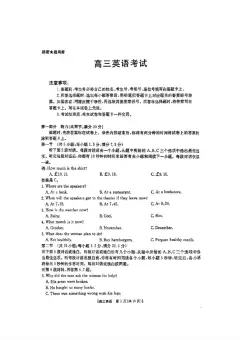
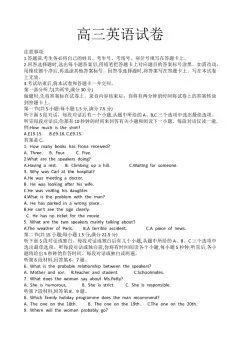
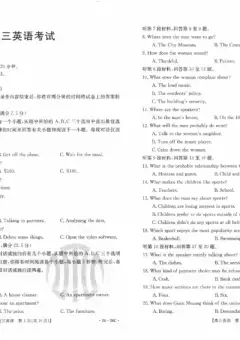
【27届试卷】广东金太阳高三11月期中联考英语试卷II Senior High School English Exam (Grade 12)
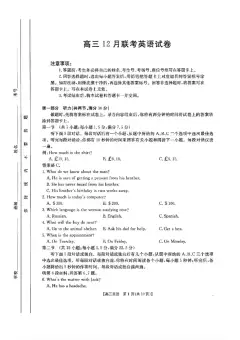
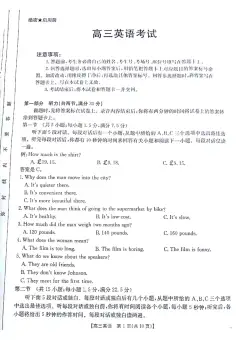
Senior High School English Exam (Grade 12)
School: ________ Class: ________
Name: ________ Exam Number: ________
Sealed Line
Notes:
·Fill in personal information as required.
·For multiple-choice questions, blacken the corresponding bubble on the answer sheet in standard manner.
·Return the paper and answer sheet when finishing.
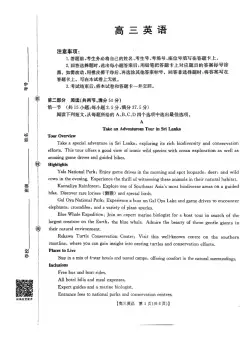
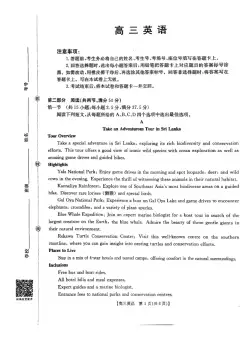
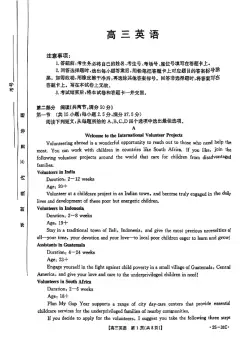
Part II Reading (2 sections, total 50 points)
Section A (15 questions; 2.5 points each; total 37.5 points)
Read the following passages. For questions 21–35, choose the best answer from the four choices marked A, B, C and D.
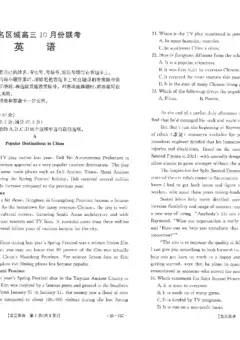
Passage A: A Look at the Bar Exam
The bar exam is the test that aspiring lawyers in the United States must pass to become licensed to practice law. Below is an overview of the exam, its ongoing reforms, and the moral requirements that accompany admission to the bar.
1. The basics of the bar exam
The bar exam is typically administered over two days. The first day usually consists of the Multistate Bar Examination (MBE), a set of 200 multiple-choice questions covering subjects such as contracts, torts, criminal law, and constitutional law. The second day often includes essay questions and performance tests that require candidates to analyze fact patterns and draft legal documents. Most states also require applicants to pass the Multistate Professional Responsibility Examination (MPRE), a separate ethics test.
2. Ongoing changes to the bar exam
The legal profession is currently undergoing a major reform of the bar exam. The National Conference of Bar Examiners is developing the NextGen Bar Exam, which is expected to place greater emphasis on lawyering skills such as client interviewing, negotiation, and problem solving, rather than solely on memorization of black-letter law. Some jurisdictions are also considering whether the exam should remain a universal requirement or whether supervised practice could serve as an alternative path to licensure. The changes reflect concerns that the traditional exam does not fully measure readiness to serve diverse clients in modern practice.
3. Character and fitness
Beyond passing the written exam, every bar applicant must undergo a "character and fitness" review. State bar authorities investigate an applicant's past conduct, including academic honesty, financial responsibility, and criminal history. The purpose of this review is to ensure that only individuals who demonstrate the moral fitness to practice law are admitted. Even a high exam score cannot overcome serious character deficiencies.
Questions 21–23
21.What is the main purpose of the first part of the passage?
A.To describe the structure of the bar exam
B.To argue for abolishing the bar exam
C.To compare the bar exam in different states
D.To explain how to prepare for the MPRE
22.According to the passage, the NextGen Bar Exam is intended to ______.
A.reduce the number of subjects tested
B.focus more on practical lawyering skills
C.replace the MPRE with an ethics course
D.eliminate the character and fitness review
23.The "character and fitness" review is primarily meant to ______.
A.check an applicant's academic performance
B.guarantee moral suitability to practice law
C.assess physical health of future lawyers
D.verify work experience in law firms
Passage B
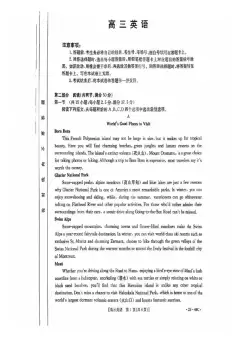
Sravani Ramachandran once loved sketching (素描), but after a paralysis (瘫痪的) caused by a serious illness, she lost both her ability to draw and her confidence. For a long time she felt isolated, especially because she also has autism (孤独症). Slowly, however, she rediscovered her passion for art. Inspired by her own journey, she founded a nonprofit organization called Pragathi, which helps disabled artists exhibit and sell their work. Through Pragathi, she hopes to show that disability does not define creativity and that art can be a bridge out of loneliness.
24.Why did Ramachandran start sketching again?
A.She won a national art competition.
B.She wanted to earn money for her family.
C.She rediscovered her passion for art after recovering from paralysis.
D.Her doctor advised her to take up drawing as physical therapy.
25.What mainly inspired Ramachandran to found Pragathi?
A.A school project on nonprofit management
B.Her own experience of overcoming paralysis and isolation
C.A request from a famous art gallery
D.A government grant for disability services
26.What can be inferred about "Art from the Heart"?
A.It is a commercial gallery focused on high prices.
B.It is an exhibition that values emotional expression from disabled artists.
C.It only accepts works by professional painters.
D.It trains artists to work in traditional styles.
27.Which of the following is the best title for the passage?
A.The Difficult Life of a Disabled Artist
B.From Paralysis to Purpose: Helping Disabled Artists
C.How to Run a Nonprofit Organization
D.Autism and Modern Art Education
Passage C
Porto, the second-largest city in Portugal, has long struggled with traffic congestion in its historic center. To address the problem, the city government announced that, starting on July 10, 2026, public transport will be free for residents who hold a Porto Card. With this municipal card, holders can ride the metro, buses, trams, and ferries unlimited times at no cost. The program is expected to cost 10.25 million euros per year, which will be covered by an increase in the tourist tax. Porto is not the first city to try free public transport. Luxembourg made all public transport free nationwide in 2020. Tallinn, the capital of Estonia, has offered free rides to its residents since 2013. Even Belgrade, in Serbia, has tested limited free services. Supporters argue that removing fares encourages people to leave their cars at home, but critics point out that free rides alone may not change the habits of commuters who prefer driving.
28.What change does the new policy bring to Porto Card holders?
A.They can travel by public transport without paying fares.
B.They receive a discount on tourist attractions.
C.They can park in the city center for free.
D.They get a monthly allowance for taxis.
29.How will the city pay for the free public transport program?
A.By raising the tourist tax
B.By cutting spending on roads
C.By charging higher metro fares to visitors
D.By receiving donations from the EU
30.Why does the author mention Luxembourg, Tallinn, and Belgrade in paragraph 5?
A.To show that Porto is the only city with free transport
B.To argue that free transport is always successful
C.To provide examples of other cities that have tried similar measures
D.To compare the cost of living in European capitals
31.What does the underlined phrase "making it complimentary" in the passage probably mean?
A.Making it expensive
B.Making it free of charge
C.Making it more comfortable
D.Making it available only to tourists
Passage D
Heavy metal pollution in freshwater rivers has become a serious environmental problem, threatening aquatic (水生的) life and human health. Traditional water cleaning methods, such as chemical treatment and activated carbon filtration, are often costly, energy-intensive, and sometimes produce harmful byproducts. Recently, an Australian research team has developed an environmentally friendly cleaning powder (粉末) made from seashells. The powder is mainly composed of calcium carbonate (碳酸钙) and has a porous (多孔的) structure that allows it to absorb heavy metal pollutants such as lead, cadmium, and mercury from water.
In laboratory tests, the seashell powder removed over 90% of the targeted heavy metal ions from contaminated samples within a short time. The researchers then carried out field tests in a polluted branch of a local river. They found that the powder remained effective under real-world conditions, although the removal rate was slightly lower than in the controlled lab environment. Because the raw material is abundant and inexpensive, and the production process does not require high temperatures or dangerous chemicals, this approach offers a promising, low-cost alternative for cleaning polluted freshwater.
32.What is a problem with traditional water cleaning methods?
A.They require rare minerals.
B.They are often expensive, energy-consuming, and may create harmful byproducts.
C.They cannot remove any heavy metals.
D.They work only in saltwater.
33.What is a key characteristic of the seashell powder?
A.It is made of plastic fibers.
B.It has a porous structure and contains calcium carbonate.
C.It dissolves completely in water.
D.It kills aquatic bacteria immediately.
34.What is the main idea of the second paragraph?
A.The seashell powder failed in laboratory tests.
B.The seashell powder worked well in both lab and field tests and is a low-cost option.
C.Field tests are more important than lab tests.
D.Heavy metals are impossible to remove from rivers.
35.Which of the following best describes the passage?
A.A review of different water pollutants
B.A report on an eco-friendly powder for removing heavy metals from freshwater rivers
C.A guide to building water filters at home
D.A discussion of the dangers of calcium carbonate
Section B (Information Matching — Seven Choose Five)
Read the following passage about washing clothes in cold water and the electricity cost of running a washing machine. Choose the five sentences from the list A–G that best fit into the blanks. There are two extra sentences that you do not need to use.
Many people think washing clothes in hot water gets them cleaner, but modern laundry detergents work just as well in cold water. ______ (36) Washing in cold water also lowers the electricity cost of running the machine. ______ (37) A typical washing machine uses most of its energy to heat the water. ______ (38) For households that wash several loads a week, the savings can add up over a year. ______ (39) Of course, some stains and heavily soiled items still need hot water. ______ (40) Choosing cold water for everyday loads helps protect fabrics, reduce energy use, and shrink environmental impact.
Questions 36–40: Choose from sentences A–G to fill in the blanks.
·A. This could be a mistake.
·B. The extra energy costs real money.
·C. Cold water works better for most fabrics.
·D. Modern washing machines and detergents work well in cold water.
·E. Some people think cold water might not clean clothes thoroughly.
·F. Besides saving energy, cold-water washing can also protect your clothes.
·G. This is confirmed by some organizations that test washing machines.
______ (36)
______ (37)
______ (38)
______ (39)
______ (40)
Part III
Cloze Test (Questions 41-55)
Read the following passage and choose the best word or phrase for each blank from the four choices marked A, B, C and D.
My second year of college left an unforgettable lesson on me. One night, a fast-coming 41 pushed me to my limits and made me uncover my hidden 42.
It was the week before midterm exams, and I had a cold and was buried in 43. My literature course that week 44 a ten-page essay, scheduled for submission at 8 am the following day. By 9 pm, merely three pages were 45. Empty coffee cups lay around me, and the blinking mark on my computer screen seemed to laugh at me. My roommate had long slipped into sleep. Alone with 46 notes, I was seized by mounting anxiety. Ideas refused to 47, and my eyes hurt from looking at the screen.
Then I wanted to 48 the writing. Yet the 49 on my parents, who took extra shifts to cover my school fees, and my instructor, who praised my sharp analytical skills, renewed my 50. I thought I couldn't let them down. So I decided I couldn't give up—not for 51, but to prove to myself I could keep trying.
I breathed deeply, turned off my phone and began writing. 52, sentences began to come one after another. By 1:00 am, I had completed all my writing. I handed in the essay just 53 and got an A. Yet the score was not the true win. That night taught me to be 54 and find clear thoughts in trouble. That late-night experience still 55 me, telling me I can move forward even in hard times.
Questions 41–55: Choose the best word or phrase for each blank.
41. A. deadline — B. schedule — C. exam — D. assignment
42. A. potential — B. ability — C. capacity — D. power
43. A. homework — B. assignments — C. tasks — D. projects
44. A. called for — B. looked for — C. asked for — D. cared for
45. A. finished — B. completed — C. wrote — D. read
46. A. nervous — B. confused — C. disorganized — D. upset
47. A. come — B. appear — C. emerge — D. form
48. A. give up — B. put off — C. turn down — D. take back
49. A. pressure — B. expectations — C. requirements — D. demands
50. A. ability — B. skill — C. talent — D. strength
51. A. show — B. prove — C. tell — D. explain
52. A. Suddenly — B. Unexpectedly — C. Miraculously — D. Interestingly
53. A. in time — B. on time — C. at times — D. over time
54. A. strong — B. confident — C. brave — D. calm
55. A. supports — B. encourages — C. reminds — D. helps
Read the following passage. Fill in each blank with the proper form of a word or a suitable word.
Zambia is a country in southern Africa. Recently, a woman named Miriam Chola has become known for her work in community health. She ______ (56. work) in a small village clinic, providing basic medical care to families that otherwise would have little access to doctors. Chola ______ (57. believe) that prevention is more important than treatment, so she spends much of her time teaching local mothers about nutrition and clean water.
Last year, she ______ (58. start) a project to train young volunteers to spread health information in remote areas. The project ______ (59. be) very successful, and now over fifty villages are taking part. Chola says that her greatest reward is ______ (60. see) children grow up healthy.
In addition to health education, she also helps organize clean water programs. The wells they build ______ (61. use) simple local materials, which keeps the cost low. According to Chola, clean water is ______ (62. essential) for a strong community. She hopes that more people ______ (63. join) the effort in the coming years. For her, improving health is not just a job but ______ (64. way) of life.
If more communities follow this example, Zambia ______ (65. have) a healthier future.
Part V Writing
Section A (Email Reply)
Assume you are Li Hua. Your foreign friend Chris has written to ask you to help plan a column called "Discover China" for the school English newspaper. Write an email reply to Chris, telling him:
1.you are happy to help;
2.suggest two topics for the column (for example, traditional festivals and Chinese food); and
3.explain why you think these topics are good choices.
Write about 80 words.
Section B (Continuation Writing)
Read the following story and continue it with two paragraphs. The beginning of the first paragraph is given as "They moved slowly through the trees." The beginning of the second paragraph is given as "Later that night, Daniel and Amelia had a chat in the tent."
Daniel and Amelia, a brother and sister, went camping in a forest near their grandparents' cabin. During the afternoon, they wandered too far from the camp and lost their way. The sun began to set, and the woods grew dark and quiet. Neither of them had a phone signal. Remembering a safety lesson from their father, they decided not to panic and to stay together while looking for familiar landmarks.
They moved slowly through the trees.
Later that night, Daniel and Amelia had a chat in the tent.
(End of Paper)
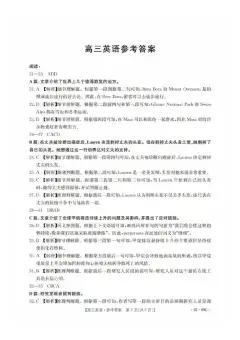
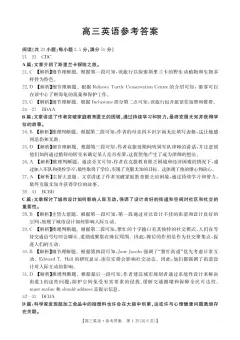
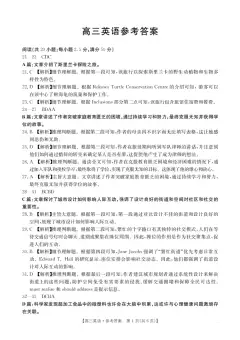
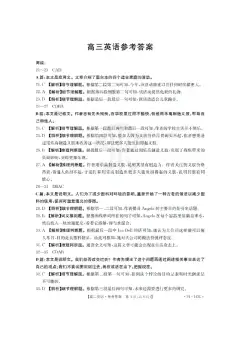
第21题:答案:A、Future lawyers.
根据文章 A 第一段,美国各地的应届法律毕业生需要参加律师资格考试(bar exam),通过后才能开始法律职业生涯。
第22题:答案:D、Testing legal skills in real situations.
根据文章 A 第三段,NextGen Bar Exam 的重点是通过真实生活中的案例情境来考察实际的法律技能(stresses practical legal skills through real-life case situations)。
第23题:答案:C、To protect their future careers.
根据文章 A 最后一段,如果申请人有过去的麻烦事,应该诚实地报告,因为隐瞒事实可能会毁掉他们的职业未来(hidden problems may destroy their professional future)。
第24题:答案:A、To ease pain and restore confidence.
根据文章 B 第二段,她重新开始素描是为了分散自己对痛苦和不确定性的注意力,并帮助自己重建自信(rebuild my confidence)。
第25题:答案:D、The lack of talent-showing channels for disabled artists.
根据文章 B 第三段,她发现缺乏展示残障艺术家才华的平台,因此创立了非营利组织 Praghathi。
第26题:答案:B、It proved financially rewarding.
根据文章 B 第四段,该展览售出了 69 件艺术品,并收到了多个委托请求,说明它在经济上是有回报的。
第27题:答案:C、Art as Strength: Turning Difference into Visibility
文章主要讲述了 Ravani Ramachandran 如何帮助残障艺术家通过艺术获得认可和生计,C 选项最能概括全文主旨。
第28题题干和选项没有拍全,暂时无法可靠作答。
第28题:答案:B、They enjoy unlimited free travel.
根据文章 C 第二段,新规定用无限次免费乘车(unlimited travel)取代了原来每年 22 次免费乘车。
第29题:答案:D、It will rely partly on non-resident contributions.
根据文章 C 第三段,城市计划将游客税从 3 欧元提高到 4 欧元,这意味着游客也会间接为这个系统买单。
第30题:答案:C、To show the shared tendency.
第五段列举了其他城市,是为了说明波尔图并不是唯一一个推行公共交通免费政策的城市,这是一种共同的趋势。
第31题:答案:D、Removing the payment requirement.
“making it complimentary”所在的语境是讨论免费乘车能否解决交通拥堵,因此它的意思是“取消付费要求”。
第32题:答案:A、High costs and extra waste.
根据文章 D 第一段,传统的水处理方法不仅生产成本高,而且会产生需要进一步处理的额外废物。
第33题:答案:C、Its outward composition can absorb heavy metals.
根据文章 D 第二段,贝壳粉具有特殊的多孔表面结构,可以有效捕获有害的重金属颗粒。
第34题:答案:B、A shell-powder field test and its key findings.
第三段主要描述了在受污染的小河支流中进行的实地测试以及测试结果。
第35题:答案:B、Introducing a new solution to pollution.
全文主要介绍了一种利用废弃贝壳制成的新型净水材料,作为治理水污染的新方法。
36. A:前文提到习惯用热水洗衣服,后文说现代洗衣机和洗涤剂在冷水中也能很好地工作,前后构成转折,“这可能是个错误”符合语境。
37. E:前文说热水最适合消毒,后文说除了这些例外情况,冷水效果更好。E项“有些人认为冷水可能无法彻底清洁衣物”作为被反驳的观点,承上启下。
38. G:前文提到酶在低温下效果更好,G项“这一点得到了一些测试洗衣机的机构的证实”是对前文的进一步说明。
39. B:前文说洗衣机大部分能量用于加热水,B项“额外的能源消耗需要花费真金白银”引出下文关于电费的具体数据。
40. F:后文说反复暴露在高温下会削弱纤维,F项“除了节省能源,冷水洗涤还能保护你的衣物”概括了本段主旨。
第41—55题(完形填空)
41. D. deadline:期中考试临近,最后期限逼近。
42. B. capacity:发掘隐藏的潜力/能力。
43. C. assignments:忙于作业。
44. A. called for:要求写一篇十页的论文。
45. C. completed:到晚上9点只完成了三页。
46. A. disorganized:面对杂乱的笔记感到焦虑。
47. B. emerge:思路无法浮现。
48. C. abandon:想要放弃写作。
49. C. expectations:父母和老师的期望。
50. B. talent:老师肯定了我的分析才能。
51. D. prove:向自己证明我能坚持。
52. D. Miraculously:奇迹般地,句子开始接连出现。
53. B. in time:及时交上了论文。
54. A. strong:变得坚强。
55. B. supports:这段经历一直支持着我。
第56—65题(语法填空)
56. which:引导非限制性定语从句,指代 Kalulushi。
57. was realized:梦想在2025年实现,需用一般过去时的被动语态。
58. equipped:be equipped with 为固定搭配,表示配备有。
59. myself:主语是 I,对应的反身代词为 myself。
60. limited:修饰 access,表示有限的受教育机会。
61. enterprises:an increasing number of 后接可数名词复数。
62. to help:动词不定式作目的状语。
63. but also:not only... but also... 为固定搭配。
64. highly:修饰 praised,表示高度赞扬。
65. in:play a role in doing sth. 为固定搭配,表示在……中发挥作用。
第四部分写作
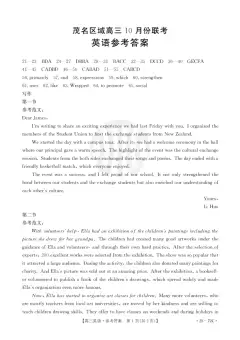
应用文参考范文:
Dear Chris,
I’m delighted to know that you are planning a column named “Discover China”. Here is some advice on its content and implementation.
To start with, the column can cover traditional festivals, historical sites, and famous literature, which will offer a comprehensive view of Chinese culture. As for the practice, you may invite students to share their own experiences and hold cultural exchange activities. Additionally, it would be a good idea to publish articles and take vivid photos.
I hope my suggestions will be of help to you.
Yours,
Li Hua
读后续写参考范文:
They moved slowly through the trees. Daniel held the flashlight tightly, scanning the dark surroundings while calling Amelia’s name. The ranger followed behind, checking the map occasionally. After what seemed like an eternity, they heard a faint sobbing sound coming from a bush. There was Amelia, shivering and frightened. Daniel rushed to her and wrapped her in his arms. “I’m so sorry,” she cried. “I just needed some air, but I got lost.” They quickly returned to the campsite with the ranger’s help.
Later that night, Daniel and Amelia had a chat in the tent. They admitted that their argument over such a small thing was not worth risking their relationship. “We should have communicated calmly instead of walking away,” Daniel said. Amelia nodded, realizing that anger had clouded her judgment. They agreed to work on their communication and appreciate the importance of each other. With this understanding, they fell asleep, feeling closer than ever.
相关文档
- 广东2025届高三10月金太阳联考英语答案
- 2025届广东高三金太阳11月联考物理试卷
- 广东茂名区域2025届高三10月金太阳联考英语
- 广东2025届高三10月金太阳联考英语试题
- 广东省金太阳2025届高三11月联考英语及答案
- 广东省金太阳2026届高三8月开学联考英语(05C)
- 广东省金太阳2025届高三11月联考数学试卷
- 广东省部分高中2024-2025学年高三上学期11月期中联考政治试题(金太阳联考)
- 金太阳广东2026届高三8月开学联考英语(05C)
- 广东省金太阳2026届高三8月开学联考英语答案(05C)
- 金太阳广东2026届高三8月开学联考英语答案(05C)
- 陕西高三金太阳8月联考英语试卷
- 金太阳高三9月百万联考英语试卷
- 广东省部分高中2024-2025学年高三上学期11月期中联考地理试题(金太阳联考)
- 2025届12月广东福建金太阳联考英语
- 2023届陕西高三1月金太阳联考英语试卷
- 湖南2024届高三10月金太阳联考英语试卷
- 广东省2024届高三11月金太阳联考24-142C英语答案
- 广东金太阳2025届高三上学期9月联考语文试卷答案
- 广东金太阳2026届高三8月开学联考物理试卷(05C)
- 广东金太阳2026届高三8月开学联考语文试卷(05C)
- 广东金太阳高三上9月联考英语试题及答案
- 广东省金太阳2026届高三8月开学联考物理(05C)
- 广东省2024届高三11月金太阳联考24-142C英语试题
- 江门部分学校金太阳联考高三语文答案(2025年8月)
- 金太阳2025届高三11月期中百万联考英语试题
- 广东福建金太阳2025届12月联考政治试卷
- 广西2025届金太阳高三9月联考英语试卷
- 内蒙古高三金太阳9月联考英语试卷
- 广东金太阳2025届高三上学期9月联考语文试卷及答案
- 2025届广东高三金太阳11月联考语文
- 广东省金太阳2025届高三11月联考历史试题
- 广东省金太阳2025届高三11月联考化学及答案
- 福建广东金太阳2025届高三12月联考数学
- 广东2025届高三10月金太阳联考物理答案
- 广东2025届高三10月金太阳联考数学答案
- 广东2025届高三10月金太阳联考政治答案
- 广东2025届高三10月金太阳联考历史答案
- 广东茂名区域2025届高三10月金太阳联考25-72C英语答案
- 湛江2026届高三上学期第一次联考物理试卷
- 广东省金太阳2025届高三上学期9月联考25-31C英语
- 2025届广东高三金太阳11月联考语文答案
- 2025届广东高三金太阳11月联考生物答案
- 2025届广东高三金太阳11月联考物理答案
- 广东省金太阳2025届高三11月联考数学答案
- 2025届广东高三金太阳11月联考政治答案
- 广东省2025届高三金太阳11月联考地理答案
- 广东省金太阳2025届高三11月联考历史答案
- 广东省部分高中学校联考2024-2025学年高三上学期11月期中生物试题
- 广东金太阳2026届高三8月开学联考语文答案(05C)